The Agate Slice Necklace: Material Properties & Buyer Guide
Discover the material properties of an agate slice necklace. Learn to identify natural vs. dyed stones, Mohs hardness, and ideal chain pairings.

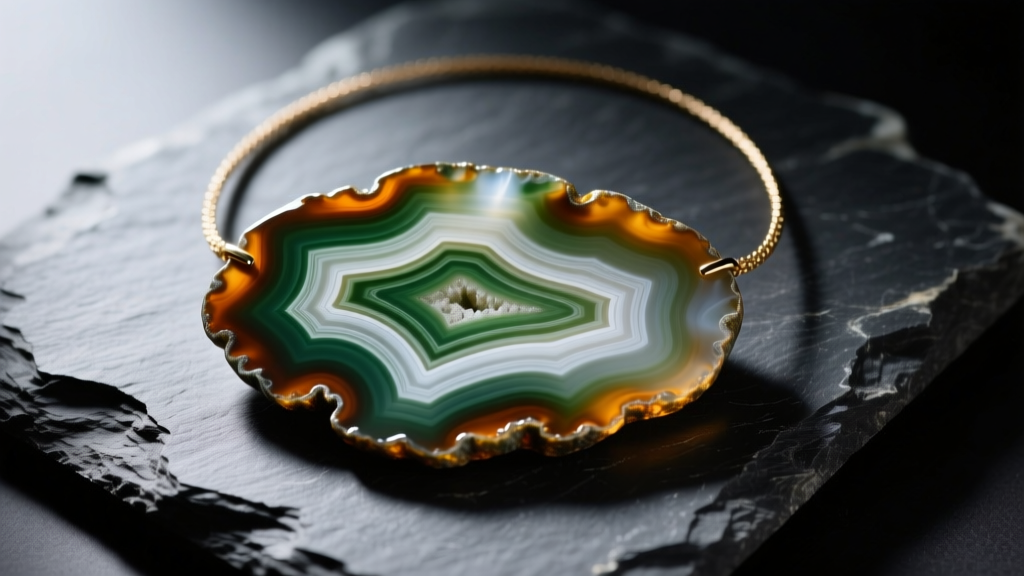
The agate slice necklace has evolved from a niche lapidary curiosity into a staple of contemporary mineral jewelry. Unlike faceted gemstones that rely on precise optical geometry for their appeal, agate slices showcase the raw, unedited geological history of the earth. However, because these pendants are essentially cross-sections of porous volcanic rock, understanding their material properties is critical for both collectors and everyday wearers. From structural integrity and Mohs hardness to the pervasive use of chemical dyes, this guide breaks down the exact material science behind the agate slice necklace so you can make an informed, durable purchase.
The Geology of Agate: Cryptocrystalline Structure
Agate is not a single, distinct mineral; it is a banded variety of chalcedony, which itself is a cryptocrystalline form of quartz (silicon dioxide, SiO2). According to the Gemological Institute of America (GIA), cryptocrystalline means the quartz crystals are so microscopic that they cannot be seen even with a standard gemological microscope. Instead, they form interlocking fibrous structures.
This interlocking matrix is what gives an agate slice necklace its exceptional toughness. While a single macro-crystal of quartz might cleave or shatter along specific planes, the fibrous web of chalcedony distributes kinetic energy, making agate highly resistant to chipping. The signature banding seen in these slices occurs when silica-rich groundwater permeates volcanic cavities (vesicles) and precipitates in rhythmic layers over millions of years. The varying colors in natural, untreated bands are caused by trace mineral inclusions, primarily iron oxides (reds and browns) and manganese (blacks and grays).
Natural vs. Dyed Agate: A Material Comparison
The most crucial material distinction when shopping for an agate slice necklace is determining whether the stone is natural or dyed. Because the cryptocrystalline structure of agate contains microscopic capillary channels, it is inherently porous. Lapidaries have exploited this porosity for centuries to enhance pale or gray stones with vibrant colors.
There are two primary methods of dyeing agate slices:
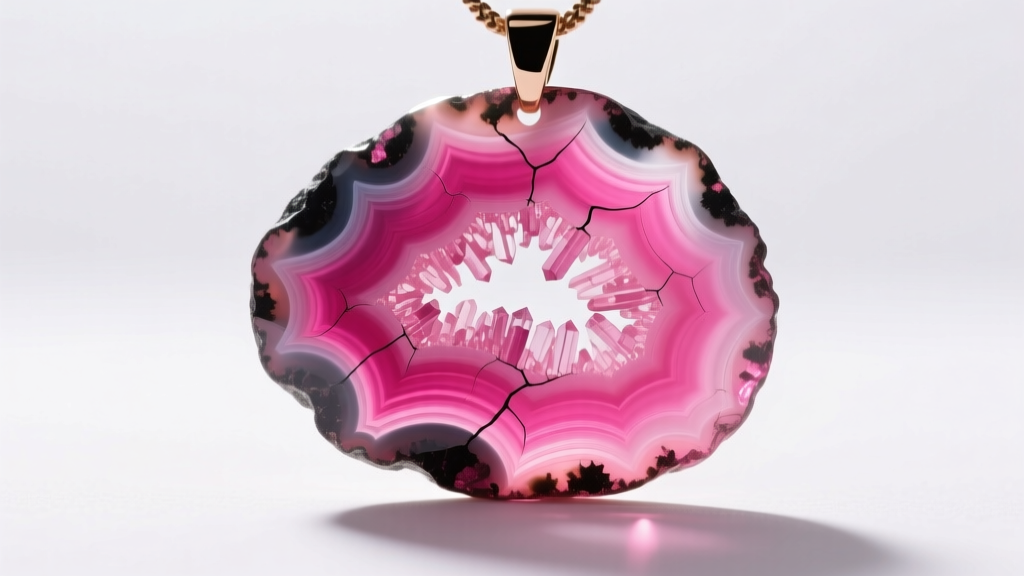
- Aniline Dye Treatment: Used to create neon pinks, electric blues, and vibrant purples. The slice is soaked in a chemical dye bath, often requiring a mordant to fix the color. These dyes sit near the surface and in the microscopic fractures.
- Sugar-Acid Treatment: Used to create deep black or dark brown bands. The agate is soaked in a sugar solution, which permeates the pores, and then submerged in concentrated sulfuric acid. The acid carbonizes the sugar, leaving behind permanent black carbon deposits within the stone's matrix.
The Acetone Test for Dye Detection
If you are evaluating an agate slice necklace for natural authenticity, the acetone test is your first line of defense. Dab a cotton swab in pure, 100% acetone (standard nail polish remover often contains conditioners that interfere with the test) and rub it firmly against an inconspicuous edge of the agate. If the swab picks up pink, blue, or green pigment, the stone has been treated with surface-level aniline dyes. Note that this test will not detect carbonized sugar treatments, which are permanent and chemically stable, but it will easily expose cheap, unstable surface dyes that will bleed onto your clothing when exposed to sweat or rain.
Durability & Wearability: Mohs Hardness and Fracture
When evaluating the daily wearability of a pendant, we must look at both hardness (scratch resistance) and toughness (break resistance). The Mindat.org mineral database classifies agate with a Mohs hardness of 6.5 to 7. This means it is harder than window glass (5.5) and steel (4.5-6.5), making it highly resistant to everyday scratching from dust and incidental contact.
However, agate lacks cleavage planes. Instead, it exhibits a conchoidal (shell-like) fracture. While it won't split cleanly like a diamond or topaz, a sharp, direct impact against a hard surface like a granite countertop can cause a piece of the raw edge to chip off.
| Material | Mohs Hardness | Porosity | Toughness | Common Treatments |
|---|---|---|---|---|
| Agate (Chalcedony) | 6.5 - 7.0 | High (Micro-porous) | Excellent | Dye, Sugar-Acid, Edge Plating |
| Amethyst Geode | 7.0 | Low (Macro-crystal) | Good (Brittle points) | Heat, Irradiation |
| Opal (Ethiopian) | 5.5 - 6.5 | Very High (Hydrophane) | Poor | Smoke, Resin Impregnation |
| Mother of Pearl | 2.5 - 4.5 | Organic / Non-porous | Fair (Flexible) | Bleaching, Dyeing |
Edge Banding and Metal Treatments
The raw, crystalline edge of an agate slice is its defining aesthetic feature, but it is also the most vulnerable point for snagging on textiles. To protect the edge and elevate the pendant, jewelers apply metal banding. The material properties of this banding dictate the necklace's lifespan and price point.
- Electroplated Brass: The most common treatment for slices under $50. A thin layer of gold or silver is electroplated over a brass base. Over time, the friction from clothing will wear through the plating, exposing the brass, which will oxidize and turn the skin green due to copper content reacting with sweat acidity.
- Gold Vermeil (Sterling Silver Base):strong> A superior mid-tier option. Vermeil requires a base of 925 sterling silver plated with at least 2.5 microns of 10k or 14k gold. It is hypoallergenic and significantly more durable than brass plating.
- Solid 14k Bezel Wire: Found in high-end lapidary work. The agate is wrapped or set in solid 14k gold wire. This eliminates the risk of plating wear entirely and provides the highest structural protection for the agate's conchoidal edges.
Chain Pairings: Weight and Tensile Strength
A frequent failure mode for agate slice necklaces is the chain snapping. Agate is a dense material (specific gravity of 2.58 to 2.64). A standard 50mm (2-inch) agate slice can easily weigh between 20 and 35 grams, depending on the thickness of the cut and the metal edge banding.
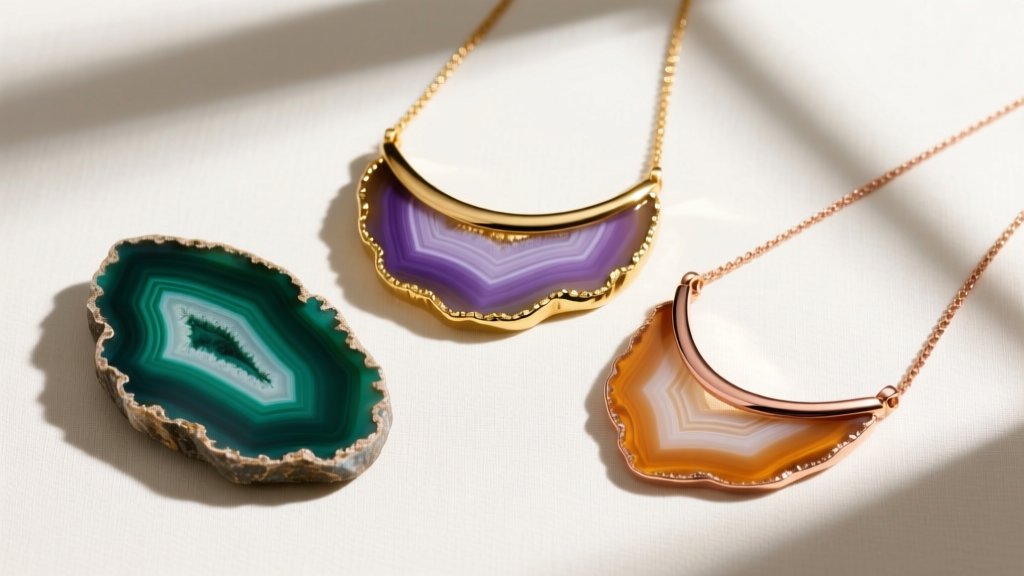
Many mass-market pendants are strung on delicate 0.9mm to 1.2mm cable chains. While these chains have a static breaking strength that technically supports 35 grams, they fail under dynamic load—such as the pendant catching on a sweater or being pulled by a child. For an agate slice weighing over 20 grams, you must upgrade the chain. Opt for a 2.5mm to 3.0mm rope chain, a 3.0mm Cuban curb, or a 2.0mm box chain. These structures distribute kinetic stress across multiple interlocking links, preventing the localized deformation that causes delicate cable chains to snap at the clasp ring.
Pricing Tiers and Market Value
Understanding the material properties helps contextualize the pricing of an agate slice necklace in the current market:
- Tier 1: Raw Edge / Electroplated ($20 - $45): Mass-produced slices, heavily dyed in unnatural colors (neon blue, hot pink), with thin brass electroplating on the edges. High risk of dye bleeding and metal tarnishing.
- Tier 2: Natural Color / Gold Vermeil ($60 - $130): Slices featuring natural earthy bands (rust, cream, gray) or high-quality permanent carbon treatments. Edges are wrapped in gold vermeil or sterling silver, ensuring longevity and hypoallergenic wear.
- Tier 3: Lapidary Grade / Solid Gold ($250 - $600+): Custom-cut, highly polished slices with exceptional natural banding patterns (such as fortification or water agate). Set in solid 14k or 18k gold bezels, often featuring accent diamonds or custom bail work.
Care and Maintenance Protocols
Proper care depends entirely on the treatment history of your specific pendant. For natural, undyed agate, cleaning is straightforward: use warm water, a mild dish soap, and a soft-bristled toothbrush to gently scrub the crystalline edges where skin oils and lotion accumulate. Ultrasonic cleaners are generally safe for natural agate, provided the stone does not have deep, pre-existing surface-reaching fractures.
For dyed agate slices, avoid ultrasonic cleaners and harsh chemical jewelry dips. The high-frequency vibrations and acidic solutions can break down the mordants holding aniline dyes in the porous channels, causing the color to leach out and fade. Always remove dyed agate necklaces before swimming in chlorinated pools or entering hot tubs, as chlorine is a powerful bleaching agent that will permanently strip artificial colors, leaving the stone a mottled, pale gray.
Expert Storage Tip: Because agate is harder than most precious metals, storing an agate slice necklace loosely in a jewelry box will result in the stone acting like sandpaper against your gold or silver chains. Always store agate pendants in individual microfiber pouches to prevent them from scratching softer jewelry pieces.