The Algerian Love Knot Necklace: An Expert's Technical Guide
Explore the metallurgy, wire gauges, and structural integrity of the Algerian love knot necklace. An expert guide to authentic hand-woven pieces.

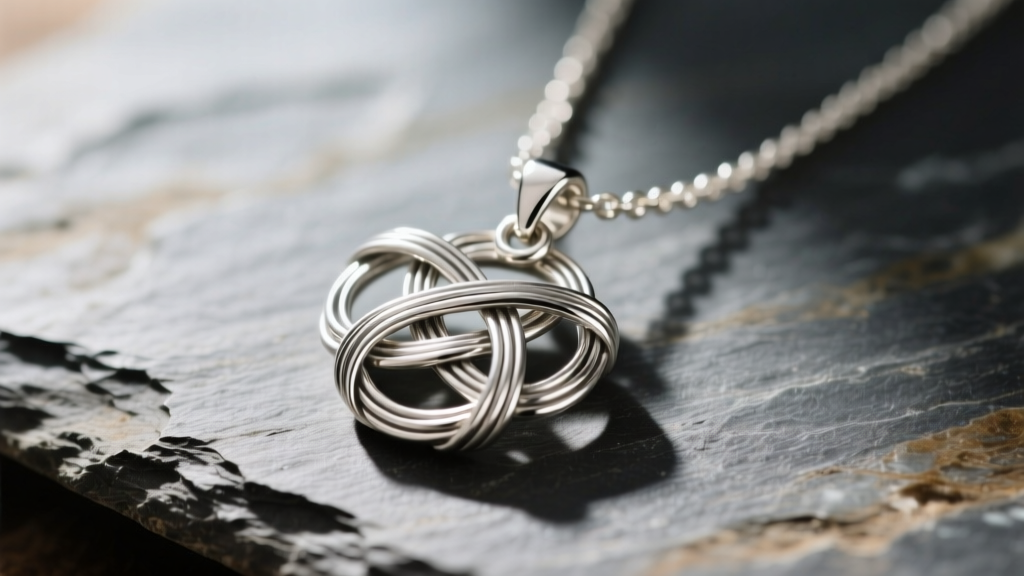
The Architecture of the Nœud Algérien
The Algerian love knot necklace, historically rooted in the Nœud Algérien of North African passementerie, represents one of the most structurally complex motifs in artisan metalwork. Unlike standard Celtic or sailor knots, which rely on simple over-under weaving, the Algerian knot features a multi-lobed, symmetrical geometry that folds back onto a central axis. Originally developed as intricate textile trimmings for Ottoman-influenced Maghreb garments, the design was translated into precious metals by Kabyle and Moorish silversmiths in the 19th century.
From an engineering perspective, the Algerian love knot pendant requires a continuous wire path that maintains uniform tension across multiple radial loops. The structural integrity of the piece relies on the friction and mechanical locking of the wire crossovers. If the tension is uneven during the weaving process, the knot will warp, resulting in an asymmetrical profile that compromises both the aesthetic and the tensile strength of the pendant. Master artisans use a brass mandrel and specialized nylon-jaw pliers to ensure that each lobe achieves the exact mathematical curvature required for the traditional silhouette.
Metallurgy, Annealing, and Wire Gauge Specifications
Creating a hand-woven Algerian love knot necklace demands a profound understanding of metallurgy. The most common material is 925 sterling silver, chosen for its optimal balance of malleability and structural rigidity. Fine silver (999) is entirely unsuitable for this design; its low yield strength means the intricate loops would deform under the mere weight of a chain. The 7.5% copper alloy in sterling silver provides the necessary tensile strength, but it also introduces the risk of work-hardening.
As the silversmith bends and wraps the wire, the copper lattice compresses, causing the metal to become brittle. To prevent micro-fractures at the tightest crossover points, the wire must undergo intermediate annealing—heating the silver to approximately 1,200°F (648°C) to relax the crystalline structure. According to industry standards outlined by Rio Grande's wire metallurgy guides, failing to anneal 925 silver during complex knotting will result in catastrophic structural failure.
| AWG Gauge | Diameter (mm) | Vickers Hardness (Annealed) | Structural Role in Knot |
|---|---|---|---|
| 18 AWG | 1.02 mm | 65 HV | Central load-bearing core and bail |
| 20 AWG | 0.81 mm | 60 HV | Primary lateral loops and crossovers |
| 22 AWG | 0.64 mm | 55 HV | Secondary wrap, binding, and detailing |
For high-end bespoke pieces, 18k yellow gold is occasionally utilized. However, gold's higher density requires the artisan to adjust the wire gauge down by one or two sizes to prevent the pendant from becoming excessively heavy and pulling on the wearer's neckline.
Diagnostic Authentication: Hand-Woven vs. Cast Replicas
As the popularity of heritage-inspired jewelry has surged, the market has been flooded with mass-produced, cast replicas of the Algerian love knot necklace. Distinguishing a true hand-woven piece from a cast imitation requires a trained eye and an understanding of manufacturing limitations.
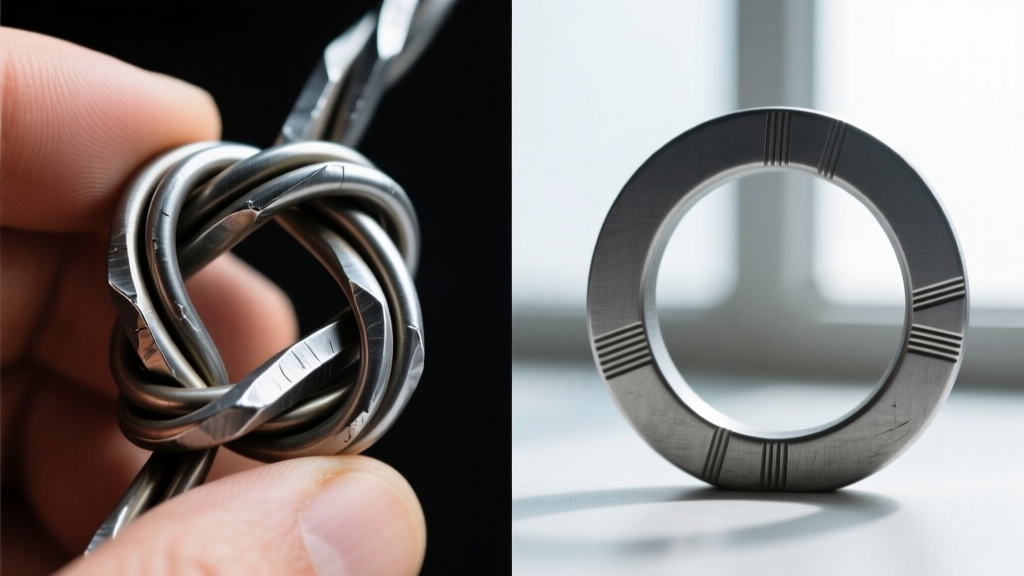
- The Crossover Shadow: In a genuine hand-woven knot, the wire physically passes over and under itself. When viewed under a 10x jeweler's loupe, you will see a sharp, 90-degree edge where the top wire meets the bottom wire, accompanied by a natural microscopic shadow. Cast pieces are made from a single mold; the "crossovers" are merely sculpted illusions, resulting in soft, rounded transitions that lack depth.
- Tool Marks and Tension: Hand-woven silver will exhibit microscopic, parallel striations from the jeweler's pliers, particularly on the inner curves of the loops. Furthermore, a hand-woven knot is inherently rigid due to work-hardening. If you gently attempt to compress the lateral loops of an authentic piece, it will resist. A cast piece, lacking the internal tension of woven wire, will feel slightly more yielding or uniformly stiff without the spring-back effect.
- The Bail Integration: On authentic pieces, the bail (the loop that holds the chain) is often forged from the same continuous wire as the knot's core, or seamlessly soldered with hard silver solder. Cast replicas typically feature a bail that is cast as part of the whole, often showing porosity (tiny air bubbles) near the junction under magnification.
Chemical Maintenance of Complex Interstices
The very architecture that makes the Algerian love knot necklace visually stunning also makes it a magnet for environmental contaminants. The tight interstices between the wire crossovers easily trap sebum, dead epidermal cells, cosmetic powders, and atmospheric sulfur. Over time, this leads to localized galvanic corrosion and severe tarnishing in the recesses of the knot.
Standard jewelry cleaning advice fails here. Using a baking soda and aluminum foil bath is highly discouraged for intricate wirework; the resulting chemical reaction can leave a stubborn, chalky residue deep within the knot's core that is nearly impossible to rinse out. Similarly, abrasive polishing cloths cannot reach the internal crossovers, leading to a two-tone effect where the outer surfaces are bright but the inner crevices remain black.
Expert Protocol: For deep cleaning a sterling silver Algerian knot, utilize a thiourea-based commercial silver dip for exactly 10 to 15 seconds. Thiourea chemically converts silver sulfide (tarnish) back into pure silver without abrasive action. Immediately following the dip, the piece must be submerged in a neutralizing bath of distilled water and a drop of pH-neutral dish soap, followed by an ultrasonic rinse.
A critical warning regarding ultrasonic cleaners: while they are excellent for dislodging trapped debris, they should only be used on fully annealed or properly stress-relieved wire. If the artisan failed to anneal the silver during the final stages of weaving, the high-frequency cavitation of an ultrasonic bath can induce harmonic resonance, causing micro-cracks to propagate at the tightest bend radii. For absolute safety, consult the Gemological Institute of America (GIA) guidelines on silver care before subjecting heritage wirework to ultrasonic frequencies.
Market Tiers and Chain Pairing Mechanics
When sourcing an Algerian love knot necklace in the current market, buyers must navigate distinct pricing tiers that reflect the manufacturing methodology and material provenance.
Mass-Market Cast Tier ($40 - $90): These pieces are typically produced via rubber mold casting in 925 silver. While they capture the general silhouette of the Nœud Algérien, they lack the structural tension and historical authenticity of wire-wrapping. They are often heavily rhodium-plated to prevent tarnish, which gives them a cold, white-metal appearance that masks the warmth of traditional silver.
Artisan Hand-Woven Tier ($250 - $650): This is the sweet spot for collectors and jewelry purists. These pieces are individually woven by silversmiths using traditional techniques. The pricing reflects the 4 to 8 hours of meticulous labor required to weave, solder, and finish a single pendant. Look for artisans who specialize in North African or Berber jewelry replications, as they understand the historical context and precise geometry of the knot.
Bespoke High-Karat Tier ($1,500+): Commissioning a piece in 18k gold or platinum from a master wire-weaver. Due to the extreme cost of materials and the difficulty of annealing high-karat gold without melting the thin wire sections, this tier is reserved for high jewelry connoisseurs.
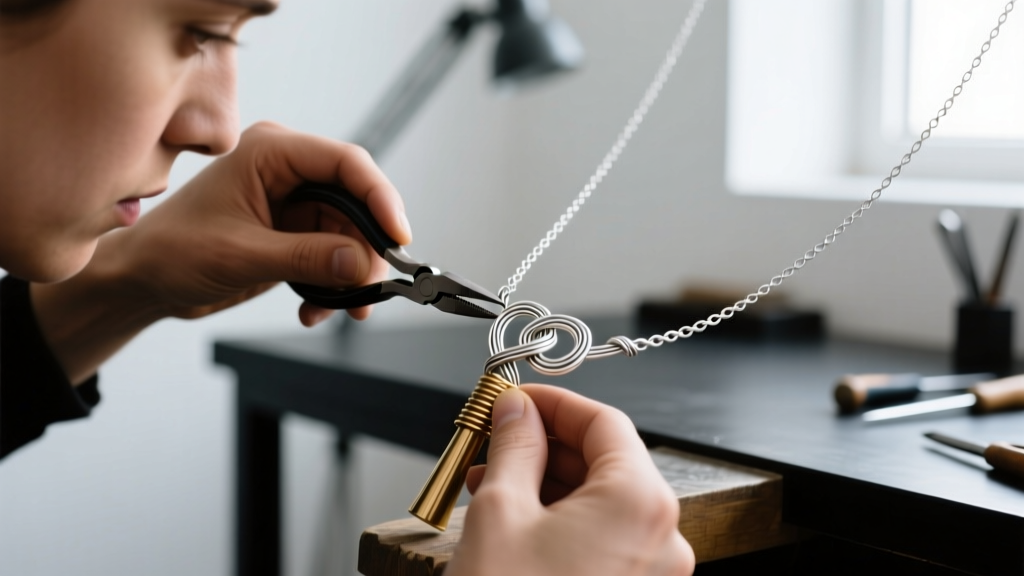
Finally, the mechanics of chain pairing are crucial. The Algerian love knot is a dense, visually heavy pendant. Pairing it with a delicate cable chain will result in a severe visual imbalance and excessive wear on the chain's jump rings. The optimal pairing is a 2.0mm to 3.0mm oxidized silver rope chain or a woven wheat chain. These chain styles possess the tensile strength to support the pendant's weight while offering a complementary textured aesthetic that echoes the complexity of the knot itself. For a comprehensive historical perspective on the origins of these North African metalworking techniques, the Metropolitan Museum of Art's Heilbrunn Timeline of Art History provides invaluable context on Berber silver traditions.


