Technical Guide to Sizing and Authenticating Amber Necklace Beads
Discover the technical nuances of amber necklace beads. Learn authentication tests, inclusion grading, heat treatments, and precise sizing metrics.

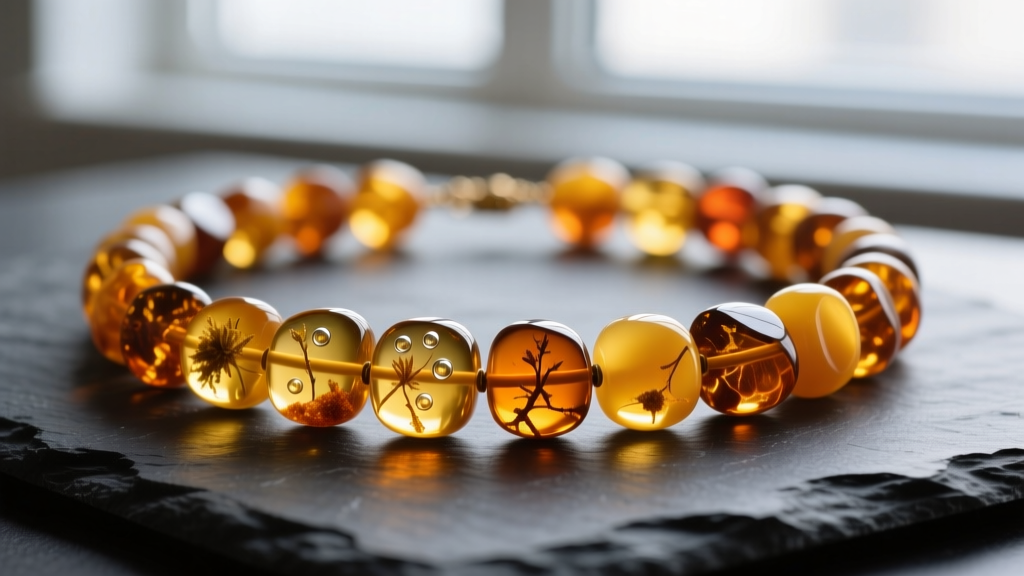
For jewelry professionals and serious collectors, sourcing and evaluating amber necklace beads requires moving beyond basic visual inspection. Amber is not a mineral; it is a fossilized organic resin with complex chemical behaviors, specific gravity metrics, and distinct structural vulnerabilities. Whether you are designing a high-end botanical inclusion strand or assessing vintage Baltic cherry amber, understanding the material science behind these beads is critical for authentication, valuation, and long-term preservation.
This technical deep dive explores the mineralogy, authentication protocols, clarity grading, and mechanical stringing requirements for amber necklace beads in the modern market.
The Mineralogy and Origin of True Amber
True Baltic amber, scientifically classified as succinite, is the fossilized resin of the extinct conifer Pinus succinifera. Unlike standard tree sap, which is a fluid transport medium, resin is a viscous, protective secretion triggered by tree injury. Over 35 to 50 million years, the volatile terpenes evaporate, and the remaining organic compounds undergo polymerization and cross-linking.
Baltic succinite is uniquely characterized by its succinic acid content, which typically ranges from 3% to 8% by weight. This chemical signature is the primary differentiator between Baltic amber and other global deposits, such as Dominican or Burmese amber, which are classified as retinite or glessite and lack significant succinic acid. According to the Gemological Institute of America (GIA), this specific chemical composition also dictates the material's refractive index (1.540) and its relatively low Mohs hardness of 2.0 to 2.5, making it highly susceptible to scratching during the bead tumbling and polishing phases.
Copal vs. True Amber: The Age and Polymerization Factor
The most common point of failure in the wholesale amber market is the misrepresentation of copal as true amber. Copal is sub-fossilized resin that is typically less than 2.5 million years old. Because it has not undergone complete polymerization, copal remains chemically unstable.
Identifying Copal Failure Modes
- Crazing: Copal beads are highly prone to 'spiderweb' crazing (micro-fracturing) when exposed to low humidity or rapid temperature fluctuations.
- Solvent Sensitivity: Copal will instantly dissolve or become tacky when exposed to standard jewelry cleaning solvents, whereas true amber is highly resistant.
- Melting Point: Copal softens at approximately 150°C, while fully polymerized Baltic amber does not melt until it reaches 250°C to 300°C.
Definitive Authentication Protocols for Amber Necklace Beads
Visual inspection is insufficient due to the prevalence of advanced glass and phenolic resin imitations. Gemologists rely on a matrix of non-destructive and micro-destructive tests to verify amber necklace beads.
1. Specific Gravity (Saltwater Flotation)
Baltic amber has a specific gravity of 1.05 to 1.10. This means it will sink in fresh water but float in a saturated saline solution. To create the testing medium, dissolve 1 part standard sodium chloride (table salt) into 4 parts warm water. True amber and copal will both float, while glass, phenolic resin, and casein imitations will sink. Note: This test cannot be performed if the beads are already strung on heavy wire or paired with metal clasps.
2. UV Fluorescence Testing
Using a 365nm long-wave UV flashlight, genuine Baltic amber will exhibit a strong, pale blue to milky green fluorescence. Copal typically fluoresces a dull, chalky white, while plastic imitations show no fluorescence or an artificial, neon purple glow depending on the optical brighteners used in the manufacturing process.
3. The Acetone Solvent Test
Apply a single drop of pure acetone to an inconspicuous area of the bead (such as the drill hole margin). Wait 10 seconds and press with a fingernail. True amber will remain completely hard and impervious. Copal and plastic imitations will become sticky, tacky, or leave a fingerprint indentation.
4. Thermal Reaction (Hot Needle Test)
Heat a sewing needle until it glows red, then touch it to the bead's surface near the drill hole. True amber will emit a faint, pleasant pine-wood smoke and will not melt instantly. Plastic will emit a harsh, acrid chemical odor and melt into a stringy residue. This is a destructive test and should only be used as a last resort on unstrung beads.
Grading Inclusions, Clarity, and Color Matrices
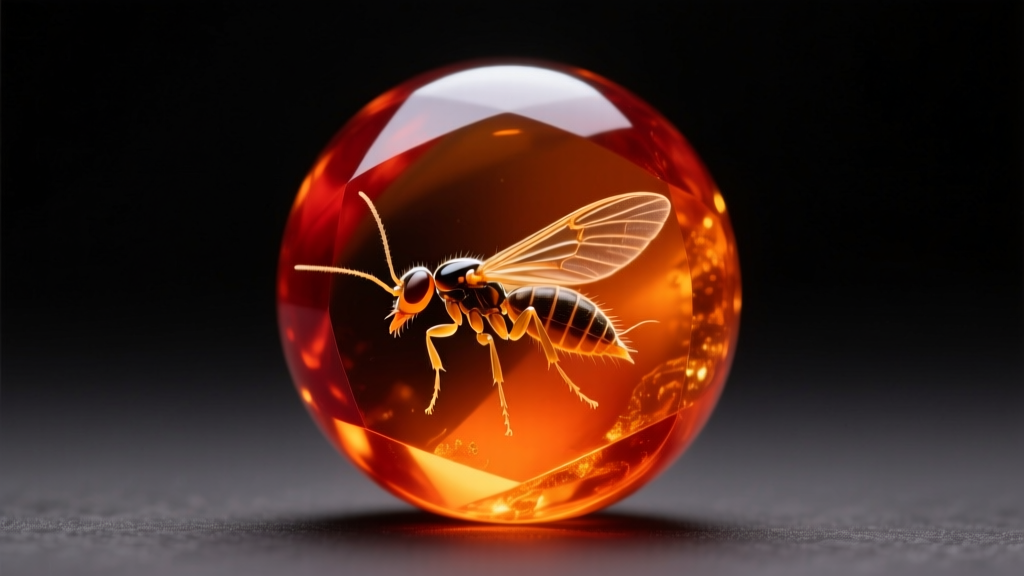
The value of amber necklace beads is heavily dictated by clarity and the presence of prehistoric biological inclusions (entomology and botanicals). The International Amber Association recognizes several distinct commercial grades based on optical properties and natural alterations.
| Clarity Grade | Visual Characteristics | Market Application | Relative Value Multiplier |
|---|---|---|---|
| Clear (Floral) | Highly transparent, golden-yellow, may contain insect/botanical inclusions. | High-end statement pieces, collector strands. | 3.0x - 10.0x (if rare inclusions) |
| Translucent (Cloudy) | Semi-transparent with internal mist, swirls, or micro-bubbles. | Standard commercial jewelry, everyday wear. | 1.0x (Baseline) |
| Opaque (Butterscotch/Bone) | Completely opaque, milky white to deep yellow, high bubble density. | Men's jewelry, bold geometric bead strands. | 1.5x - 2.0x |
| Cherry (Cognac) | Deep reddish-brown, highly transparent, often heat-treated. | Vintage-style necklaces, formal evening wear. | 1.2x - 1.8x |
Heat Treatment and Pressed Amber (Ambroid)
Not all amber necklace beads are entirely natural in their final state. Understanding treatment methodologies is vital for accurate appraisal.
Autoclave Heating and 'Sun Spangles'
To enhance clarity and alter color, manufacturers place raw amber in an autoclave, subjecting it to temperatures of 150°C to 200°C under high nitrogen pressure. This process clarifies cloudy amber by collapsing micro-bubbles. However, rapid cooling causes internal stress fractures known as 'sun spangles' or 'lily pads.' While visually striking and entirely accepted in the trade, these discs are proof of thermal treatment and lower the bead's value compared to naturally clear, untreated specimens.
Pressed Amber (Ambroid)
Amber dust and small scraps are fused together under extreme heat (200°C+) and pressure to create large, uniform blocks, which are then cut into beads. Pressed amber is chemically identical to natural amber but lacks the continuous internal structure. Under magnification, pressed amber reveals distinct flow lines and fragmented inclusion boundaries. It is significantly cheaper and must be disclosed as 'pressed' or 'reconstructed' in ethical retail environments.
Sizing, Drilling, and Stringing Mechanics
The mechanical assembly of amber necklace beads requires specialized techniques to accommodate the material's low hardness and brittleness.
Drill Hole Sizing and Stress Fractures
Standard amber beads (6mm to 10mm) are typically drilled with a 0.8mm bit. However, for larger statement beads (14mm and above), a 0.8mm hole creates a high risk of radial stress fracturing during the stringing process. Expert lapidaries recommend stepping up to a 1.0mm or 1.2mm drill bit for beads exceeding 12mm to distribute the tension of the stringing material evenly.
Stringing Materials and Knotting Protocols
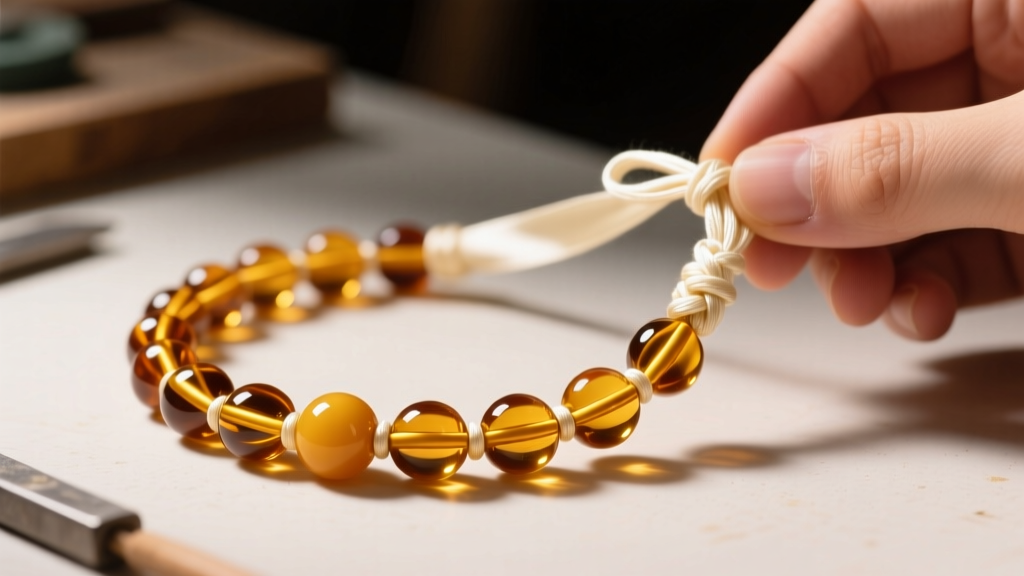
Never string high-value amber necklace beads on monofilament or standard nylon. The sharp edges of the drill holes will eventually shear synthetic lines, leading to catastrophic strand failure. Always use size #2 or #3 natural French silk thread.
Furthermore, amber beads must be individually knotted. Because amber is lightweight, a broken unknotted strand will result in the beads scattering and chipping against hard flooring. Hand-tied overhand or French knots between each bead act as shock absorbers and prevent bead-on-bead abrasion, which can dull the polish of adjacent succinite spheres over time.
Market Pricing and Value Indicators in 2026
The wholesale pricing for Baltic amber necklace beads is calculated by weight (grams) and heavily modified by the shape and clarity. Standard 8mm round, cloudy beads wholesale at approximately $1.50 to $2.50 per gram. In contrast, perfectly round, untreated clear beads with verified, identifiable dipteran (fly) inclusions can command $15.00 to $40.00 per gram. Baroque and chip shapes are significantly less expensive, often trading at 40% below round bead pricing due to the lower material waste during the cutting process. When sourcing, always request a certificate of origin from the Baltic region to ensure you are acquiring genuine succinite rather than stabilized copal or synthetic resins.


