How Do Amber Teething Necklaces Work? The Science & Safety Facts
Discover how amber teething necklaces work, the science behind succinic acid, material grading, and critical safety data from pediatric experts.

When parents search for natural remedies to soothe an infant's oral discomfort, they frequently encounter a specific query: how do amber teething necklaces work? Marketed as an ancient, holistic alternative to pharmaceutical gels, these necklaces are crafted from fossilized tree resin and worn around a baby's neck. The jewelry industry and holistic practitioners claim that body heat activates the amber, releasing therapeutic compounds into the skin. However, when we subject these claims to rigorous material science, thermodynamics, and pediatric safety standards, a very different reality emerges. This expert deep dive explores the chemical composition of Baltic amber, the pharmacological myths surrounding it, and the critical mechanical safety data every parent must understand.
The Claimed Mechanism: Succinic Acid and Skin Absorption
The foundational marketing premise behind amber teething necklaces relies on a specific organic compound: succinic acid (butanedioic acid). Baltic amber, which originated from the extinct Pinus succinifera forests during the Eocene epoch approximately 44 million years ago, contains varying concentrations of this acid. Proponents argue that when the amber beads rest against a baby's skin, the infant's body heat (roughly 37°C or 98.6°F) warms the resin. This thermal energy supposedly causes the amber to release microscopic amounts of succinic acid, which is then absorbed transdermally into the bloodstream, acting as a natural analgesic and anti-inflammatory agent.
Chemical Profile and Concentration Limits
Authentic Baltic amber typically contains between 3% and 8% succinic acid by weight. In pharmacological contexts, succinic acid is indeed recognized for its role in the Krebs cycle (cellular energy production) and is used in some dietary supplements. However, the leap from a solid, fossilized polymer matrix to a bioavailable transdermal drug delivery system ignores fundamental chemical barriers. The succinic acid in amber is not sitting on the surface as a liquid or easily mobilized powder; it is chemically bound within a complex, cross-linked macromolecular structure known as a polyterpene resin.
The Scientific Reality: Thermodynamics and Dermatological Barriers
To answer the question of how amber teething necklaces work from a strictly scientific perspective, we must look at thermodynamics. The melting point of succinic acid is approximately 185°C (365°F). The glass transition temperature of Baltic amber—the point at which the hard resin begins to soften—ranges between 150°C and 200°C. A baby's skin temperature, even when flushed and feverish from teething, will never exceed 39°C (102.2°F). Therefore, there is insufficient thermal energy to break down the amber's polymer matrix or melt the succinic acid into a state that could be secreted onto the skin.
Furthermore, the human stratum corneum (the outermost layer of the epidermis) is a highly effective barrier against the passive absorption of solid, unformulated compounds. For a substance to be absorbed transdermally, it generally requires a specialized chemical vehicle or carrier, such as an alcohol base, liposomes, or a permeation enhancer. Dry, polished, or raw amber beads resting on dry skin possess none of these delivery mechanisms.
'There is no scientific evidence that amber teething necklaces provide any pain relief. Furthermore, the FDA strongly warns against using any teething jewelry due to the severe risks of strangulation and choking.' — U.S. Food and Drug Administration (FDA)
The perceived 'effectiveness' reported by some parents is widely attributed by pediatricians to the placebo effect, confirmation bias, or the natural, fluctuating timeline of teething pain, which often peaks and subsides independently of external interventions.
Material Analysis: Baltic Amber vs. Copal and Synthetics
If you are analyzing amber jewelry, verifying the material grade is essential. The market is heavily saturated with immature resins (copal) and outright synthetic plastics (like Bakelite or phenolic resins) masquerading as ancient amber. True Baltic amber is a fully fossilized resin, whereas copal is only partially fossilized (often less than 2 million years old) and is much more brittle and reactive to solvents.
| Material Type | Age / Origin | Density (g/cm³) | UV Fluorescence | Acetone Reaction |
|---|---|---|---|---|
| Authentic Baltic Amber | ~44 Million Years | 1.05 - 1.10 | Strong pale blue/green | No reaction (remains hard) |
| Copal (Immature Resin) | < 2 Million Years | 1.03 - 1.06 | Weak or chalky white | Surface becomes tacky/sticky |
| Synthetic Plastic | Modern Manufacture | 1.15 - 1.40+ | None or artificial glow | No reaction (but may melt) |
Gemologists and material scientists utilize the saturated saline float test to verify authenticity. Because authentic Baltic amber has a density of roughly 1.05 to 1.10 g/cm³, it will sink in fresh water but float in a saturated saltwater solution (which has a density of about 1.20 g/cm³). Most synthetic plastics and copal variants will sink in the saline solution. Additionally, genuine amber exhibits a distinct pale blue or milky green fluorescence under short-wave ultraviolet (UV) light, a result of millions of years of geological oxidation and terpene polymerization.
Critical Safety Standards and Hazard Data
The most vital aspect of understanding amber teething necklaces is not their pharmacological inefficacy, but their severe mechanical danger. Teething jewelry poses two primary, life-threatening hazards: strangulation and choking/aspiration. The American Academy of Pediatrics (AAP) explicitly advises parents to avoid placing any jewelry, including amber necklaces, on infants and toddlers.
Mechanical Safety Requirements (EN 71-1 Compliance)
In regions where the sale of these necklaces is not outright banned, manufacturers who adhere to toy and jewelry safety standards (such as the European EN 71-1 for mechanical and physical properties) must incorporate specific fail-safes. However, even with these fail-safes, the risk remains unacceptably high for unsupervised use.
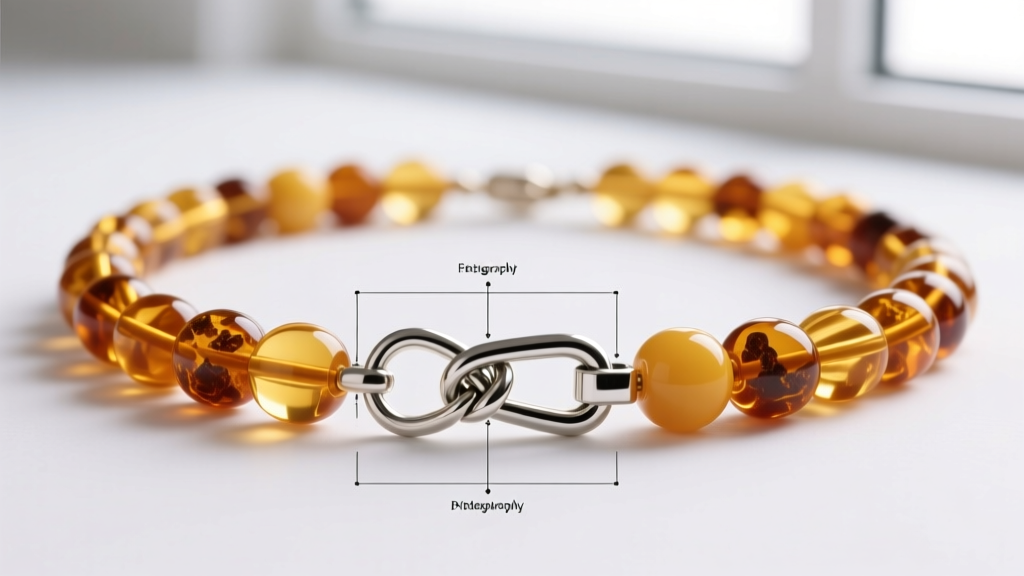
- Breakaway Clasps: A compliant necklace must feature a safety clasp (often plastic or magnetic) designed to pop open when subjected to a specific tensile force, typically releasing at less than 15 Newtons to prevent hanging if the necklace catches on a crib slat or playground equipment.
- Individual Knotting: The strand must be hand-knotted between every single bead. If the main cord snaps, this ensures that only one bead (usually 5mm to 8mm in diameter) is released at a time, rather than the entire strand scattering and creating a massive choking hazard.
- No Glue: The knots must be physically tied and melted or fused into the bead, not secured with chemical adhesives, which can degrade when exposed to saliva, sweat, and varying temperatures.
- Clasp Shielding: The clasp itself must be made of a non-toxic, BPA-free material and should ideally be covered by a bead to prevent the baby from chewing on the hard plastic or magnetic components, which could fracture and be aspirated.
Despite these engineering controls, infant motor skills are unpredictable. Babies frequently pull on objects around their necks, and the tensile strength of silk or nylon cord degrades over time when exposed to the acidic environment of human saliva and sweat. A cord that snaps while the child is sleeping or unsupervised can lead to immediate airway obstruction.
Expert Verdict and Safer Alternatives
From a materials science and pediatric medicine perspective, the answer to 'how do amber teething necklaces work' is definitive: they do not work as analgesics, and they function primarily as a hazardous mechanical risk. The thermodynamic requirements for releasing succinic acid are entirely incompatible with human biology, and the dermatological barriers prevent any theoretical absorption. The perceived benefits are anecdotal and unsupported by clinical trials.
For parents seeking effective, evidence-based teething relief, experts recommend the following actionable alternatives:
- Solid Silicone Teethers: Look for one-piece, 100% food-grade silicone teethers that can be sterilized. Avoid liquid-filled teethers, which can puncture and leak unknown chemicals.
- Thermal Therapy: A clean, damp washcloth placed in the refrigerator (not the freezer, which can cause frostbite to delicate gum tissue) for 20 minutes provides safe, localized numbing and counter-pressure.
- Gum Massage: Washing your hands thoroughly and applying firm, gentle pressure to the infant's erupting gums with a clean finger remains one of the most effective, zero-cost interventions.
- Pharmacological Options: If pain is severe and disrupting sleep or feeding, consult a pediatrician regarding weight-appropriate dosing of infant acetaminophen or ibuprofen (for infants over 6 months).
Ultimately, the jewelry market relies heavily on aesthetic appeal and historical mystique. While Baltic amber is a fascinating, beautiful material worthy of study and adult adornment, its application in infant teething jewelry is a triumph of marketing over material science and pediatric safety.


