Anatomy of a Miniature Duck Call Necklace: An Expert Guide
Discover the craftsmanship, acoustic tuning, and material grades behind the miniature duck call necklace in this expert technical deep dive.

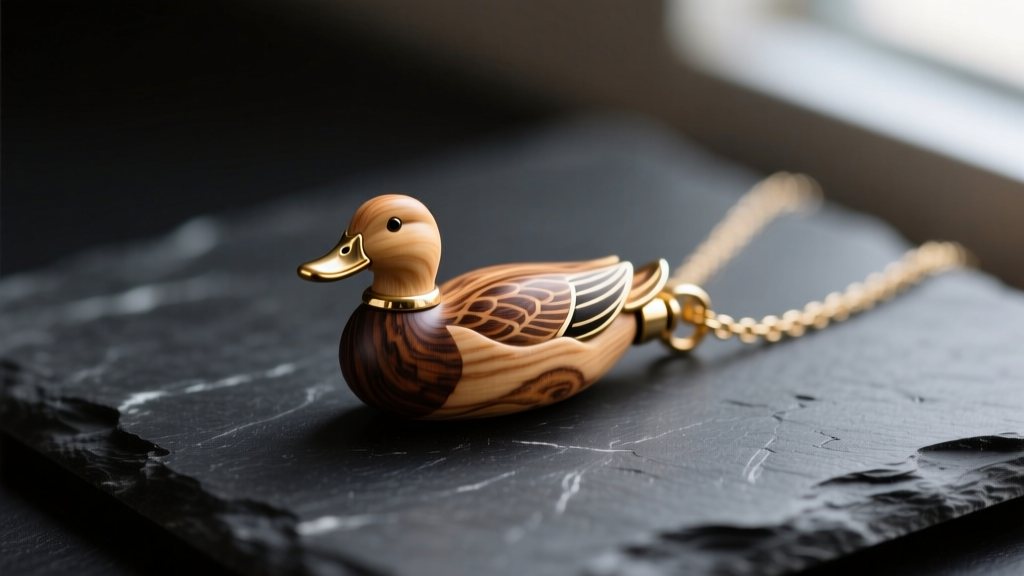
The Engineering Behind Micro-Scale Waterfowl Calls
The intersection of waterfowl hunting heritage and bespoke jewelry has given rise to one of the most technically demanding novelty pendants on the market: the miniature duck call necklace. Unlike standard novelty jewelry that merely mimics the shape of an object, a true artisan-crafted miniature duck call necklace is often a fully functional, acoustically tuned instrument scaled down to a 1:4 or 1:5 ratio. A standard mallard call measures approximately 5.5 inches in length with a 1.25-inch outer diameter. Scaling this down requires extreme precision; the resulting pendant is roughly 1.37 inches long with a bore diameter of just 0.156 inches (5/32").
As of 2026, advancements in micro-CNC lathes and high-speed steel (HSS) micro-chisels have allowed artisans to achieve tolerances of ±0.001 inches on these micro-tone boards. Turning a stabilized wood or acrylic blank down to these dimensions requires lathe speeds between 2,500 and 3,000 RPM to prevent the material from tearing or shattering. According to WOOD Magazine's guide on stabilized wood, achieving a glass-like finish on micro-turned burl wood requires sanding up to 12,000 grit before applying a cyanoacrylate (CA) glue finish, ensuring the pendant can withstand the oils and friction of daily wear against the skin.
Material Science: Acrylics, Resins, and Exotic Woods
The barrel and insert of a high-end miniature duck call necklace are typically constructed from either cast acrylic (PMMA), polycarbonate, or stabilized exotic woods. The choice of material drastically affects both the durability and the acoustic resonance of the piece.
- Cast Acrylic (PMMA): Preferred by acoustic purists. PMMA has a higher acoustic impedance than polycarbonate, resulting in a sharper, more resonant tone. It is also highly resistant to UV yellowing.
- Polycarbonate: While virtually unbreakable and highly impact-resistant, polycarbonate tends to produce a slightly duller, more muffled sound due to its internal damping properties. Data from Plastics International highlights that polycarbonate's sound absorption coefficient is notably higher than PMMA's.
- Stabilized Burl Woods: Woods like maple burl, redwood lace, or desert ironwood are vacuum-impregnated with methyl methacrylate resins (often branded as Cactus Juice). This process replaces the wood's internal air and moisture with hardened polymer, increasing the blank's density and preventing warping from ambient humidity.
Moisture Resistance and Tonal Output
Because a functional miniature duck call necklace is blown into directly, moisture management is critical. Human breath introduces condensation into the micro-bore. If the insert is made from untreated wood, it will swell within minutes, choking the reed and silencing the call. This is why master artisans exclusively use C36000 free-machining brass or 304 stainless steel for the internal tone board and exhaust inserts, pairing them with a stabilized or acrylic outer barrel.
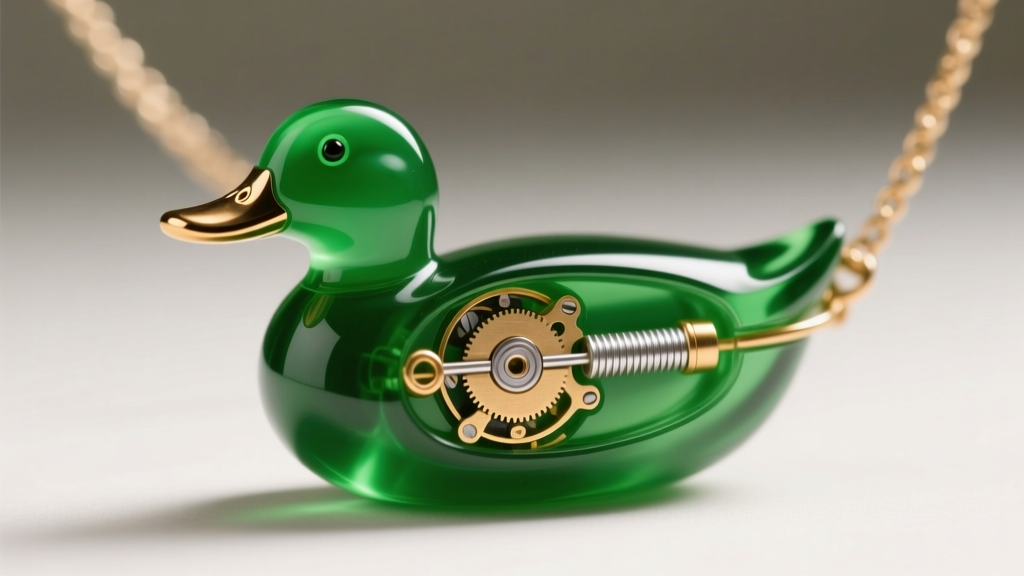
Internal Mechanics: Reeds, Tone Boards, and Inserts
The true marvel of the miniature duck call necklace lies in its internal mechanics. A standard mallard call utilizes a 0.010" to 0.015" thick mylar or polycarbonate reed. At a 1:4 scale, a reed of that thickness is far too stiff to vibrate at the required amplitude using human lung capacity forced through a 3mm exhaust port.
To solve this, micro-call makers utilize ultra-thin 0.003" to 0.005" mylar film, or in some bespoke cases, phosphor bronze shim stock. This reduction in mass allows the reed to vibrate at a much higher frequency. While a standard mallard call operates around 800 Hz to 1,200 Hz, a miniature duck call necklace typically resonates between 2,200 Hz and 2,800 Hz. The resulting sound is less of a deep mallard quack and more closely resembles the high-pitched, raspy call of a teal or a wood duck.
"Tuning a micro-tone board is an exercise in extreme patience. Removing a single thousandth of an inch of brass from the soundboard's taper can shift the pitch by over 100 Hertz or cause the reed to stick entirely." — Master Call Artisan Bench Notes, 2025.
The insert itself is usually turned from C36000 brass. The 2-3% lead content in this specific alloy acts as a chip breaker, allowing for clean, burr-free threading on micro-lathes, which is essential when cutting the delicate 1/2-20 or custom metric threads required to screw the insert into the acrylic barrel without cracking it.
Chain Selection and Load-Bearing Specifications
A fully assembled miniature duck call necklace pendant—complete with a brass insert, acrylic barrel, and mylar reed—typically weighs between 18 and 32 grams. This is substantially heavier than standard gemstone or stamped metal pendants. Suspending this weight requires careful consideration of chain gauge and tensile strength to prevent snapping or kinking.
A standard 1.2mm sterling silver cable chain has a breaking strength of roughly 4 lbs (1.8 kg). If the pendant snags on a jacket zipper or brush, the dynamic load can easily exceed this limit. Therefore, experts recommend a minimum 2.5mm gauge in a structural link pattern.
| Chain Style | Recommended Gauge | Est. Tensile Strength | Best For |
|---|---|---|---|
| Rope Chain | 2.5mm - 3.0mm | 15 - 22 lbs | Heavy brass/wood inserts; provides excellent drape and snag resistance. |
| Curb Chain | 3.0mm - 3.5mm | 20 - 30 lbs | Maximum durability; lays flat against the chest, ideal for active outdoor wear. |
| Figaro Chain | 2.8mm - 3.2mm | 18 - 25 lbs | Aesthetic contrast; the alternating link pattern complements the cylindrical pendant. |
| Box Chain | 2.0mm - 2.5mm | 12 - 18 lbs | Lighter acrylic-only models; offers a modern, geometric look. |
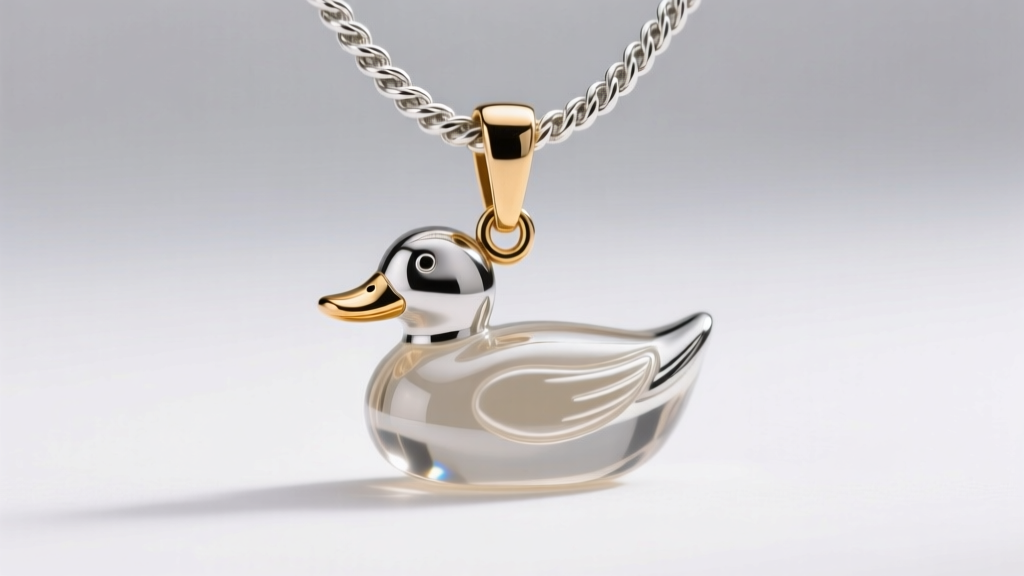
Attachment Hardware: Bails and Threaded Inserts
How the chain connects to the call is a frequent point of failure in lower-quality novelties. Glued-on pinch bails inevitably fail when exposed to the moisture of breath and the heat of the skin. The professional standard for a miniature duck call necklace involves drilling and tapping the top of the brass insert or the acrylic barrel to accept an M3 or M4 threaded stainless steel eyelet. Artisans secure this eyelet using a medium-strength threadlocker (such as Loctite 603) to ensure it never backs out, providing a permanent, load-bearing jump ring attachment that integrates seamlessly into the call's architecture.
Pricing Tiers and Artisan Benchmarks
When shopping for a miniature duck call necklace, pricing is a direct reflection of the manufacturing method and material integrity. Buyers should be aware of the distinct market tiers:
- Entry-Level / Mass Cast ($35 - $60): These are typically solid resin casts made from silicone molds. They are not functional, lack internal tone boards, and often feature glued-on bails. They serve purely as visual novelties.
- Artisan / Hand-Turned ($120 - $250): Fully functional, hand-turned on a micro-lathe from PMMA or stabilized woods. Features genuine brass inserts, properly tuned mylar reeds, and threaded hardware. This is the sweet spot for hunters and collectors seeking authentic craftsmanship.
- Master / Bespoke ($300 - $600+): Incorporates precious metals (sterling silver or 14k gold inserts), exotic stabilized burls with gemstone inlays, and custom engraving. Often tuned to specific waterfowl species upon request.
Care and Maintenance for Micro-Acoustic Jewelry
Maintaining a functional miniature duck call necklace requires specific care protocols to preserve both the jewelry finish and the acoustic tuning. Never use alcohol-based cleaners or ammonia on cast acrylic or polycarbonate barrels; these solvents induce micro-crazing (tiny internal fractures) that will eventually cause the barrel to shatter under the pressure of a blown quack. Instead, use a dedicated plastic polish like Novus 2 to remove skin oils and restore optical clarity.
Furthermore, avoid leaving the necklace in a hot vehicle. Acrylic begins to soften and warp at temperatures exceeding 160°F (71°C). If the barrel warps even slightly, it will break the airtight seal against the brass insert, rendering the call completely silent. Store the pendant in a rigid, lined jewelry box to protect the delicate exhaust port from being crushed against harder gemstones or metals.


