Expert Guide: Aquamarine and Sapphire Necklace Design
Master the technical details of an aquamarine and sapphire necklace. Explore gemological compatibility, setting mechanics, and metal alloys.

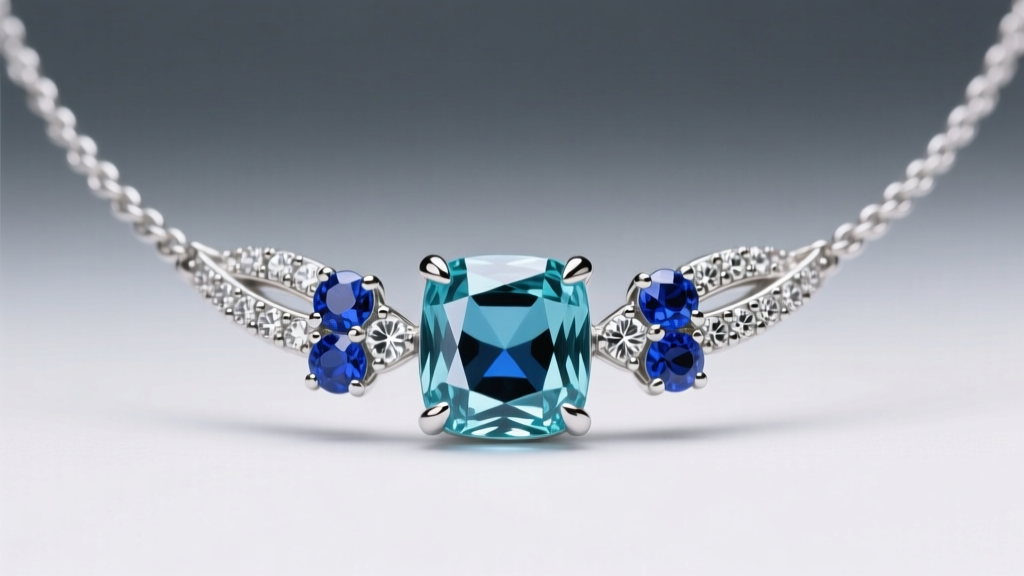
Designing a custom aquamarine and sapphire necklace is an exercise in balancing contrasting gemological properties. While both stones offer breathtaking blue hues, their internal crystal structures, hardness profiles, and lapidary requirements differ drastically. For jewelers and informed collectors, combining these two gems into a single pendant or layered necklace requires a rigorous understanding of material science and precision setting mechanics. This technical deep dive explores the exact specifications required to engineer a durable, optically balanced, and structurally sound mixed-gemstone necklace.
Gemological Compatibility: Mohs Scale vs. Toughness
The most common mistake in mixed-gemstone jewelry design is conflating hardness with toughness. According to the Gemological Institute of America (GIA), hardness measures resistance to scratching, while toughness measures resistance to chipping and breaking. Sapphire (corundum) and aquamarine (beryl) sit on opposite ends of the toughness spectrum.
| Property | Sapphire (Corundum) | Aquamarine (Beryl) |
|---|---|---|
| Mohs Hardness | 9.0 | 7.5 - 8.0 |
| Cleavage | None (Parting present) | Poor (but brittle) |
| Toughness | Excellent | Poor to Fair |
| Crystal System | Trigonal | Hexagonal |
| Specific Gravity | 3.99 - 4.00 | 2.68 - 2.74 |
Because aquamarine is inherently brittle and sensitive to mechanical stress, it cannot be subjected to the same prong-tensioning forces as sapphire. When designing an aquamarine and sapphire necklace, the sapphire can safely bear the structural load of the piece, while the aquamarine must be treated as a fragile focal point requiring shock-absorption within the mounting.
Precision Setting Mechanics for Mixed-Gemstone Pendants
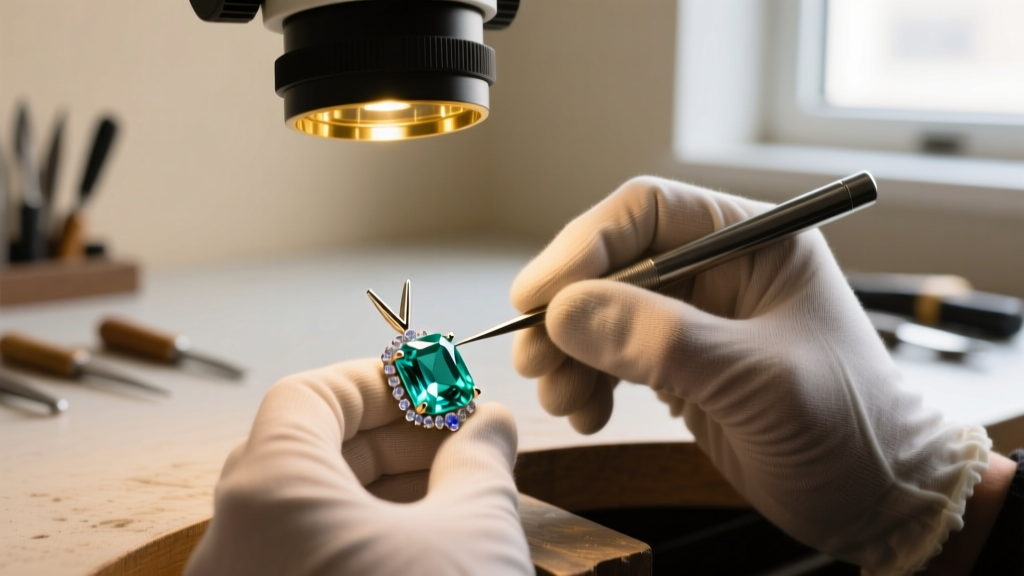
The setting phase is where most structural failures occur in mixed-stone necklaces. The bearing cuts—the tiny grooves carved into the metal prongs to hold the gemstone's girdle—must be customized for each stone's specific geometry.
Prong Configuration and Bearing Angles
- Sapphire Setting: Sapphires are typically cut with a sharp 90-degree girdle edge. Jewelers will use a standard 45-degree bearing cut in the prong, allowing the metal to wrap securely over the crown without putting undue pressure on the stone's table.
- Aquamarine Setting: Aquamarines, particularly emerald or step-cuts, feature sharp, vulnerable corners. Standard prongs will inevitably cause micro-fractures over time due to neck movement. V-prongs are mandatory for the corners, and the bearing must be cut at a precise 90-degree angle to match the stone's corner geometry, distributing pressure evenly across two planes rather than a single point.
For a unified pendant design, a hybrid bezel-and-prong basket is highly recommended. A full bezel for the aquamarine eliminates corner vulnerability, while shared prongs can be utilized for the surrounding sapphire melee or accent stones.
Lapidary Proportions and Weight Ratios
Combining these stones in a single necklace pendant introduces a significant lapidary challenge: differing pavilion depths. Aquamarine rough is highly prized by weight, and cutters frequently cut the pavilion shallow to maximize the face-up spread of the stone. Conversely, sapphire cutters often cut deep pavilions to retain carat weight and force light to bounce internally, enriching the blue saturation.
If you place a shallow-cut aquamarine and a deep-cut sapphire into a standard, symmetrical CAD-designed basket, the stones will sit at completely different heights, ruining the optical plane. Expert jewelers must draft a custom, asymmetrical gallery wire that steps down to accommodate the aquamarine's shallow draft while providing a deep cradle for the sapphire. Failing to account for this specific gravity and cut-depth discrepancy results in a pendant where one stone visually overpowers the other, or worse, the taller stone's culet scratches the back of the mounting.
Metal Alloy Selection and Thermal Shock Risks
The choice of precious metal dictates the long-term structural integrity of an aquamarine and sapphire necklace, particularly regarding thermal conductivity and maintenance.
Platinum (Pt950/Ru) vs. 18k White Gold
Platinum 950 alloyed with Ruthenium is the superior choice for mixed-hardness settings. Platinum's high density and low thermal conductivity mean that if a prong breaks and requires laser welding or retipping, the heat dissipates slowly, protecting the adjacent aquamarine from thermal shock. Aquamarine is highly sensitive to sudden temperature changes, which can cause internal liquid inclusions to expand and shatter the stone.
Conversely, 18k white gold requires periodic rhodium plating. The electroplating process involves chemical baths and mild heat. While sapphire is entirely impervious to these chemicals, many aquamarines on the market are fracture-filled with optically clear resins to mask internal fissures. The harsh acids used in rhodium stripping can dissolve these resins, leaving the aquamarine looking heavily included and cloudy.
Optical Performance and Refractive Index
A successful necklace design must account for the differing Refractive Index (RI) of the two gems. Sapphire possesses a high RI of 1.76 to 1.77, resulting in brilliant, sharp light return and high dispersion. Aquamarine has a much lower RI of 1.57 to 1.58, yielding a softer, more glass-like luster.
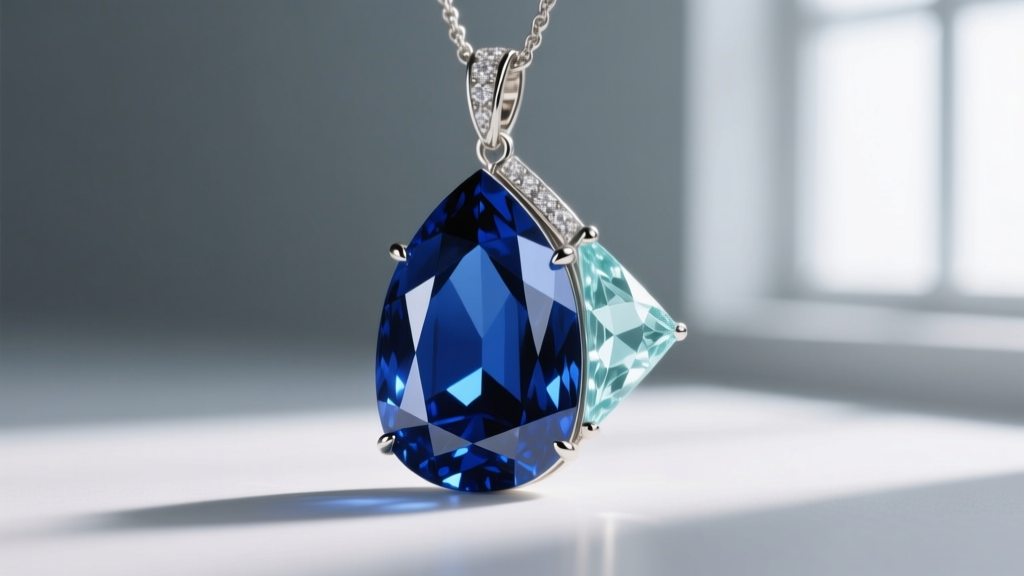
To prevent the sapphire from visually drowning out the aquamarine, designers should utilize step-cuts (like emerald or baguette cuts) for the aquamarine to emphasize its clarity and hall-of-mirrors effect, while using brilliant-cuts for the sapphires to maximize their scintillation. Furthermore, sapphire exhibits strong dichroism (showing different colors from different crystal axes), meaning the lapidary must orient the table facet perpendicular to the c-axis to ensure the blue faces up correctly, rather than showing a dull greenish-gray pleochroic hue.
Advanced Maintenance and Ultrasonic Cleaning Protocols
The maintenance protocol for an aquamarine and sapphire necklace is dictated entirely by the more vulnerable stone. While a sapphire can easily withstand ultrasonic cleaners and high-pressure steam, an aquamarine cannot.
Expert Warning: Never place a mixed aquamarine and sapphire necklace in an ultrasonic cleaner. The high-frequency vibrations can cause microscopic internal fractures in the beryl crystal structure to propagate, leading to catastrophic stone failure. Furthermore, steam cleaners can melt the fracture-filling resins commonly used in commercial-grade aquamarines.
The only safe cleaning method for this specific necklace combination is a lukewarm bath of distilled water and a few drops of pH-neutral dish soap, agitated gently with a soft-bristled baby toothbrush. The necklace should be dried with a lint-free microfiber cloth, avoiding compressed air, which can force moisture into the microscopic gaps between the gemstone girdle and the metal bearing cuts.
By respecting the distinct crystallographic and optical properties of both corundum and beryl, jewelers can craft an aquamarine and sapphire necklace that is not only visually striking but engineered to survive generations of wear.


