How to Assess True Value From a Necklace Pic Online
Learn how to evaluate jewelry quality, material grades, and fair pricing from a simple necklace pic. Expert tips for smart online buying in 2026.

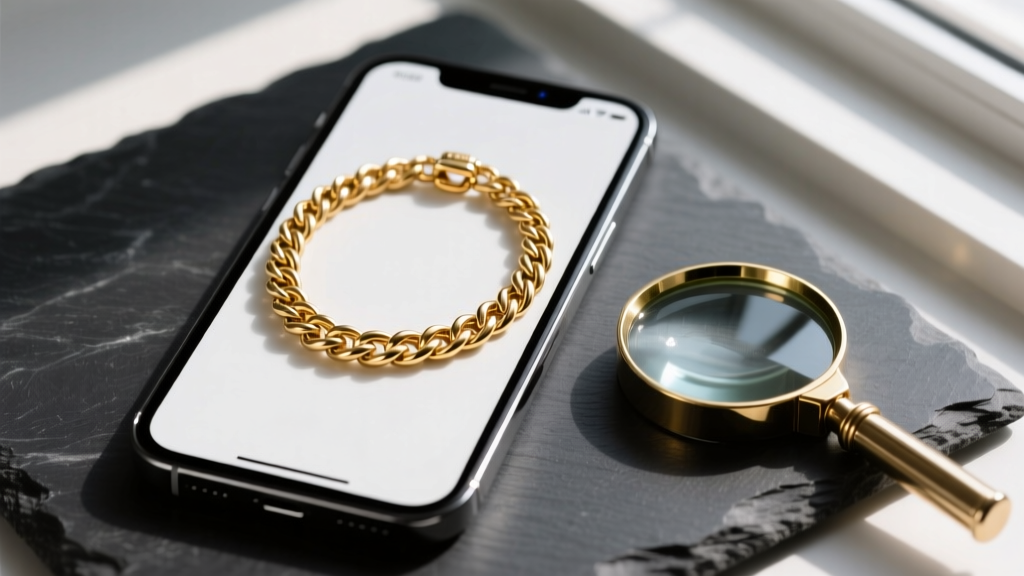
In the modern digital jewelry market, your purchasing decision almost always begins with a single image. Whether you are browsing an independent jeweler on Instagram or scrolling through an e-commerce marketplace, the visual representation of the piece is your only immediate point of reference. However, in 2026, AI-enhanced product photography and advanced digital color grading have made it increasingly difficult to distinguish a $1,500 solid 14k gold chain from a $45 gold-plated brass imitation. Learning how to critically assess a necklace pic is no longer just about admiring the design; it is a vital skill for budget protection and value assessment.
As a buyer, you must train your eye to look past the aesthetic appeal and scrutinize the structural, metallurgical, and optical clues hidden within the photograph. This guide will break down the exact technical details you need to evaluate when inspecting jewelry online, ensuring you pay a fair price for genuine quality.
Decoding Lighting and Color Temperature
The most common trick used in low-value jewelry photography is manipulating the color temperature to mask inferior metal alloys. Genuine 14k and 18k yellow gold have a distinct, rich warmth that reflects light evenly. Conversely, 10k gold, gold vermeil, and PVD-coated brass often exhibit subtle green or copper undertones. To hide these brassy tints, sellers will photograph the jewelry under warm, 3200K tungsten-style lighting or apply a digital warm filter.
When examining a necklace pic, look for the white balance of the background or the model's skin tone. If the skin looks overly orange or the white background appears yellowish, the seller is likely compensating for the metal's true color. Honest, high-value jewelry photography utilizes neutral 5500K daylight-balanced lighting, which renders the exact hue of the gold alloy without artificial enhancement.
The Overexposure Trick
Another red flag is blown-out highlights. Mass-produced cast pendants often suffer from porosity—tiny microscopic pits on the metal surface caused by trapped gas during the casting process. To hide this, photographers will overexpose the image, washing out the shadows and reflections. If the metal looks like a flat, glowing white blob rather than a reflective surface with distinct contrast and environment mapping, you are likely looking at a low-quality cast piece rather than a hand-finished or die-struck pendant.
Evaluating Chain Construction from a Photo
Chain necklaces represent a significant portion of the jewelry market, and their construction dictates both their durability and their intrinsic value. When you zoom in on a high-resolution necklace pic, the links tell a detailed story about the manufacturing process.
Solid vs. Hollow Links
Hollow chains, particularly in styles like the rope, figaro, or Cuban link, are designed to offer a massive look for a fraction of the gold weight. While they fit a tighter budget, they are prone to crushing and are nearly impossible to repair. In a close-up pic, examine the inner curvature of the links. Solid links will have a uniform, rounded thickness throughout. Hollow links often reveal flat spots, visible seams, or a slightly pinched appearance where the metal was folded over a core and laser-welded. If a 5mm Cuban link chain is being sold for $300, the pic is undoubtedly showing a hollow or gold-plated construction, as the raw gold value alone would exceed that price.
PVD Coating vs. Gold Vermeil
Physical Vapor Deposition (PVD) has become the standard for budget fashion jewelry in 2026. Unlike traditional electroplating, PVD coats a brass or stainless steel base with a microscopic layer of titanium nitride and gold dust. In a necklace pic, PVD coatings often look unnaturally perfect, almost like plastic, because they lack the deep, soft luster of real gold. Gold vermeil (a thick layer of gold over sterling silver) will show a more authentic metallic reflection. If the seller does not explicitly state the base metal in the description, assume the pristine pic is hiding a PVD-coated brass core.
2026 Pricing Benchmarks and Melt Value Reality
To accurately assess the value of the necklace pic you are viewing, you must understand the relationship between retail markup and intrinsic melt value. With gold spot prices hovering around the $2,250 per ounce mark in 2026, the raw material cost of solid gold jewelry is substantial. Use the table below as a baseline for evaluating online listings.
| Chain Type (18 inch, 3mm) | Material | Expected 2026 Retail | Approx Melt Value | Value Indicator |
|---|---|---|---|---|
| Rope Chain | Solid 14k Gold | $950 - $1,300 | $580 | High intrinsic value |
| Rope Chain | 14k Gold Vermeil | $85 - $140 | $5 | High markup, fashion tier |
| Cuban Link | Solid 10k Gold | $600 - $850 | $390 | Budget-friendly solid |
| Cuban Link | Brass w/ PVD Coat | $40 - $75 | $1 | Zero intrinsic value |
If a seller posts a necklace pic of a 'solid 14k gold' 3mm rope chain but prices it at $250, you are not getting a deal; you are being deceived. The math simply does not support the claim. According to the Jewelers of America, reputable jewelers typically apply a markup of 1.5x to 2.5x over the melt value to cover labor, overhead, and retail margins. Any price significantly below the melt value is an immediate indicator of misrepresentation.
Hardware and Hallmarks: The Tell-Tale Signs
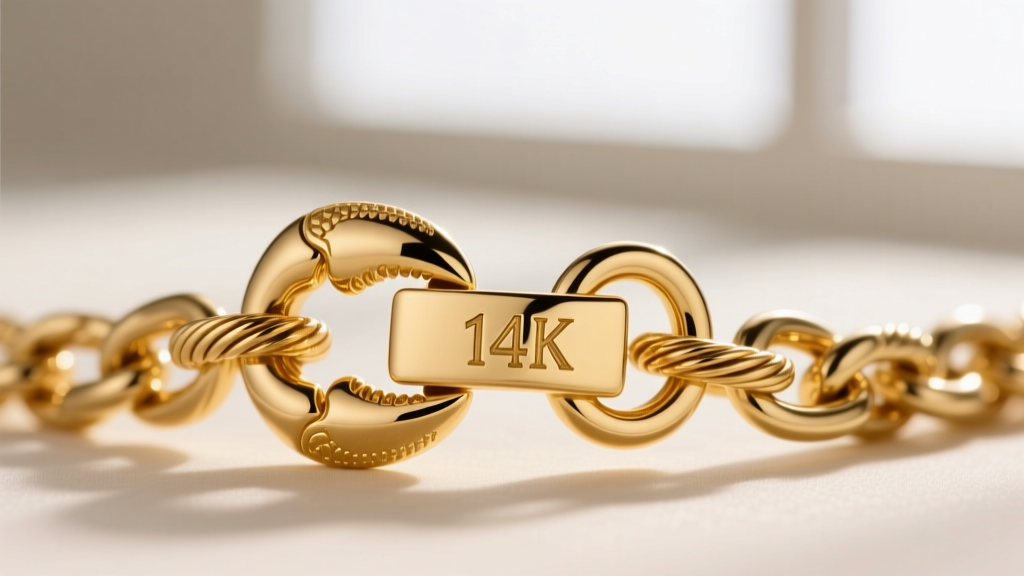
The hardware on a necklace is often the most revealing element in a photograph. High-end manufacturers invest heavily in their clasps because they are the primary failure point of any chain.
Clasp Proportions and Mechanics
Look closely at the clasp in the necklace pic. A heavy, solid gold chain requires a robust, cast lobster claw clasp or a custom box clasp with dual safety latches. If you see a tiny, lightweight spring-ring clasp attached to a thick, supposedly solid chain, this is a massive structural red flag. It indicates that the chain is either hollow, heavily weighted with internal resins, or gold-plated. Furthermore, spring-ring clasps are notoriously difficult to operate and are rarely used on premium jewelry pieces weighing over 15 grams.
FTC Stamping Rules and Hallmarks
The Federal Trade Commission Jewelry Guides strictly mandate that any piece of jewelry stamped with a quality mark (like 14k, 18k, or 925) must also bear the registered trademark of the manufacturer. In a high-quality necklace pic, you should be able to zoom in on the clasp or the jump ring and clearly see both the purity stamp and the maker's mark. If the photo is intentionally blurry around the clasp, or if the hallmark looks crudely stamped and misaligned, the piece is likely counterfeit or imported without proper quality control.
Gemstone Reflections and Optical Properties
When assessing pendants featuring gemstones, the way the stone interacts with light in the photograph can help you distinguish between natural diamonds, lab-grown alternatives, and cheap simulants.
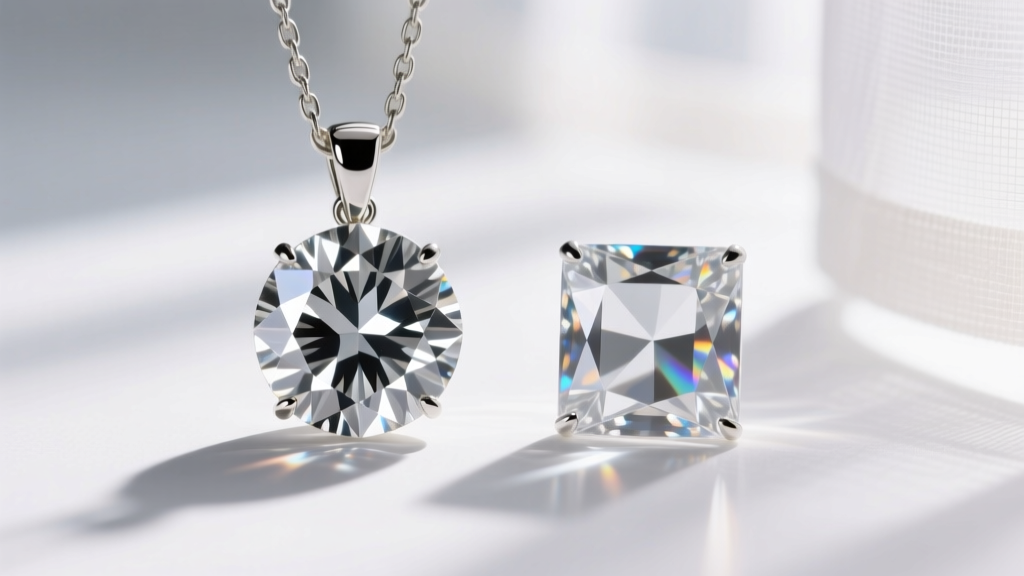
Cubic Zirconia (CZ) has a higher dispersion rate than diamond, meaning it often exhibits an artificial 'rainbow' effect or excessive fire in photographs. In a well-lit necklace pic, CZ will often show flat, glassy white reflections with rounded, dull facet edges due to its lower hardness (8.5 on the Mohs scale). Diamonds and moissanite, being much harder, take a sharper polish, resulting in crisp, razor-sharp facet edges and intense, contrasting light return. The Gemological Institute of America (GIA) notes that moissanite also exhibits double refraction, which can sometimes be seen in macro photos as a slight 'doubling' of the back facet lines when viewed through the crown of the stone.
The Reverse Image Search Protocol
Finally, the most powerful tool in your value assessment arsenal is the reverse image search. Before purchasing based on a beautiful necklace pic, run the image through Google Lens or TinEye. In the current market, many boutique brands drop-ship identical designs directly from overseas manufacturers. A reverse search might reveal that the 'handcrafted, bespoke' $800 pendant you are looking at is actually a mass-produced brass mold available on wholesale platforms for $12. This does not necessarily mean you shouldn't buy it if you love the design, but it radically shifts the value assessment from an 'investment piece' to 'fast fashion,' allowing you to negotiate or adjust your budget accordingly.
Conclusion
Assessing the true value of a necklace pic requires a shift in mindset from passive consumer to analytical appraiser. By scrutinizing the lighting conditions, examining the link construction, verifying the clasp hardware, and cross-referencing the price against current 2026 melt values, you can protect your budget and ensure that the jewelry you receive matches the promise of the photograph. Always demand high-resolution, unfiltered images from sellers, and never hesitate to walk away if the visual evidence contradicts the product description.


