The Balance Necklace Trend: Mastering Asymmetry in 2026
Discover the 2026 balance necklace trend. Learn how to style asymmetrical pendants, match chain gauges, and master visual weight in jewelry.

The Evolution of the Balance Necklace
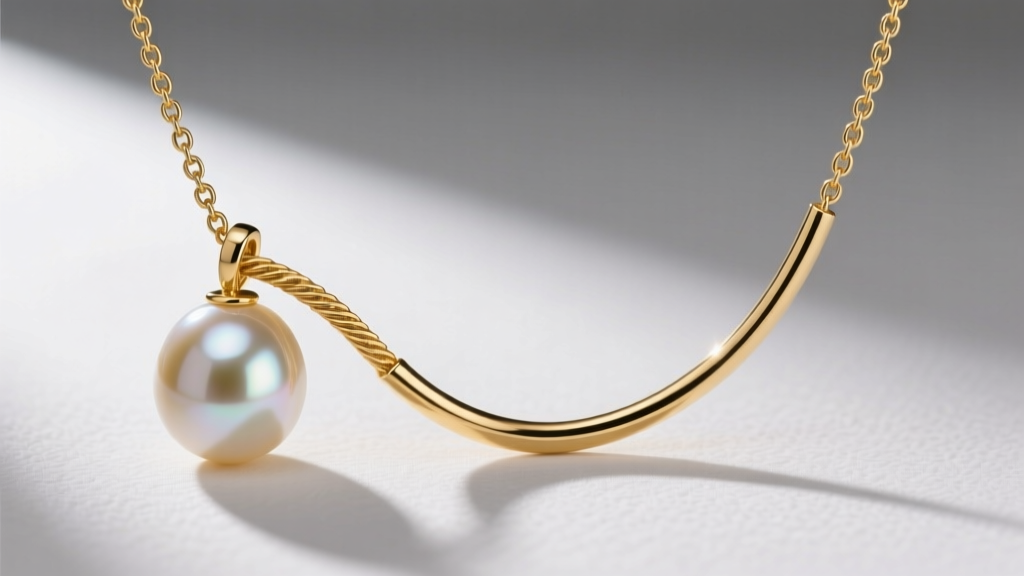
In the ever-shifting landscape of fine jewelry, symmetry is no longer the sole arbiter of elegance. As we navigate the style landscape of 2026, the balance necklace has emerged as a definitive statement piece, championing the art of calculated asymmetry. Unlike traditional pendants that hang dead-center on a uniform chain, a balance necklace relies on the deliberate distribution of visual and physical weight. This creates a dynamic, kinetic aesthetic that moves with the wearer, drawing the eye across the neckline rather than anchoring it to a single focal point.
The modern balance necklace is a triumph of jewelry engineering. It requires a deep understanding of metal densities, chain tensile strength, and ergonomic drape. Whether you are a collector of avant-garde fine jewelry or a stylist looking to elevate a minimalist wardrobe, mastering the mechanics and styling of this trend is essential for the contemporary jewelry enthusiast.
The Anatomy of Visual and Physical Weight
To truly appreciate the balance necklace, one must distinguish between visual weight and physical weight. A piece can look incredibly heavy due to its volume and light reflection, yet be physically lightweight, or vice versa. Master jewelers manipulate both to create a piece that sits perfectly on the clavicle without sliding off-center.
Hidden Counterweights and Metal Density
When a balance necklace features a massive, heavy gemstone or solid gold sculpture on one side, the chain alone cannot prevent the pendant from migrating to the lowest point of the neck. To solve this, designers utilize hidden counterweights inside the clasp or the opposing chain links. According to the Gemological Institute of America (GIA), understanding metal density is crucial here. While 18k yellow gold has a density of roughly 15.5 g/cm³, innovative designers are now incorporating Tungsten carbide (density ~19.25 g/cm³) inside hollowed-out 14k gold clasps. This provides the necessary physical counterbalance without adding bulky, unsightly metal to the back of the neck.
Friction Sliders and Kinetic Hinges
For Y-drop or lariat-style balance necklaces, the drop length dictates the visual equilibrium. In 2026, the industry standard has moved away from fixed jump rings to micro-silicone friction sliders (typically 1.5mm inner diameter) encased in precious metal beads. This allows the wearer to adjust the drop length by millimeters, finding the exact center of gravity for their unique neck circumference. Furthermore, kinetic hinges—micro-pivots that allow the pendant to swivel independently of the chain—ensure the piece lays flat against the sternum regardless of the wearer's posture.
2026 Trend Forecast: Materials and Motifs
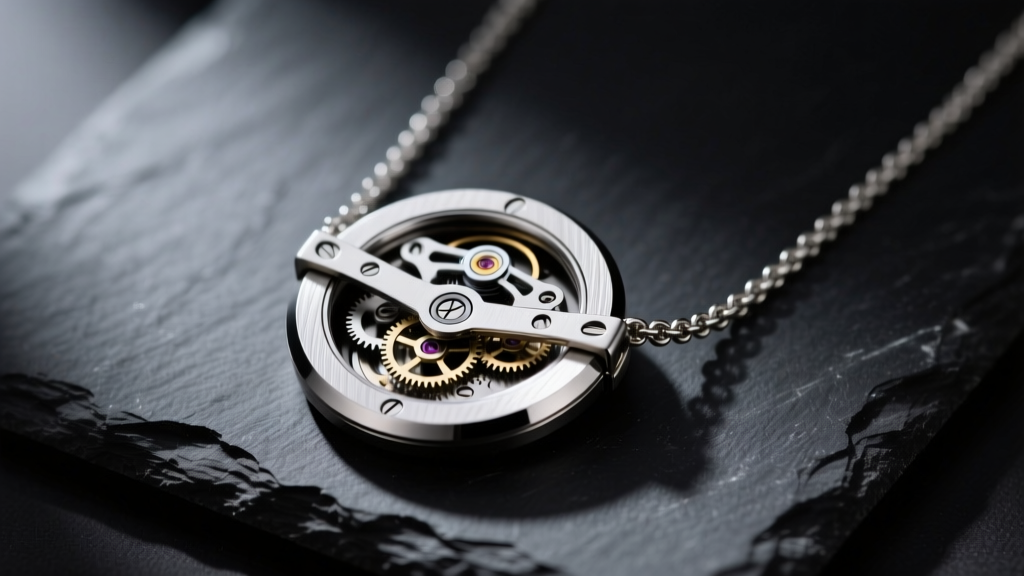
This year, the balance necklace trend is defined by a juxtaposition of raw, unrefined materials against high-polish precision. The industry is seeing a massive shift toward mixed-media asymmetry, as noted by market analysts at JCK Online. Here are the dominant material trends defining the category this year:
- Grade 5 Titanium & Recycled 18k Gold: Titanium offers unparalleled strength at a fraction of the weight of steel, allowing for oversized, architectural counter-drops that won't strain the cervical spine. Paired with warm, recycled 18k gold, it creates a striking thermal contrast.
- Baroque Pearls vs. Geometric Onyx: The organic, unpredictable shape of a heavy baroque pearl on one side, balanced by a razor-sharp, geometric slice of black onyx on the other, perfectly encapsulates the 2026 ethos of 'controlled chaos'.
- Gradient Chain Weaving: Instead of a uniform chain, the chain itself transitions from a thick 4.0mm curb link near the counterweight to a delicate 1.0mm box chain near the main pendant, creating a visual gradient that guides the eye.
Visual Weight Distribution: A Jeweler’s Framework
When selecting or designing a balance necklace, the chain style plays a pivotal role in how the piece is perceived. The table below outlines the standard chain gauges used in asymmetrical designs and their corresponding visual impact.
| Chain Type | Gauge (mm) | Visual Weight | Best Application in Balance Necklaces |
|---|---|---|---|
| Cable | 1.0 - 1.5 | Low | Delicate counter-drops; allows heavy pendants to dominate visually. |
| Curb | 2.5 - 4.0 | High | Anchoring heavy pendants; provides a strong visual counterweight. |
| Rope | 1.5 - 3.0 | Medium | Twisted light reflection adds texture without overwhelming the pendant. |
| Box | 1.2 - 2.0 | Medium-Low | Modern geometric offsets; pairs well with architectural metal drops. |
| Snake | 1.5 - 2.5 | Medium | Fluid drape; excellent for kinetic pieces requiring smooth movement. |
How to Style a Balance Necklace for Different Necklines
The asymmetrical nature of a balance necklace means it interacts with clothing necklines differently than a traditional symmetrical pendant. The goal is to create harmony, not competition, between the garment and the jewelry.
The Deep V-Neck and Plunge
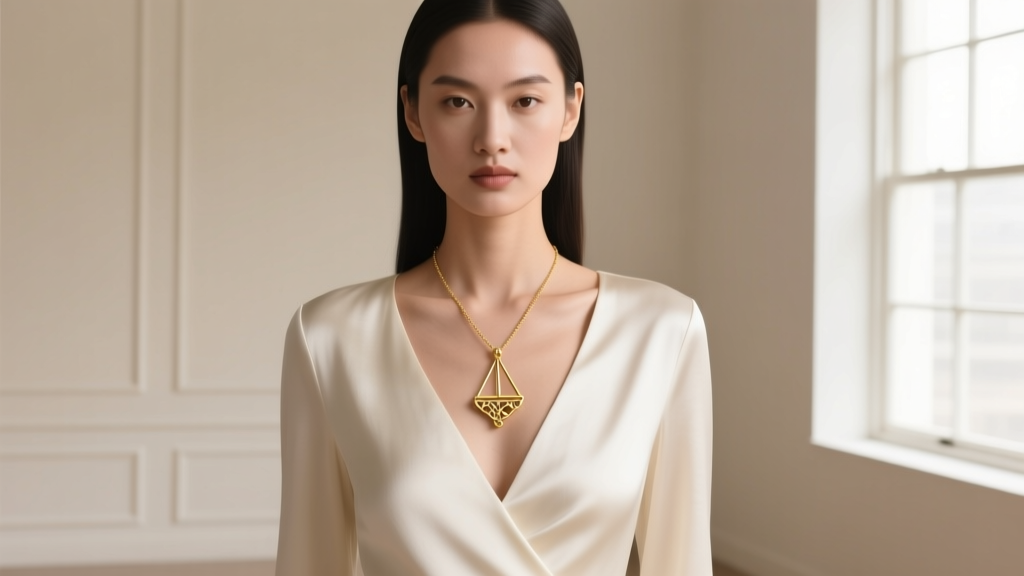
A deep V-neck provides a natural geometric frame for a Y-drop balance necklace. The key is to ensure the terminal drop of the necklace ends exactly one inch above the apex of the V-neckline. If the metal touches the fabric's edge, it creates visual clutter. Opt for a high-polish gold chain to catch the light in the negative space of the décolletage.
The Asymmetrical or One-Shoulder Top
Pairing an asymmetrical necklace with an asymmetrical top requires the 'Rule of Opposition.' If the top's fabric drapes over the left shoulder, the heavy pendant of the balance necklace should be positioned on the right side. This cross-body tension creates a balanced, editorial look that prevents the outfit from feeling top-heavy on one side.
The Classic Crew Neck
For high crew necks, avoid long lariat drops that will tangle with the fabric rim. Instead, choose a collar-length balance necklace (14-15 inches) where the asymmetry is achieved through chain thickness rather than pendant drops. A 3mm curb chain transitioning into a 1mm cable chain resting just on the collarbone offers a sophisticated, subtle nod to the trend.
Sourcing and Pricing: What to Expect in 2026
Because of the complex engineering required to properly counterweight and articulate a balance necklace, pricing structures differ from standard cast pendants. Hand-fabrication and micro-hinge assembly drive up labor costs. Here is a realistic pricing framework for the current market:
Entry-Level (Brass, Vermeil, Sterling Silver): $65 – $180. At this tier, physical counterweights are rarely used; balance is achieved purely through visual design and thicker chains. Expect silicone sliders rather than mechanical locks.
Mid-Tier (Gold-Filled, 10k/14k Solid Gold, Semi-Precious Stones): $350 – $950. This is the sweet spot for durability and engineering. You will find hidden tungsten clasp weights, properly soldered kinetic hinges, and high-quality friction sliders.
Fine & High Jewelry (18k Gold, Platinum, Diamonds, Custom Cuts): $2,500 – $12,000+. These pieces are masterclasses in metallurgy. Designers use CAD modeling to calculate the exact center of gravity before casting, ensuring the piece hangs perfectly without the need for heavy, uncomfortable counter-clasps.
Care and Maintenance for Asymmetrical Pieces
The moving parts and varied chain gauges of a balance necklace require specific maintenance protocols to ensure longevity. The most common failure mode in asymmetrical necklaces is the wearing down of the micro-hinge pin or the tearing of a delicate chain link near a heavy counterweight.
Never place a kinetic balance necklace in an ultrasonic cleaner. The high-frequency vibrations can loosen the microscopic tension screws inside the swivel hinges and degrade the silicone friction sliders. Instead, clean the piece using a soft-bristled baby toothbrush and a mild, ammonia-free dish soap solution. When storing, always lay the necklace flat in a lined jewelry box; hanging an asymmetrical piece on a standard jewelry tree places constant, uneven stress on the weakest link of the lighter chain segment, eventually leading to metal fatigue and chain snap.
By understanding the intricate balance of weight, material, and visual gravity, you can confidently navigate this sophisticated trend, turning a simple accessory into a masterclass of wearable engineering.


