The Anatomy of an Authentic Buddhist Mala Necklace: A Technical Guide
Explore the technical anatomy of a Buddhist mala necklace, from bead materials and sizing to traditional knotting techniques and authentic sourcing.

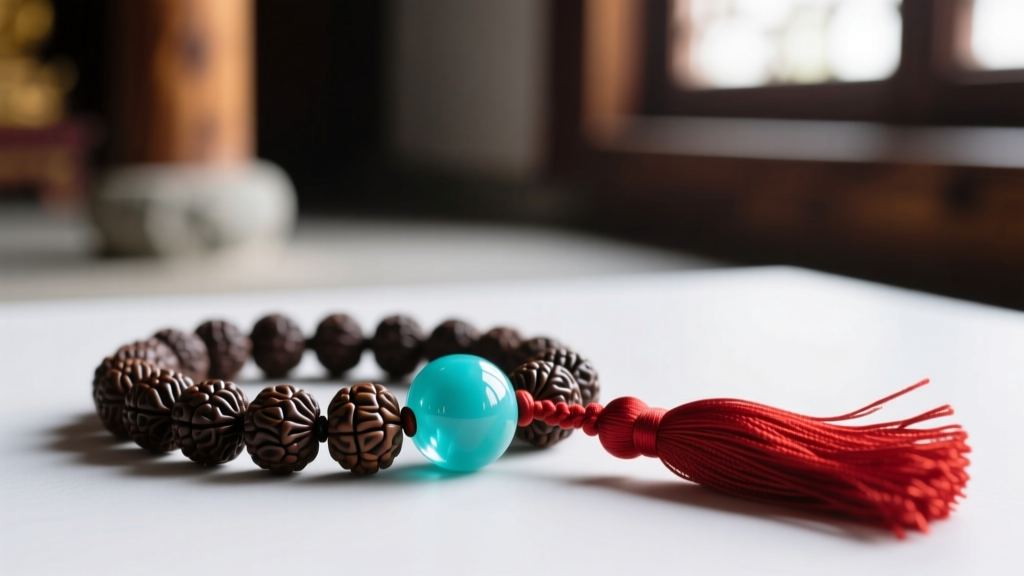
The modern jewelry market is saturated with mass-produced "yoga beads" that loosely mimic traditional meditation tools. However, an authentic Buddhist mala necklace is a precision-crafted spiritual instrument, governed by strict numerical, material, and structural guidelines. For practitioners, collectors, and jewelry scholars alike, understanding the technical anatomy of a mala separates genuine devotional tools from mere fashion accessories. This deep dive explores the exact specifications, material grades, and stringing mechanics that define a true Buddhist mala.
The Core Anatomy: Beyond the 108 Beads
A standard Buddhist mala necklace consists of exactly 108 counting beads. In Buddhist cosmology, this number represents the 108 earthly desires (kleshas) or defilements that one must overcome to achieve nirvana. However, the structural integrity of the mala relies on three additional, critical components:
The Guru Bead (Meru) and Tassel Mechanics
The Guru bead, also known as the Meru or Stupa bead, is the 109th bead that anchors the strand. It is typically larger than the counting beads and serves as a physical and spiritual boundary. During japa (mantra recitation), the practitioner never crosses the Guru bead; instead, they flip the mala and reverse direction. According to Lion's Roar, crossing the Guru bead is considered a sign of disrespect to one's teachers and the lineage of the practice.
Beneath the Guru bead sits the tassel, traditionally made of silk or cotton. The tassel represents the lotus flower or the connection to the divine. From a structural standpoint, the tassel acts as a counterweight, ensuring the Guru bead rests properly at the nape of the neck or the sternum, depending on the cord length.
Marker Beads and Interval Spacing
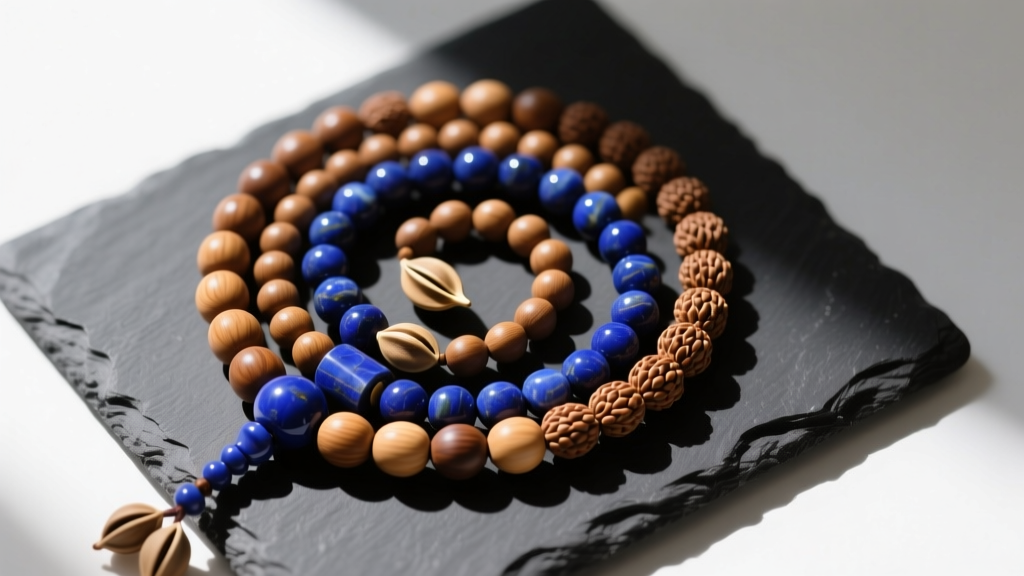
Many authentic Tibetan and Nepalese malas incorporate marker beads (often made of turquoise, coral, or lapis lazuli) at the 27th, 54th, and 81st positions. These divide the mala into four quadrants of 27 beads, allowing the practitioner to track their progress through a 108-bead cycle without losing count. These marker beads are usually slightly smaller or distinctly shaped (e.g., flat discs or barrels) to provide tactile feedback in the dark.
Material Science: Seed, Wood, and Stone Grading
The efficacy and longevity of a Buddhist mala necklace are heavily dependent on its material composition. Authentic malas utilize organic materials that interact with the wearer's skin chemistry over time, developing a unique patina.
Rudraksha Seeds (Elaeocarpus ganitrus)
Rudraksha beads are the seeds of the Elaeocarpus ganitrus tree. They are graded by their "mukhis" (facets or clefts). The 5-mukhi (Panchamukhi) is the most common and is associated with the deity Kalagni Rudra, representing general spiritual well-being. High-grade Rudraksha beads are dense, sink in water, and possess deep, well-defined natural clefts. Mass-produced fakes are often carved from inferior wood and glued together; a microscopic inspection of the clefts will reveal tool marks rather than natural growth lines.
Bodhi Seeds and Sandalwood
Contrary to popular belief, "Bodhi seeds" used in malas do not come from the sacred Ficus religiosa (Bodhi tree). They are typically the hard endocarps of the Ziziphus or palm species. High-density Bodhi seeds are prized because they absorb sebum and natural skin oils, darkening from a pale cream to a deep, glossy mahogany over years of use. Sandalwood (Santalum album) malas are graded by their santalol (essential oil) content. True Mysore sandalwood has a Janka hardness of roughly 1,200 lbf and retains its aromatic profile for decades if kept away from harsh soaps.
Comparative Material Data for Mala Construction
| Material | Botanical/Mineral Origin | Hardness/Density Profile | Technical Best Use & Wear |
|---|---|---|---|
| 5-Mukhi Rudraksha | Elaeocarpus ganitrus (Seed) | High density; sinks in water | Daily Japa; develops dark patina with skin oils |
| Bodhi Seed | Ziziphus/Palm (Endocarp) | Very hard; low porosity | High-friction counting; long-term color evolution |
| Mysore Sandalwood | Santalum album (Heartwood) | Janka ~1200 lbf; high oil content | Aromatic grounding; avoid water/submersion |
| Lapis Lazuli | Metamorphic Rock (Lazurite) | Mohs 5.5 - 6.0; prone to chipping | Occasional wear; requires protective knotting |
| Amethyst | Quartz variety (Silicate) | Mohs 7.0; highly durable | Daily wear; resists scratching and oil degradation |
Data compiled with reference to the Gemological Institute of America (GIA) for mineral hardness and botanical standards for organic beads.
Stringing Techniques: Elastic vs. Traditional Hand-Knotting
The stringing method dictates the drape, durability, and tactile experience of the mala. The use of elastic cord (polyurethane or rubber) is a modern shortcut primarily reserved for bracelets. For a traditional Buddhist mala necklace, elastic is structurally inappropriate; it degrades under UV exposure and skin acids, leading to catastrophic failure (snapping) during meditation.
The Mechanics of Traditional Cordage
Authentic malas are strung on waxed cotton, pure silk (Size F or G), or high-tensile nylon (Chinese knotting cord). The cord diameter must be precisely matched to the bead hole. For standard 8mm beads with a 1.0mm drill hole, a 0.8mm braided nylon cord is optimal. This allows enough friction for knotting while preventing the cord from fraying against the bead edges.
Knotting Styles and Spacing
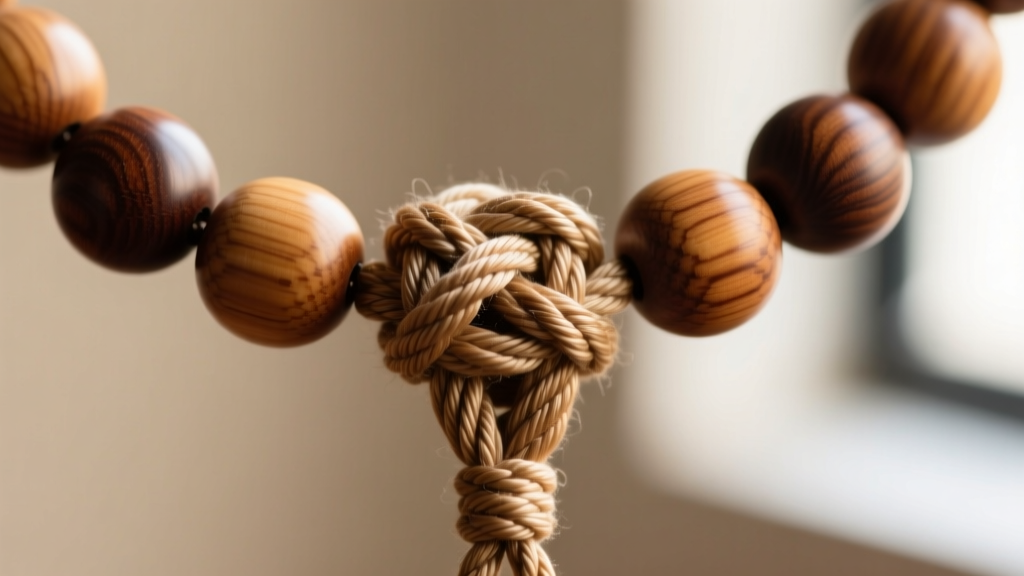
Hand-knotting between each bead serves two purposes: it prevents the beads from grinding against one another (preserving the drill holes), and it ensures that if the cord breaks, only one bead is lost. The traditional knot is a variation of the overhand knot, pulled tight against the bead using an awl or needle. According to BuddhaNet, the spacing and consistency of these knots are the primary indicators of a master craftsman. In high-end malas, the knots are uniform, symmetrical, and sit flush against the bead without excessive cord exposure.
Sizing Metrics: How Bead Diameter Alters Drape
The overall length and drape of a Buddhist mala necklace are strictly mathematical, dictated by the bead diameter and the thickness of the knots. Understanding these metrics is crucial for selecting a mala that suits your physical build and meditation posture.
- 6mm Beads (The Traveler's Mala): Yields a total strand length of approximately 26 to 28 inches. This sits high on the chest, similar to a standard princess-length necklace. It is lightweight, unobtrusive, and ideal for wearing under clothing or during active movement.
- 8mm Beads (The Standard): Yields a total strand length of 34 to 36 inches. This is the most common size, resting at the sternum. It provides a substantial tactile feel without being overly heavy, making it the gold standard for seated meditation.
- 10mm Beads (The Statement/Jumbo): Yields a total strand length of 42 to 45 inches. These malas are heavy and often worn doubled (wrapped) around the neck or wrist. The large beads are easier to manipulate for practitioners with reduced fine motor skills or arthritis.
Identifying Authentic Craftsmanship vs. Mass Production
When evaluating a Buddhist mala necklace, look beyond the marketing copy. Inspect the drill holes: authentic stone and seed beads are center-drilled using diamond-tipped core bits, resulting in clean, uniform channels. Mass-produced beads often feature off-center drilling or "blowouts" (chipped edges) at the exit point of the drill. Furthermore, examine the adjustable slider knot at the back of the neck. A genuine artisan will use a complex macramé slider, such as a Josephine knot or a multi-pass square knot, which glides smoothly but holds tension. Factory-made replicas often use a simple, loose overhand knot that slips during wear.
Expert Sourcing Tip: Always check the tassel binding. A high-quality mala will have the tassel threads individually bound and glued with a flexible, archival-grade adhesive (like jade glue) before being wrapped with metallic or silk thread. If the tassel threads are simply stuffed into a metal cone cap with hot glue, the mala will shed and unravel within months of regular use.
Care and Maintenance of Organic Mala Materials
Organic malas are living materials that require specific maintenance. Rudraksha and Bodhi seeds can dry out and crack in low-humidity environments. To prevent this, lightly condition the beads every six months with a micro-dab of pure jojoba oil or food-grade mineral oil, wiping off any excess immediately. Never submerge wooden or seed malas in water, as the internal moisture will cause the beads to swell and split upon drying. For stone malas (like Lapis Lazuli or Turquoise), avoid ultrasonic cleaners and harsh chemicals; a simple wipe with a damp, lint-free microfiber cloth is sufficient to remove accumulated skin oils and maintain the stone's natural luster.


