The Expert Guide to Grading Turquoise Beaded Necklaces
Discover how to evaluate turquoise beaded necklaces. Learn about stabilization, matrix patterns, grading scales, and stringing techniques for longevity.

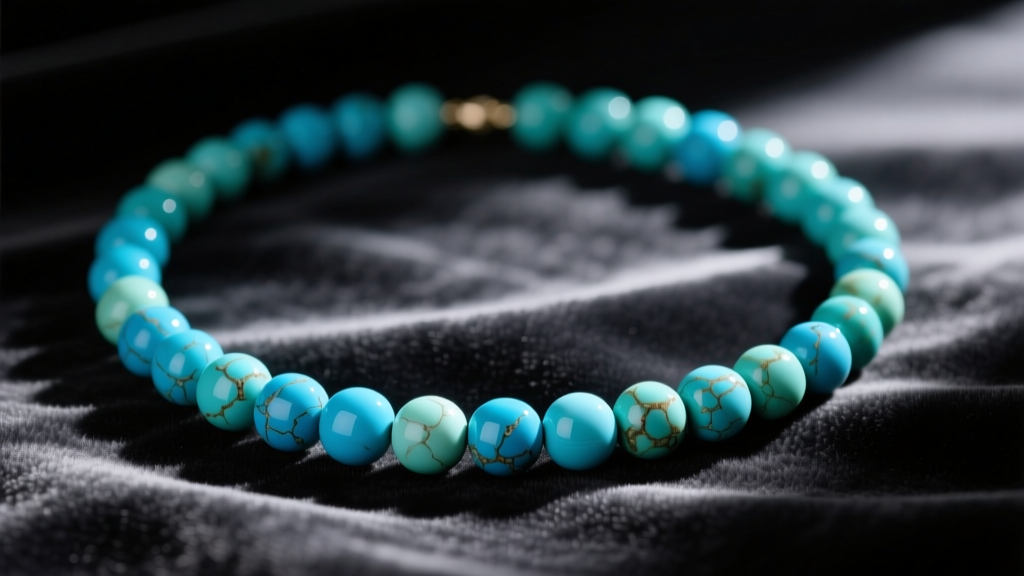
The market for turquoise jewelry is vast, but navigating the quality spectrum of turquoise beaded necklaces requires a gemological eye. Unlike faceted diamonds where the 4Cs provide a rigid framework, turquoise is an opaque, porous phosphate mineral that demands a nuanced understanding of origin, treatment, and structural integrity. Whether you are sourcing high-end collector pieces or designing durable everyday jewelry, understanding the technical specifications of turquoise beads is critical to making informed acquisitions.
The Anatomy of a Turquoise Bead: Natural vs. Treated
In its purest gemological form, turquoise is a hydrous phosphate of copper and aluminum (CuAl6(PO4)4(OH)8·4H2O). However, only about 10% to 15% of all turquoise mined globally is 'gem-grade'—meaning it possesses a Mohs hardness of 6 or higher and a low enough porosity to be cut, polished, and drilled without chemical intervention. The remaining 85% is too chalky or soft and requires stabilization.
Understanding Stabilization
Stabilization is not inherently a negative term; it is a necessary lapidary process for the majority of authentic turquoise. Under a vacuum chamber, soft turquoise is infused with a clear epoxy or acrylic resin (such as Opticon). This process permanently hardens the stone, enhances its natural color, and prevents it from absorbing oils, lotions, and sweat, which can cause untreated stones to turn a muddy green over time. When evaluating turquoise beaded necklaces, the key distinction is whether the stone has been stabilized (color preserved, structure hardened) or dyed (artificial color added). The Gemological Institute of America (GIA) notes that while stabilization is an accepted industry practice, dyed or reconstituted turquoise must be explicitly disclosed.
The Gemological Grading Scale for Turquoise Beads
Unlike diamonds, turquoise lacks a single, universally enforced global grading laboratory. However, the American turquoise market relies on a standardized alphabetical grading scale based on hardness, color saturation, and matrix (the host rock pattern). Below is the technical breakdown used by high-end lapidaries and wholesalers.
| Grade | Hardness (Mohs) | Treatment Status | Matrix Quality | Wholesale Price Range (per carat) |
|---|---|---|---|---|
| AAA (Gem) | 6.0 - 7.0 | Untreated / Natural | None or Perfect Spiderweb | $15.00 - $50.00+ |
| AA | 5.0 - 6.0 | Stabilized (Clear) | Tight, Aesthetic Webbing | $5.00 - $15.00 |
| A | 4.0 - 5.0 | Stabilized | Heavy or Asymmetrical Matrix | $1.50 - $5.00 |
| B / Chalk | 2.0 - 4.0 | Stabilized & Color-Enhanced | Often Dyed to Imitate AAA | $0.10 - $1.00 |
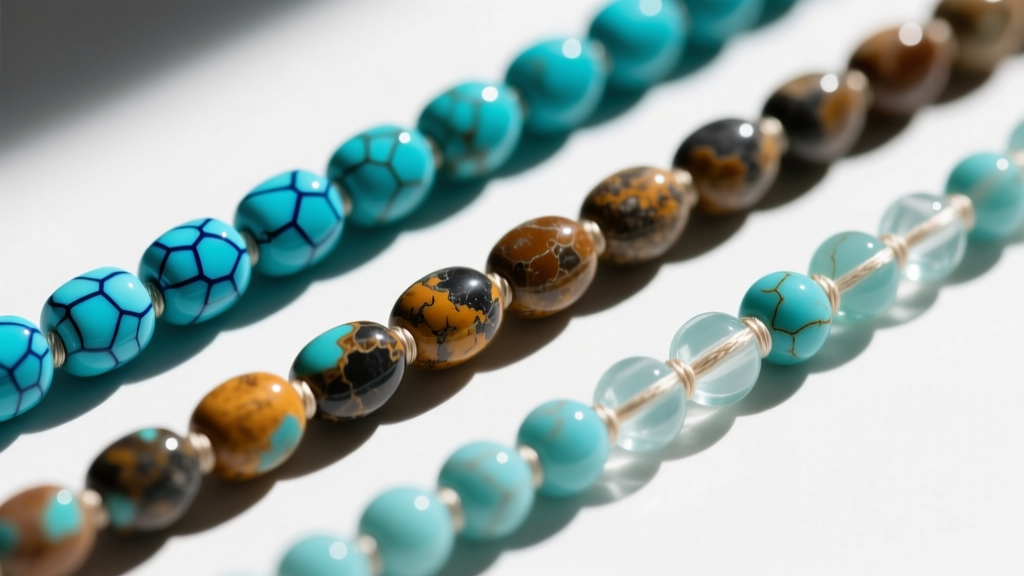 When examining turquoise beaded necklaces, pay close attention to the matrix. Stones from the Kingman mine in Arizona are prized for their tight, black 'spiderweb' matrix, while Royston (Nevada) stones often feature a heavy brown matrix. Conversely, the now-closed Sleeping Beauty mine produced a highly uniform, sky-blue turquoise with virtually no matrix, making perfectly matched, untreated Sleeping Beauty bead strands exceptionally rare and valuable in today's market.
Stringing Mechanics: Why Your Necklace Fails
The most common failure point in turquoise beaded necklaces is not the stone itself, but the stringing material. Turquoise is relatively soft and can feature microscopic, jagged edges inside the drill holes. If strung improperly, the beads will act like tiny saws, severing the cord over time.
Wire vs. Thread: Tensile Strength Data
For heavy turquoise beads (8mm and above), traditional silk thread is a structural liability. Silk degrades with moisture and lacks the shear strength to resist the abrasive interior of a turquoise drill hole. Professional jewelers rely on multi-strand stainless steel beading wires coated in nylon.
- 0.024-inch (49-strand) Wire: Offers a tensile strength of up to 40 lbs. Ideal for large, heavy turquoise nuggets or graduated bead designs. The 49-strand core provides maximum drape and flexibility.
- 0.019-inch (49-strand) Wire: The industry standard for 6mm to 10mm round turquoise beads. Balances tensile strength (approx. 30 lbs) with a soft, fabric-like drape.
- 0.014-inch (19-strand) Wire: Reserved for lightweight, 3mm to 5mm heishi (flat disc) turquoise beads. Tensile strength drops to roughly 15 lbs, making it unsuitable for heavy pendants.
To prevent the wire from snapping at the clasp connection, always use a French wire (also known as gimp or bullion) or a wire protector. This creates a smooth, metal-lined loop that prevents the sharp edge of the clasp jump ring from shearing the nylon-coated wire.
Identifying Fakes: Howlite, Magnesite, and Reconstituted Slag
Because high-grade turquoise commands premium prices, the market is flooded with imitations. As a buyer, you must be able to identify the three most common turquoise substitutes used in beaded necklaces.
1. Dyed Howlite and Magnesite
Howlite is a naturally white, porous borate mineral with grey veining that closely mimics turquoise matrix when dyed blue. Magnesite is a magnesium carbonate that takes dye exceptionally well. The Acetone Test: Rub a cotton swab soaked in pure acetone (nail polish remover) vigorously against a bead. If the swab turns blue, the stone is dyed. Natural and properly stabilized turquoise will not release color when exposed to acetone.
2. Reconstituted (Block) Turquoise
This material is created by grinding low-grade turquoise dust and chalk, mixing it with epoxy resins and dyes, and pressing it into blocks before cutting it into beads. It lacks the natural crystalline structure of genuine stone. The Hot Point Test: If you touch a red-hot needle to an inconspicuous area of the bead (like the inside of the drill hole), reconstituted turquoise will melt slightly and emit the acrid smell of burning plastic. Natural turquoise will not melt or smell.
3. Gilson Synthetic Turquoise
Created in a lab using the same chemical constituents as natural turquoise, Gilson stones are chemically identical but lack the natural host rock matrix. Under 10x magnification, Gilson turquoise exhibits a uniform, 'cream of wheat' granular texture that never occurs in natural geological formations.
Sizing, Drilling, and Bead Uniformity Tolerances
When sourcing turquoise beaded necklaces for fine jewelry design, dimensional tolerance is a critical metric of quality. Commercial-grade beads are often sold by the millimeter (e.g., '8mm round'), but actual caliper measurements can vary wildly from 7.2mm to 8.8mm within the same strand. This variance results in a necklace that looks uneven and poorly crafted.
Expert Lapidary Insight: Always inspect the drill holes of turquoise beads. High-quality beads are drilled from both ends to meet in the center, preventing 'blowout' (chipping) on the exit side. If the hole is jagged or conical, it indicates mass-production drilling that compromises the structural integrity of the bead.
Premium strands (AAA or AA grade) are calibrated to a strict tolerance of +/- 0.2mm. When designing a symmetrical necklace, always purchase 10% more beads than your calculated length to allow for culling misshapen or improperly drilled stones.
Care and Maintenance of Porous Gemstones
Even stabilized turquoise requires specific care protocols to maintain its optical properties. Turquoise is highly sensitive to sudden thermal shock and harsh chemicals. Ultrasonic cleaners, which use high-frequency sound waves and heat, can cause internal fractures in stabilized stones and strip the polish from natural gems. Steam cleaners will force moisture and chemical residues deep into the matrix, leading to irreversible discoloration.
To clean turquoise beaded necklaces, use only a soft, lint-free microfiber cloth slightly dampened with distilled water. Avoid commercial jewelry dips, ammonia, and chlorine, all of which can react with the copper content in the stone, causing it to oxidize and turn a dull, muddy brown. Store the necklace flat in a climate-controlled environment; hanging heavy turquoise strands for long periods can cause permanent stretching of the stringing wire and memory deformation of the nylon coating.


