Authenticating an Antique Murano Glass Bead Necklace: An Expert Guide
Learn how to authenticate, date, and restore an antique Murano glass bead necklace with our expert guide on millefiori, chevron, and sommerso techniques.

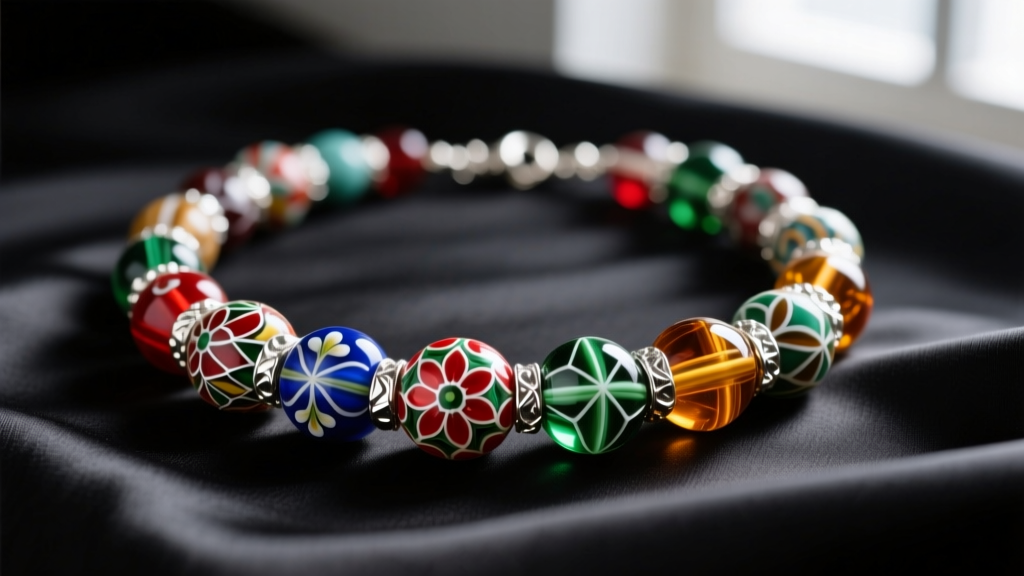
The allure of an antique Murano glass bead necklace extends far beyond its vibrant aesthetic. For collectors, historians, and master jewelers, these pieces are wearable archives of Venetian chemical and thermal mastery. However, the secondary market is currently saturated with mid-century reproductions and contemporary mass-produced imitations. Distinguishing a genuine 19th-century Salviati revival piece or a 16th-century trade bead from a modern factory replica requires a deep understanding of glass stratigraphy, pontil morphology, and historical restringing methods. In this expert deep dive, we dissect the technical anatomy of Venetian glass, providing you with the precise frameworks needed to authenticate, conserve, and value these historic jewels.
The Anatomy of Venetian Glass: Beyond the Murano Label
To accurately date an antique Murano glass bead necklace, one must first understand the geochemical composition of the glass itself. Historically, Venetian glassmakers utilized a soda-lime silica recipe, leveraging *barilla* (a plant ash imported from the Levant and Spain) as their primary flux. This composition differs significantly from the lead-heavy crystal formulations popularized in 18th-century England. Soda-lime glass possesses a lower specific gravity and a distinct refractive index, giving antique Murano beads their characteristic deep, liquid luminosity rather than the sharp, prismatic sparkle of lead crystal.
Furthermore, the term 'Murano' is a geographic indicator rooted in the 1291 decree that relocated Venice's glass furnaces to the island of Murano to mitigate fire risks. According to archival records preserved by the Corning Museum of Glass, the strict monopolization of glass recipes meant that the molecular signature of authentic antique beads often contains trace amounts of manganese and cobalt specific to the Venetian lagoon's historical supply chains. Modern reproductions, often manufactured in China or India, utilize synthetic fluxes and commercial colorants that fluoresce differently under shortwave UV light, providing a crucial diagnostic marker for gemologists.
Identifying Key Antique Glassmaking Techniques
Authenticating an antique Murano glass bead necklace requires identifying the specific thermal manipulation techniques employed by the *maestri vetrai* (master glassmakers). The three most prominent historical techniques are millefiori, chevron, and aventurine.
Millefiori and Murrine Cross-Sections
The *millefiori* (thousand flowers) technique involves the creation of *murrine*—multicolored glass canes fused together, stretched while molten, and sliced into thin discs. In genuine antique specimens, the cross-sections reveal microscopic asymmetries. Because the canes were stretched by hand using iron pincers, the floral or geometric patterns will exhibit slight warping, uneven color distribution, and tiny, naturally occurring air bubbles trapped within the silica matrix. Conversely, modern machine-extruded murrine exhibit perfect, sterile symmetry and lack the internal tension fractures visible under 10x loupe magnification.
Chevron (Rosetta) Bead Stratigraphy
Perhaps the most historically significant component of an antique Murano glass bead necklace is the chevron, or *rosetta*, bead. Developed in the late 15th century, these beads were drawn from molds featuring a 6-point, 8-point, or 12-point star. The glassmaker layered contrasting colors—typically white, blue, and red—into the star-shaped mold, encasing the core in a final layer of translucent or opaque glass.

The authentication of a chevron bead relies heavily on its stratigraphy and terminal grinding. Antique chevron beads were ground on a rotating stone wheel to expose the internal star points at the ends. This manual grinding results in slightly concave terminals and a matte, pitted texture around the bead holes. Modern replicas are often cast or machine-cut, leaving flat, perfectly polished terminals and sharp, uniform mold seams that are entirely absent in authentic drawn-cane Venetian glass.
Aventurine and Colloidal Inclusions
Often misidentified as 'goldstone,' authentic Venetian *avventurina* is a highly complex copper-colloid glass. The glassmaker introduces copper oxide into a reducing (carbon-rich) atmosphere, forcing microscopic metallic copper crystals to precipitate and align as the glass slowly cools. In an antique Murano glass bead necklace, aventurine beads will display a deep, brownish-red matrix with flashes of metallic gold that appear to possess depth and three-dimensional suspension. Imitation goldstone relies on uniform, flat metallic flecks that lack the organic, cloud-like distribution characteristic of historical crucible cooling.
Technical Authentication: Spotting Modern Reproductions
When evaluating a potential acquisition, systematic visual and tactile testing is paramount. The following diagnostic matrix outlines the primary differentiators between genuine antiques and later reproductions.
| Diagnostic Feature | Genuine Antique (Pre-1920) | Mid-Century Modern (1950-1980) | Contemporary Mass-Produced |
|---|---|---|---|
| Pontil Mark / Hole Finish | Rough, sharp, or hand-polished dimple; irregular hole diameter. | Flame-polished, slightly rounded; uniform hole. | Perfectly smooth, machine-drilled, uniform. |
| Mold Seams | Non-existent (beads are drawn, wound, or lampworked). | Non-existent. | Visible vertical seams from two-part press molds. |
| UV Fluorescence (365nm) | Inert or faint yellow/green (trace uranium/manganese). | Bright, uniform green (high uranium content). | Inert or chalky blue (modern optical brighteners). |
| Internal Inclusions | Asymmetric air bubbles, organic ash particles, tension lines. | Minimal bubbles, clean glass matrix. | Perfectly clear or uniform micro-bubbles. |
According to curatorial guidelines from the Victoria and Albert Museum, the presence of 'glass disease' (crizzling) can also aid in dating. Crizzling is a network of fine, silvery fractures caused by an imbalance in the alkali-silica ratio, often exacerbated by centuries of fluctuating humidity. While not present on all antique beads, its presence is a strong indicator of age, whereas modern beads are chemically stabilized to prevent this degradation.
Conservation and Restringing Protocols
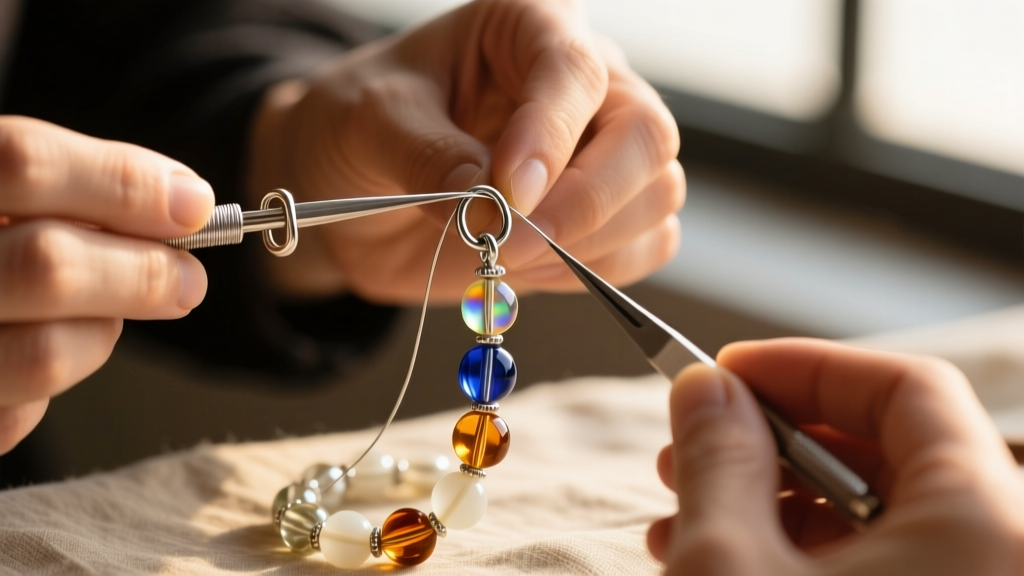
Restoring an antique Murano glass bead necklace requires specialized conservation techniques. The weight of solid glass beads, combined with the irregular, often sharp internal edges of antique bead holes, makes traditional silk thread entirely unsuitable. Silk will rapidly abrade and snap under the sheer mechanical load of a multi-strand Venetian necklace.
Wire Gauge and Material Selection
Master jewelers recommend using a multi-strand, nylon-coated stainless steel or titanium beading wire. For heavy chevron or large millefiori beads, a 0.024-inch (0.61mm) gauge is mandatory to prevent kinking and structural failure. The nylon coating must be verified for UV resistance to prevent yellowing and embrittlement over time.
Terminal Protection and Clasp Integration
Because antique beads lack the uniform holes of modern gemstones, the wire is highly susceptible to metal fatigue at the clasp junction. To mitigate this, the following protocol must be employed:
- French Wire (Gimp): A microscopic coiled wire applied over the beading wire at the clasp loop to prevent the silver or gold clasp from sawing through the nylon coating.
- Wire Protectors: Sterling silver or gold-filled horseshoe wire protectors should be used in conjunction with gimp to distribute the tension load evenly.
- Crimp Tubes vs. Bead Tips: Avoid traditional clamshell bead tips, which can crush under the weight of glass. Instead, use 2x2mm sterling silver crimp tubes, flattened with a micro-crimping tool to create a secure, folded barrel that mimics a seamless metal bead.
Market Valuation and Provenance Tracking
The valuation of an antique Murano glass bead necklace is dictated by era, technique, and documented provenance. As of the 2026 auction season, the market has seen a distinct bifurcation. Generic, unattributed 19th-century trade beads remain accessible, typically trading between $150 and $400 depending on condition and strand length. However, pieces attributed to specific historical glassmaking dynasties command significant premiums.
Provenance is the ultimate multiplier in Venetian glass. A necklace documented in a 1920s Pauly & C. or Venini catalog can eclipse the $5,000 threshold, while an identical, undocumented strand may struggle to reach $800 at private sale.
Collectors must be wary of 'composite' necklaces—assemblages created by mid-century dealers who strung together loose, mismatched antique beads to maximize profit. A genuine antique necklace will exhibit uniform wear patterns, consistent hole abrasion, and historically accurate spacer materials, such as oxidized silver foil or hand-cut bone, rather than modern plastic or machine-stamped brass. For high-value acquisitions, always consult Sotheby's or specialized European decorative arts appraisers to verify the thermal and historical integrity of the piece before finalizing the transaction.


