Fake vs Real: Troubleshooting Your Clover Necklace Designer Piece
Learn how to authenticate a clover necklace designer piece, troubleshoot common material flaws like malachite discoloration, and verify 18k gold hallmarks.

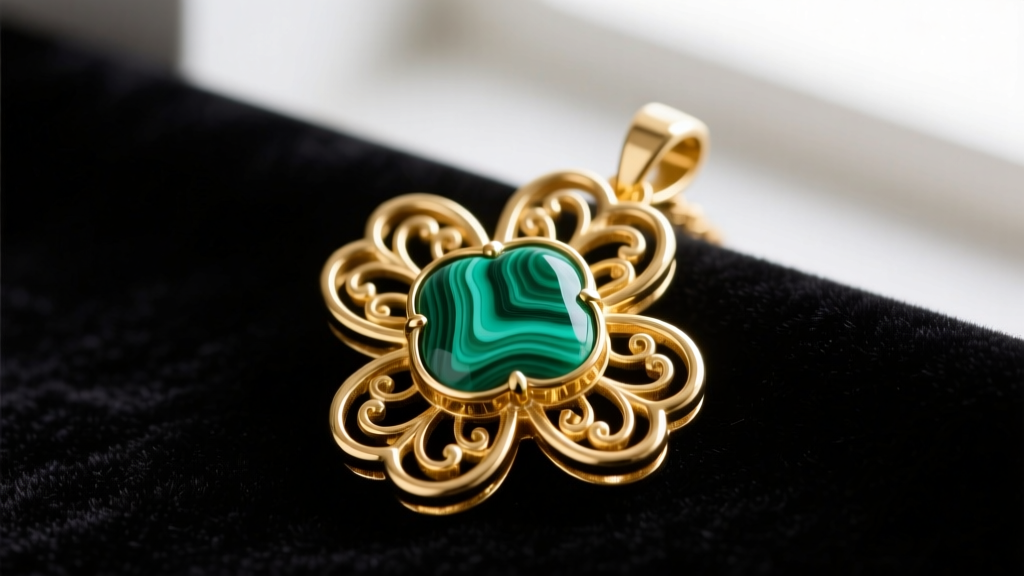
The 2026 Counterfeit Crisis: Why Super-Fakes Are Fooling Buyers
The iconic four-leaf clover motif has remained a dominant force in luxury jewelry for decades. However, as we navigate 2026, the secondary market for a clover necklace designer piece is flooded with "super-fakes." Unlike the clumsy counterfeits of the early 2010s, today's illicit manufacturers utilize CNC milling and 3D resin printing to replicate the exact dimensions, milgrain beading, and weight of authentic pieces. For buyers, estate liquidators, and even seasoned jewelers, visual inspection is no longer sufficient. Troubleshooting the authenticity and structural integrity of these necklaces requires a deep dive into metallurgical hallmarks, gemological diagnostics, and hardware engineering.
This guide provides a rigorous, problem-solving framework to authenticate, diagnose, and troubleshoot the most common issues associated with high-end clover pendant necklaces.
Metallurgical & Hallmark Troubleshooting
The foundation of authentication begins with the gold. Authentic luxury clover necklaces are almost exclusively crafted in 18k gold (75% pure gold). Counterfeiters often use 14k gold, gold-plated brass, or tungsten cores to mimic the specific gravity of 18k gold.
The Maker's Mark and the Eagle Head
French luxury houses are bound by strict assay laws. When examining the clasp or the small tag attached to the chain, you must look for two distinct stamps:
- The Maker's Mark (Poinçon de Maître): This is a diamond-shaped (losange) stamp containing the maison's initials and a specific symbol (often a star or a wing). On fakes, this stamp is frequently laser-etched rather than struck with a die, resulting in shallow, fuzzy edges under a 10x loupe.
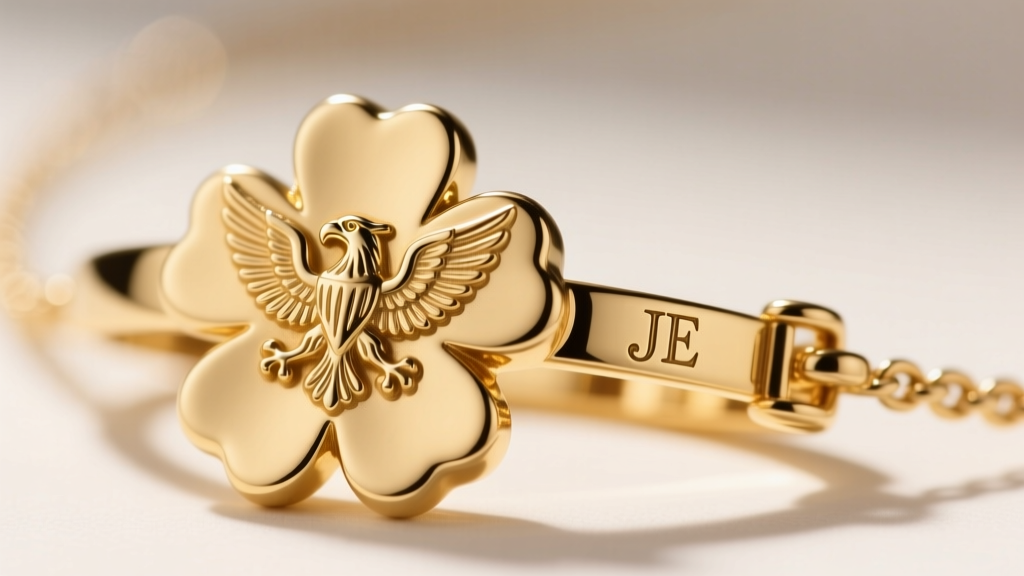
- The Tête d'Aigle (Eagle Head): The official French state hallmark for 18k gold. The eagle head must face right, with crisp, defined feathers. A common failure point in counterfeit pieces is a blurred or "melted" looking eagle, caused by casting the hallmark into the mold rather than stamping it post-casting.
Serial Number Placement and Font Diagnostics
Authentic pieces feature a unique serial number. Historically, these were engraved on a small, flat 18k gold tag soldered near the clasp. In modern iterations, the serial number may be micro-engraved on the clasp itself or the pendant's reverse bezel. The format typically begins with two letters (e.g., "JE") followed by six digits. Troubleshooting tip: If the serial number is deeply laser-etched into the back of the stone itself, or if the font features serifs (authentic sans-serif block lettering is standard), the piece is highly suspect. You can cross-reference hallmark standards via the Jewelers Vigilance Committee.
Gemological Diagnostics: Identifying Authentic Stones
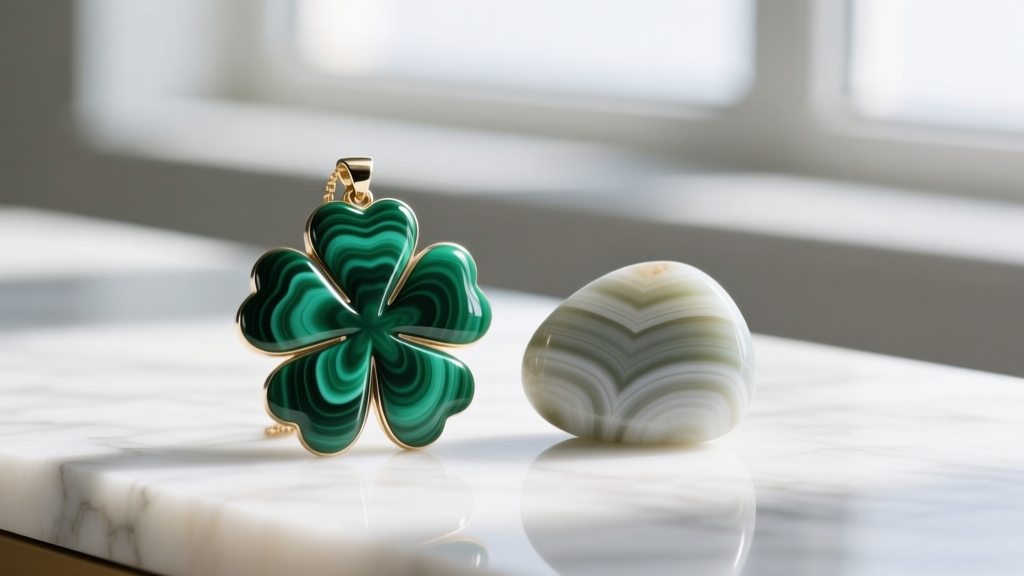
The most common materials used in clover motifs are Malachite, Mother-of-Pearl (MOP), Onyx, and Carnelian. Because these are natural, organic, or porous stones, they possess distinct gemological properties that synthetic substitutes cannot perfectly replicate.
| Material | Authentic Characteristics | Common Counterfeit Substitutes | Troubleshooting Test |
|---|---|---|---|
| Malachite | Irregular, non-repeating green banding; high porosity; cold to touch. | Dyed howlite, painted resin, or synthetic glass. | Check for dye concentration in surface cracks using a 20x loupe. |
| Mother-of-Pearl | Deep iridescence (orient); visible overlapping aragonite platelets. | Opaque white plastic, coated glass, or bleached low-grade shell. | Observe under polarized light; plastic will lack the "chatoyant" flash. |
| Onyx | Uniform, deep, light-absorbing black; high specific gravity. | Dyed black agate, black glass, or black epoxy resin. | Thermal conductivity test; glass/resin warms faster than natural chalcedony. |
| Carnelian | Translucent edges; rich reddish-orange with subtle clouding. | Dyed agate or uniform orange glass. | Backlight the stone; dyed agate shows dye streaks along crystal fractures. |
Malachite: The Porosity Problem
Malachite is a copper carbonate hydroxide mineral. It is notoriously soft (3.5 to 4 on the Mohs scale) and highly porous. A frequent troubleshooting complaint from buyers is that their malachite clover pendant has developed white, crusty spots or lost its polish. This is almost always chemical damage. Malachite reacts violently to acids, including the lactic acid in human sweat, citrus-based perfumes, and cosmetic lotions. If you are evaluating a vintage piece with "cloudy" malachite, it has suffered acid etching. This cannot be buffed out at home; it requires professional lapidary repolishing by the original maison, which removes a micro-layer of the stone.
Mother-of-Pearl: Clouding and Delamination
MOP is composed of calcium carbonate. Like malachite, it is vulnerable to acid. However, a unique failure mode in counterfeit MOP pendants is delamination. Fakes often use a thin veneer of cheap shell glued over a plastic or resin core. Over time, body heat and humidity degrade the adhesive, causing the shell to lift or "bubble" at the bezel edge. Authentic MOP is cut from a solid, thick piece of shell and will never delaminate. For advanced gemological identification techniques, refer to the Gemological Institute of America (GIA) resources on organic gems.
Hardware Failures: Clasps, Chains, and Bezel Issues
Beyond the stones and gold purity, the mechanical hardware offers critical clues to authenticity and longevity.
The Milgrain Beading
The gold border surrounding the stone features a delicate beaded edge (milgrain). On authentic pieces, this beading is applied using a specialized knurling tool or hand-finished, resulting in perfectly spherical, evenly spaced beads. On cast counterfeits, the beads are part of the mold. Under magnification, cast beads look slightly flattened, irregular, or "melted" together. If the beading feels sharp or catches on silk fabrics, it is a hallmark of poor finishing, common in unauthorized replicas.
Clasp Mechanisms and Safety Catches
High-end clover necklaces utilize specific clasp mechanisms based on their era. Vintage pieces (pre-2010s) often feature a spring-ring clasp, while modern iterations use a custom-engineered lobster clasp. A major troubleshooting red flag is the presence of a figure-8 safety catch on a modern lobster clasp; the maison typically relies on the precision tension of the lobster lever itself, without redundant safety wires. Furthermore, the chain links (usually a specialized cable or box chain) should be laser-welded at the seams. If you can see a visible solder seam that is discolored or slightly open, the chain has either been poorly repaired or is a generic aftermarket replacement.
Expert Verification Checklist
When troubleshooting a potential purchase or diagnosing a damaged piece, run through this definitive checklist:
- Weight & Dimensions: A standard Vintage Alhambra pendant measures exactly 15mm across. Super-fakes often measure 14.5mm or 15.5mm due to mold shrinkage or poor CAD modeling.
- Bezel Flush: The stone must sit perfectly flush with the gold bezel. Run a fingernail over the edge; any catching indicates the stone was poorly calibrated or the bezel was pushed down unevenly.
- Reverse Engraving: The back of the pendant should feature crisp, deep engraving of the patent numbers, metal purity, and maison logo. Fakes often use shallow laser etching that looks grey rather than bright gold.
- UV Fluorescence: Under long-wave UV light, natural onyx and MOP will generally show no reaction or a faint, natural glow. If the stone glows brightly, it indicates the presence of synthetic resins or polymer fillers used to stabilize low-grade stones.
Conclusion
Troubleshooting a clover necklace designer piece requires looking past the iconic silhouette and examining the microscopic details. From the precise geometry of the milgrain beading to the gemological realities of porous malachite, the evidence of authenticity—and the root causes of material damage—is always present. By utilizing proper magnification, understanding French assay marks, and recognizing the chemical vulnerabilities of organic stones, you can confidently navigate the secondary market and preserve the structural integrity of these horological and jewelry masterpieces for decades to come.


