How to Authenticate and Restore a Necklace with Jade
Learn how to authenticate, clean, and maintain your necklace with jade. Expert guide on Type A vs B/C jadeite, restringing, and safe care.

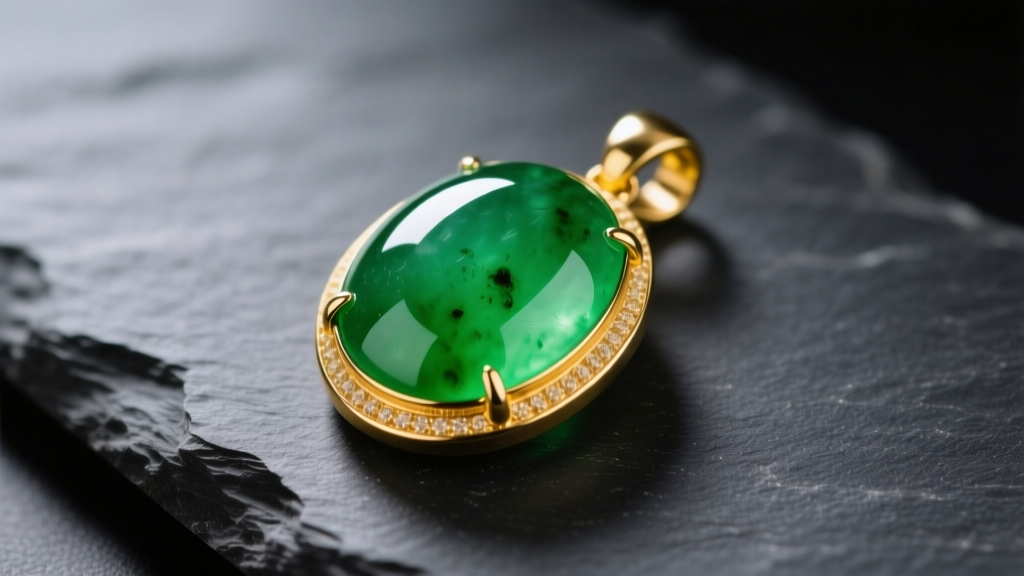
The Gemological Reality of Jade in 2026
When investing in a necklace with jade, you are navigating one of the most complex and historically significant gemstone markets in the world. Unlike single-crystal gems like diamonds or sapphires, jade is a microcrystalline aggregate. This means it is composed of millions of interlocking fibers, giving it extraordinary toughness (resistance to breaking) but a moderate Mohs scratch hardness of 6.5 to 7.0. In the 2026 gemological market, advanced nano-resins and synthetic dyes have made treated jade increasingly difficult to identify without specialized equipment. Understanding the exact composition and treatment grade of your jade pendant or bead strand is the first step in proper long-term care.
Jadeite vs. Nephrite: Know Your Material
Before applying any cleaning or restoration techniques, you must identify which of the two minerals you own. According to the Gemological Institute of America (GIA), both are classified as jade, but their chemical structures differ vastly:
- Jadeite (NaAlSi2O6): Harder, more translucent, and capable of achieving the highly prized 'Imperial Green' hue. Specific gravity ranges from 3.30 to 3.38.
- Nephrite (Ca2(Mg,Fe)5Si8O22(OH)2): Softer, more opaque, and typically found in muted greens, whites, or blacks. Specific gravity is lower, around 2.95.
Jadeite is far more susceptible to polymer degradation if treated, making authentication critical before you attempt any ultrasonic or chemical cleaning.
Decoding the Treatment Spectrum: Type A, B, and C
The structural integrity of your necklace dictates its cleaning protocol. The jade industry categorizes treatments into three distinct tiers, as outlined by authoritative gemological labs like Mason-Kay Fine Jade Jewelry.
Type A (Natural): Untreated except for surface waxing. This is the only type of jade that holds long-term investment value and can withstand traditional cleaning methods.
Type B (Bleached & Polymer-Impregnated): Acid-washed to remove brown inclusions, then injected with epoxy resin to restore translucency.
Type C (Dyed): Chemically colored. The dye often concentrates in the microscopic fractures between the interlocking crystals.
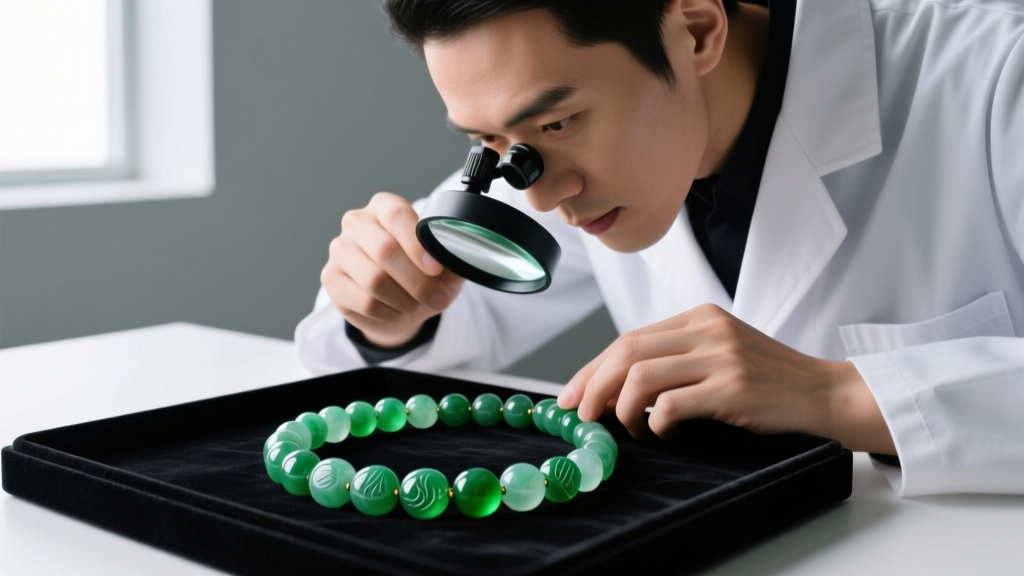
Step-by-Step Home Authentication Protocol
While a certified gemologist should always provide the final verdict, you can perform these non-destructive tests at home to assess a vintage or inherited necklace:
- The 10x Loupe Surface Test: Examine the surface of the jade cabochon or bead. Type A jade will show minor, natural polishing lines. Type B jade will often exhibit a 'spiderweb' or 'chipped paint' texture caused by acid etching.
- UV Fluorescence Test: Shine a long-wave (365nm) UV flashlight on the beads in a dark room. Natural Type A jade is generally inert or shows weak, patchy fluorescence. Type B jade will often glow with a strong, uniform whitish-blue due to the polymer resins.
- The Thermal Conductivity Test: Hold the jade against your cheek. Natural jade has high thermal inertia; it will feel distinctly cold and take longer to warm to your body temperature than glass or plastic imitations.
Safe Cleaning Frameworks for Jade Necklaces
The most common failure mode for jade jewelry is improper cleaning. Because jade is an aggregate, harsh chemicals can seep into the microscopic grain boundaries, causing irreversible discoloration or structural weakening. Below is a definitive guide to cleaning agents.
| Cleaning Agent | Safety for Type A Jade | Safety for Type B/C Jade | Notes & Failure Modes |
|---|---|---|---|
| Mild Dish Soap & Distilled Water | Safe | Safe | Use a soft baby-hair brush. Never scrub aggressively. |
| Ultrasonic Cleaners | Risky | Destructive | High-frequency vibrations can shatter the polymer bonds in Type B jade and cause micro-fractures in Type A. |
| Steam Cleaners | Destructive | Destructive | Thermal shock will cause severe cracking. Heat melts polymer resins. |
| Alcohol / Acetone | Safe | Destructive | Solvents will dissolve the epoxy in Type B jade, leaving it porous and chalky. |
The Proper Step-by-Step Wash
To clean a natural Type A necklace with jade, mix three drops of pH-neutral baby shampoo into a bowl of lukewarm distilled water. Submerge the necklace for exactly five minutes. Gently agitate the water. Use a clean, ultra-soft makeup brush to lightly sweep the crevices around the gold or silver settings. Rinse under a slow stream of distilled water and pat dry with a lint-free microfiber cloth. Never air-dry, as hard water spots can etch into the wax coating of the jade over time.
Restringing and Cord Maintenance
Many traditional jade pendants and bead strands are strung on silk or nylon cords rather than metal chains. Human sweat has a slightly acidic pH (typically 4.5 to 5.5), which degrades natural silk fibers rapidly. If you wear your jade necklace daily, the cord must be inspected and restrung regularly to prevent catastrophic failure and loss of the gemstone.
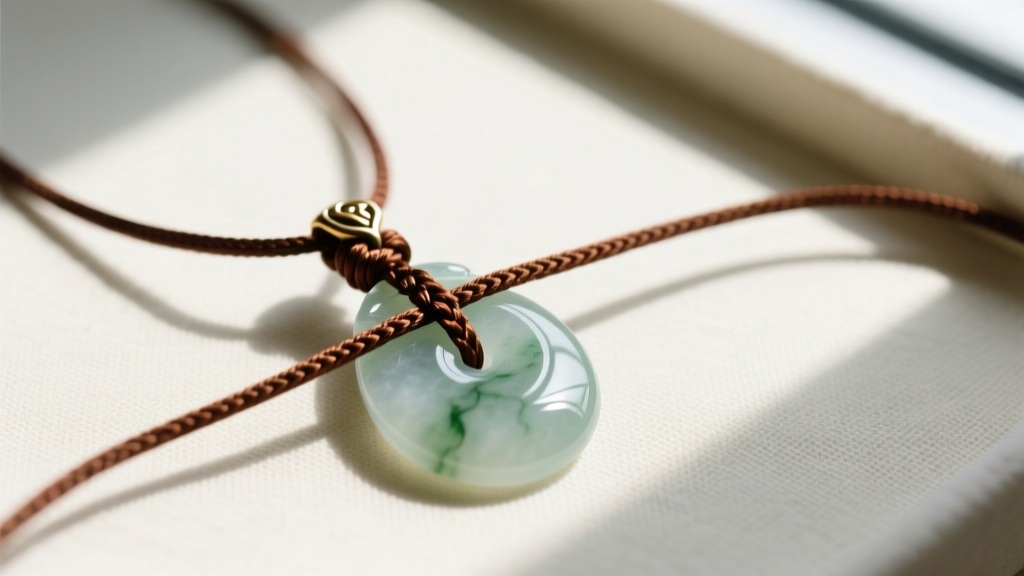
When to Restring: The 12-Month Rule
As a strict rule of thumb, a jade bead necklace worn against the skin should be restrung every 12 to 18 months. Inspect the cord by gently pulling the beads apart to expose the hidden sections of the string. If the silk appears frayed, darkened, or loses its elasticity, it is at immediate risk of snapping. When restringing, opt for braided nylon or treated silk, which offers superior resistance to moisture and UV degradation while maintaining the traditional drape required for heavy jadeite cabochons.
Environmental Storage and Prevention
Jade's toughness makes it resistant to chipping, but its 6.5 Mohs hardness makes it highly vulnerable to scratching. When storing your necklace, never toss it into a communal jewelry box. Diamonds (Mohs 10), sapphires (Mohs 9), and even quartz (Mohs 7) will easily scratch the polished surface of a jade pendant, leaving dull, white abrasions that require professional lapidary re-polishing to fix. Always store your jade necklace in a dedicated, fabric-lined compartment or a soft suede pouch, entirely separated from harder gemstones and metal chains.


