Troubleshooting Your Roman Necklace: Authenticity & Care
Learn how to authenticate, clean, and repair your Roman necklace. Expert troubleshooting for bronze disease, coin pendants, and glass bead integrity.

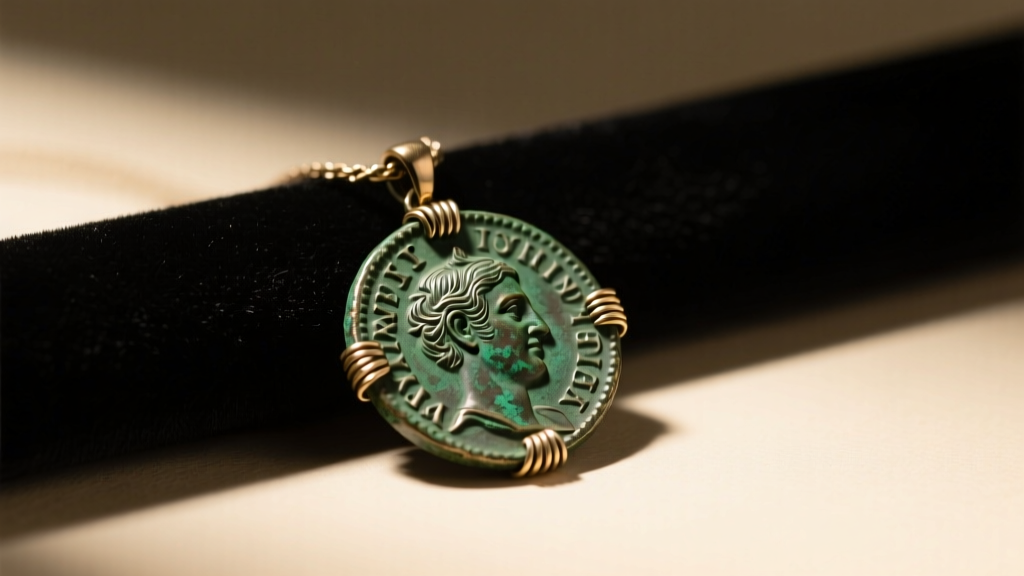
Owning an authentic roman necklace is a unique privilege that bridges the gap between ancient history and modern personal adornment. Whether your piece features a bronze bulla (an amulet worn by freeborn children), intricate millefiori glass beads, or a silver denarius coin pendant, these artifacts carry millennia of human history. However, integrating ancient materials into wearable jewelry introduces a host of structural and chemical challenges. As of 2026, the market for ancient jewelry has seen a surge in high-quality 3D-printed and laser-cast replicas, making authentication more difficult than ever. Furthermore, the chemical instability of ancient alloys and the devitrification of Roman glass require specialized conservation techniques that standard jewelers often misunderstand.
This guide provides a comprehensive, expert-level troubleshooting framework for authenticating, stabilizing, and repairing your ancient or replica Roman necklaces, ensuring they survive for generations to come.
The 2026 Replica Market: Spotting Fake Roman Coin Pendants
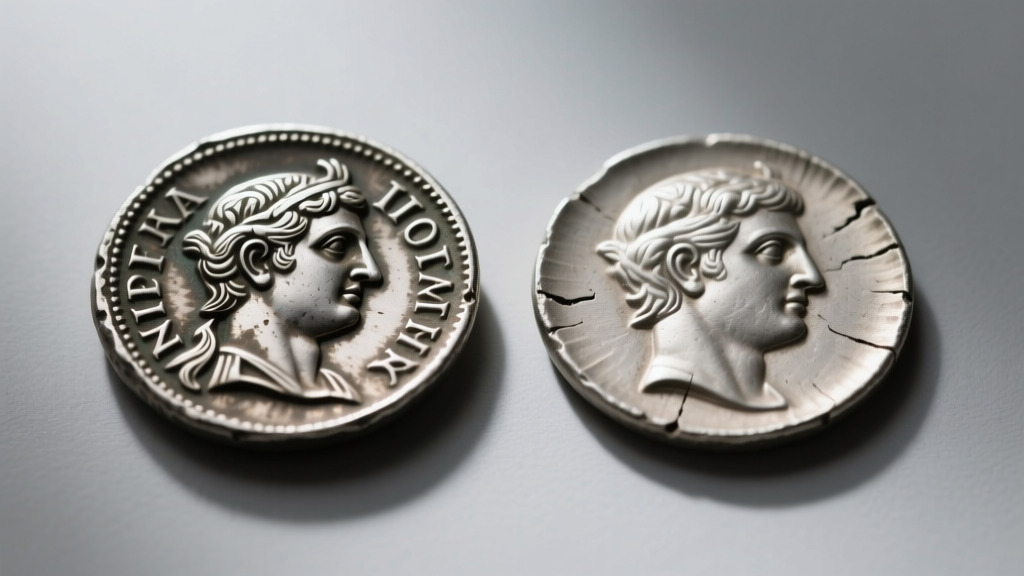
The most common centerpiece in a roman necklace is a silver denarius or bronze sestertius. Unfortunately, the secondary market is flooded with "tourist replicas" artificially aged and sold as genuine antiquities. To troubleshoot authenticity, you must look beyond the surface patina and examine the manufacturing mechanics of the coin itself.
- Strike Marks vs. Casting Seams: Genuine Roman coins were struck using hammered dies. This process forces metal outward, creating sharp details, flow lines, and occasionally off-center strikes or edge cracks. Cast replicas, conversely, are poured into molds. Look closely at the edge of the coin for a thin, raised casting seam—a definitive red flag.
- Detail Mushiness: Under 10x magnification, cast fakes often exhibit "mushy" or rounded details, particularly in the hair of the emperor or the lettering. Tiny spherical pits (gas bubbles trapped during casting) are also common in fakes but impossible in struck coins.
- Specific Gravity Testing: A silver denarius from the early Empire (e.g., Augustus or Nero) should weigh between 3.5 and 4.0 grams. If your coin pendant feels unusually heavy or light, it may be a modern alloy. The Numismatic Guaranty Company (NGC) provides excellent resources on understanding ancient coin weight standards and debasement timelines.
If you suspect your coin pendant is a modern forgery, avoid harsh chemical dips, as these will strip the artificial toning and expose the bright, modern metal underneath, instantly destroying its perceived value.
Troubleshooting "Bronze Disease" on Metal Components
Perhaps the most urgent threat to a bronze or copper-alloy roman necklace is "bronze disease." This is not a natural patina, but an active, destructive chemical reaction. When cuprous chloride (CuCl) present in the buried metal reacts with atmospheric moisture, it forms hydrochloric acid, which eats away at the metal in a continuous, self-propagating cycle.
"Failure to identify and halt bronze disease will result in the complete pulverization of the artifact. It is the single greatest threat to excavated copper-alloy jewelry." — Getty Conservation Institute Guidelines on Metal Antiquities.
Diagnosing the Threat: Patina vs. Disease
| Characteristic | Stable Patina (Safe) | Active Bronze Disease (Danger) |
|---|---|---|
| Color | Dark green, malachite, or deep azurite blue | Bright, pale, powdery mint-green |
| Texture | Smooth, hard, sometimes glossy or crystalline | Fuzzy, bubbly, powdery, easily scraped off |
| Progression | Stable; protects the underlying metal | Spreads rapidly in high humidity; pits the metal |
Step-by-Step Stabilization Protocol
If you identify active bronze disease on your necklace's bronze beads or coin bezels, immediate intervention is required. Do not use commercial silver or copper polishes, as they contain abrasives and ammonia that will accelerate the corrosion.
- Mechanical Removal: Under magnification, use a bamboo skewer or a soft brass brush to gently pick away the powdery green pustules. Bamboo is hard enough to remove the corrosion but softer than the surviving bronze, preventing scratches.
- Chemical Stabilization: Apply a 3% solution of Benzotriazole (BTA) dissolved in ethanol using a fine cotton swab. BTA acts as a corrosion inhibitor, bonding with the copper ions to halt the chloride reaction. Allow it to dry completely.
- Sealing: Once stabilized, seal the metal with a microcrystalline wax, such as Renaissance Wax. This creates a moisture barrier, preventing atmospheric humidity from reactivating any residual chlorides.
Structural Failures: Wire Wrapping Fragile Glass Beads
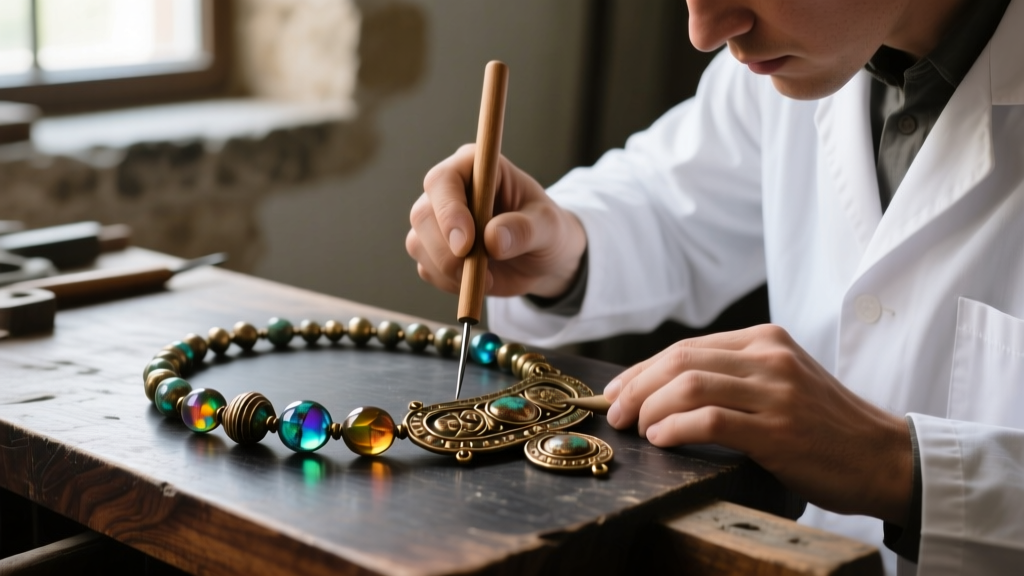
Ancient Roman glass—particularly the highly prized melon beads and millefiori slices—undergoes a process called devitrification over centuries. The glass slowly crystallizes, resulting in the beautiful, iridescent "oil slick" finish collectors love. However, this iridescence is actually a sign of structural degradation. The glass becomes incredibly brittle and prone to flaking.
When restringing or wire-wrapping a roman necklace featuring these beads, modern jewelry techniques often cause catastrophic failure.
The Danger of Hard Metals
Never use steel, hard brass, or standard sterling silver wire to wrap ancient glass. These metals have a higher tensile strength and hardness than the devitrified glass. As the necklace moves and flexes during wear, the hard wire will act like a saw, slowly cutting through the fragile bead hole and eventually snapping the bead in half.
The Solution: Dead-Soft Argentium and Pure Copper
To troubleshoot this structural vulnerability, you must use metals that are softer than the glass.
- 24-Gauge or 26-Gauge Dead-Soft Wire: Opt for dead-soft pure copper or Argentium silver. Argentium is highly tarnish-resistant and exceptionally malleable in its dead-soft state.
- Friction Reduction: Before threading, coat your wire in a microscopic layer of natural beeswax. This reduces friction inside the bead hole, preventing the wire from catching on microscopic glass crystals and causing internal fractures.
- Looping Technique: When creating wrapped loops, never pull the wire tight against the bead. Leave a 1mm "breathing room" collar of wire around the hole to absorb lateral shock and prevent the glass from cracking under pressure.
Sourcing Historically Accurate Findings
A common aesthetic mistake when restoring a roman necklace is pairing ancient components with modern, mass-produced findings. Attaching a genuine 2,000-year-old bronze amulet to a modern cable chain with a lobster clasp creates a jarring visual dissonance and can actually damage the ancient piece due to the high tensile strength of modern steel chains.
For authentic restoration, seek out specialized historical jewelers who forge penannular rings (incomplete circles that act as tension clasps) or hand-drawn bronze chain links. The The Metropolitan Museum of Art offers extensive digital archives of ancient Greek and Roman jewelry, providing excellent visual references for historically accurate clasp mechanisms and chain weaves, such as the intricate loop-in-loop chains used by Roman patricians.
Conclusion: Preserving the Past
Troubleshooting and maintaining a roman necklace requires a shift in mindset from traditional jewelry care to archaeological conservation. By rigorously authenticating your coin pendants, aggressively treating bronze disease with BTA, and utilizing soft-gauge wires to protect devitrified glass, you ensure that your piece remains both structurally sound and historically intact. Treat your ancient necklace not just as an accessory, but as a fragile artifact that requires informed, proactive stewardship to survive the modern world.


