Authenticating a Vintage Crescent Moon Necklace: An Expert's Guide
Learn how to authenticate, date, and value a vintage crescent moon necklace with our expert guide on hallmarks, metallurgy, and historical eras.

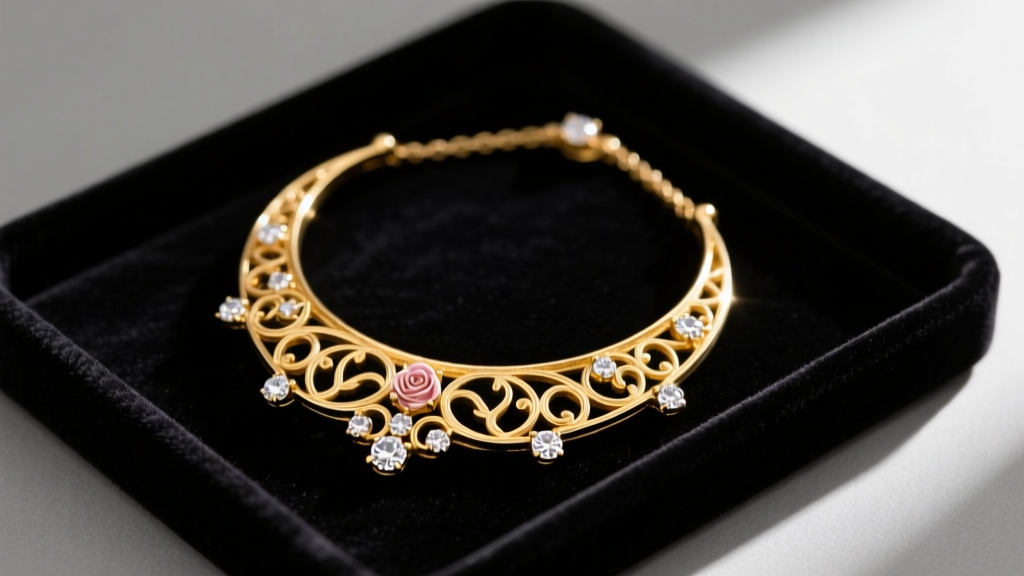
The celestial motif has captivated jewelry designers for centuries, but few pieces carry the historical weight and technical nuance of a genuine vintage crescent moon necklace. As we navigate the 2026 antique jewelry market, the proliferation of high-quality reproductions has made authentication more critical than ever. Distinguishing a true late-Victorian or Art Deco artifact from a modern homage requires a deep understanding of historical metallurgy, hallmarking laws, and period-specific construction techniques. This expert deep dive will equip you with the technical frameworks necessary to evaluate, date, and value lunar pendants and chains with absolute precision.
The Historical Evolution of Lunar Motifs in Jewelry
To accurately date a vintage crescent moon necklace, one must first understand the stylistic shifts across the three major eras of antique jewelry production. The crescent moon was not merely a decorative choice; it was heavily tied to cultural movements, astronomical events, and shifting gender norms.
The Victorian Celestial Craze (1837–1901)
The late Victorian era saw a massive surge in celestial jewelry, driven by a renewed public interest in astronomy and the romanticization of the night sky. Crescents from this period are typically characterized by their organic, slightly asymmetrical curves. They were frequently adorned with rose-cut or old mine-cut diamonds, set in closed-back foil settings to maximize candlelight reflection. The moon was often depicted with a subtle, stylized profile or surrounded by intricate gold beadwork (cannetille).
Art Nouveau and the Lunar Goddess (1890–1910)
During the Art Nouveau movement, the crescent moon became deeply intertwined with the motif of the lunar goddess and the feminine mystique. Pendants from this era often feature sinuous, whip-like curves and incorporate plique-à-jour enamel—a technically demanding technique where translucent enamel is suspended in a metal framework without a backing, resembling stained glass. Finding an intact Art Nouveau enamel crescent is exceptionally rare today due to the inherent fragility of the material.
Art Deco Geometry (1920–1935)
The Art Deco period stripped away the organic romance of previous eras, replacing it with stark geometry. A vintage crescent moon necklace from the 1920s will often feature a highly stylized, rigid arc. Designers utilized platinum and white gold, contrasting the stark white metals with calibre-cut sapphires, rubies, or onyx. The milgrain detailing on these pieces is a crucial diagnostic tool; authentic Deco milgrain is hand-applied with a knurling tool, resulting in slightly irregular, crisp beads, whereas modern reproductions often feature cast or laser-applied milgrain that appears overly uniform and soft.
Metallurgy and Material Analysis
The alloy composition of the chain and pendant bail provides some of the most reliable data points for authentication. Modern jewelry is predominantly cast in 14k or 18k gold, but historical pieces tell a different metallurgical story.
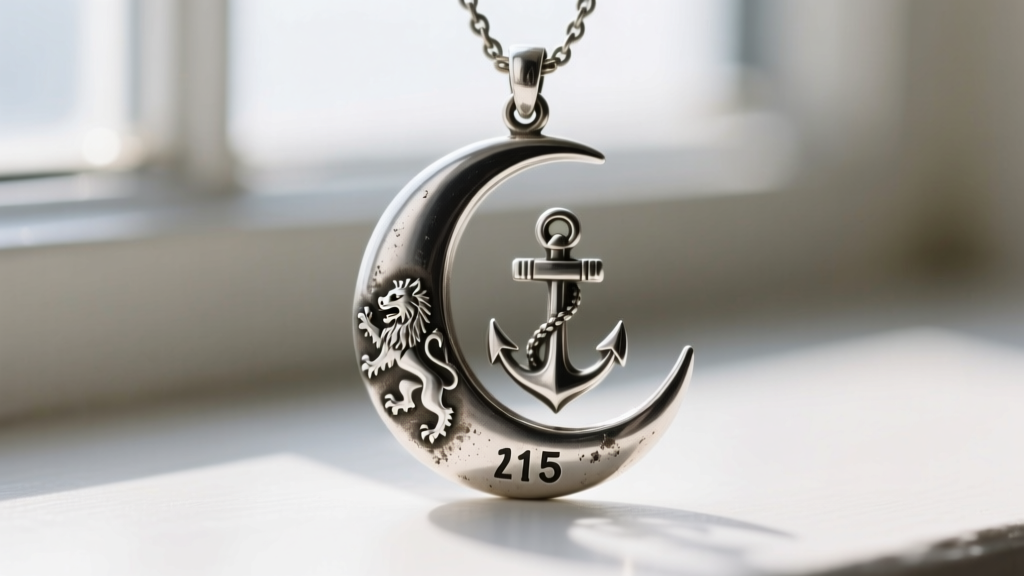
- 15k Gold (The British Standard): If you are examining a British piece, the presence of 15k gold is an immediate indicator of a pre-1932 origin. The UK assay offices recognized 15k gold (62.5% pure gold) from 1854 until 1932, when it was replaced by the 14k standard. 15k gold has a distinct, slightly brassy hue compared to 14k and 18k, and it develops a unique patina over a century of wear.
- Silver Standards and Tarnish Profiles: Victorian silver crescents were often crafted in Britannia silver (95.8% pure) or early Sterling (92.5%). Authentic antique silver tarnish (silver sulfide) tends to form in deep, uneven layers, particularly in the recesses of the engraving. Modern artificially oxidized silver often looks uniformly dark and lacks the complex, multi-tonal oxidation seen on century-old pieces.
- Platinum vs. White Gold: In the 1920s, platinum became the metal of choice for high-end Art Deco pieces. However, early white gold (an alloy of gold, nickel, and zinc) was introduced as a cheaper alternative. Under a 10x loupe, platinum will show microscopic drag marks from hand-polishing, while early white gold may show slight porosity from early casting methods.
Hallmarks, Maker's Marks, and Authentication
A hallmark is the fingerprint of a vintage crescent moon necklace. However, relying solely on hallmarks is a novice mistake, as marks can be faked or transplanted from damaged pieces onto new chains (a practice known as "marriage"). Always cross-reference the hallmark with the construction of the piece.
"When evaluating a Victorian pendant, the wear pattern around the bail must match the wear on the hallmark. If the hallmark is crisp but the bail is worn paper-thin, you are likely looking at a later reproduction or a re-cast piece." — Master Appraiser Guidelines, The London Assay Office.
Diagnostic Hallmarking Table
| Era / Region | Primary Metal | Key Hallmark Indicators | Clasp / Finding Type |
|---|---|---|---|
| Victorian (UK) | 15k Gold / Silver | Crown (Gold), Lion Passant (Silver), Date Letter | Simple 'C' clasp, no safety catch |
| Art Nouveau (France) | 18k Gold / Silver | Eagle Head (Gold), Boar Head or Crab (Silver) | 'C' clasp, early trombone catch |
| Art Deco (US/UK) | Platinum / 14k White Gold | No US marks (rely on maker's mark); UK Platinum marks began 1975 | Safety catch with locking mechanism |
Condition Reports: Assessing Wear and Structural Integrity
When appraising a vintage crescent moon necklace, structural integrity heavily influences both value and wearability. Antique chains and pendants have endured decades of friction, environmental exposure, and occasional repairs.
The Bail and Jump Ring Friction Test
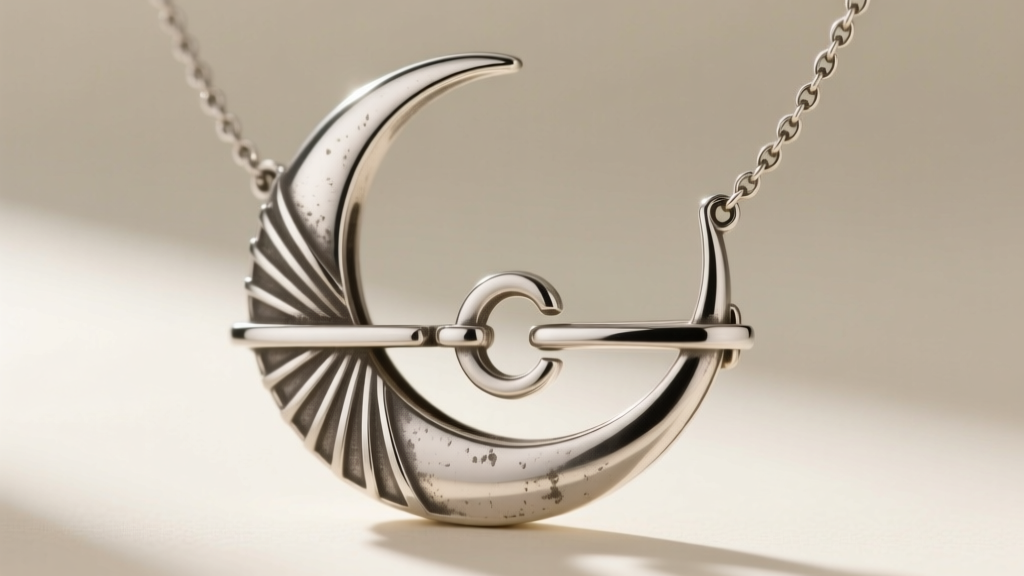
The bail (the loop connecting the pendant to the chain) is the highest-friction point on any necklace. On a genuine antique piece, the inside of the bail should show smooth, polished wear from a century of rubbing against a jump ring. If the bail shows sharp, deep grooves or looks freshly soldered, the pendant may have been converted from a brooch or earring into a necklace—a common practice in the mid-20th century that significantly diminishes collector value.
Diamond and Gemstone Setting Wear
According to gemological research published by the Gemological Institute of America (GIA), the prongs and bezels on antique jewelry require meticulous inspection. Rose-cut diamonds, commonly found in Victorian crescents, are backed by flat foil. If moisture has breached the closed-back setting over the last 100 years, the foil will have oxidized, turning black and severely dulling the stone. A jeweler must carefully assess whether the setting can be cleaned without compromising the historical integrity of the original bezel.
Valuation and Market Pricing in 2026
The market for antique celestial jewelry has matured significantly. Collectors are no longer just buying the aesthetic; they are buying the provenance and the specific technical execution of the era. Below is a realistic pricing framework for authentic pieces in the current market, assuming excellent condition and original components.
- Tier 1: Late Victorian 15k Gold & Rose-Cut Diamonds ($2,800 – $5,500)
Highly sought after for their romantic aesthetic and historical gold standard. Pricing scales with the total carat weight and the presence of a legible British hallmark. - Tier 2: Art Nouveau Silver & Plique-à-jour Enamel ($6,000 – $14,000+)
The extreme rarity of intact enamel drives these prices. Even minor hairline fractures in the enamel will drop the value by 40% to 60%. - Tier 3: Art Deco Platinum, Diamonds & Calibre Sapphires ($8,500 – $22,000+)
The pinnacle of the market. Pieces featuring hand-cut calibre sapphires fitted seamlessly into the geometric curve of the crescent command premium auction prices.
Sourcing and Provenance Verification
When acquiring a vintage crescent moon necklace, always demand high-resolution macro photography of the hallmarks, the bail interior, and the diamond culets (the bottom point of the stone). Old mine-cut diamonds will have large, open culets visible through the table, whereas modern brilliant cuts will have pointed or faceted culets. If a seller claims a piece is Victorian but the diamonds exhibit modern laser-cut precision, walk away. True expertise lies in the synthesis of metallurgical data, historical context, and physical wear patterns, ensuring your investment is both authentic and historically significant.


