Authenticating a Vintage Green Glass Necklace: An Expert Guide
Master the authentication of a vintage green glass necklace. Explore uranium glass, Art Deco molds, and expert testing methods for collectors.

The Allure and Complexity of Vintage Green Glass
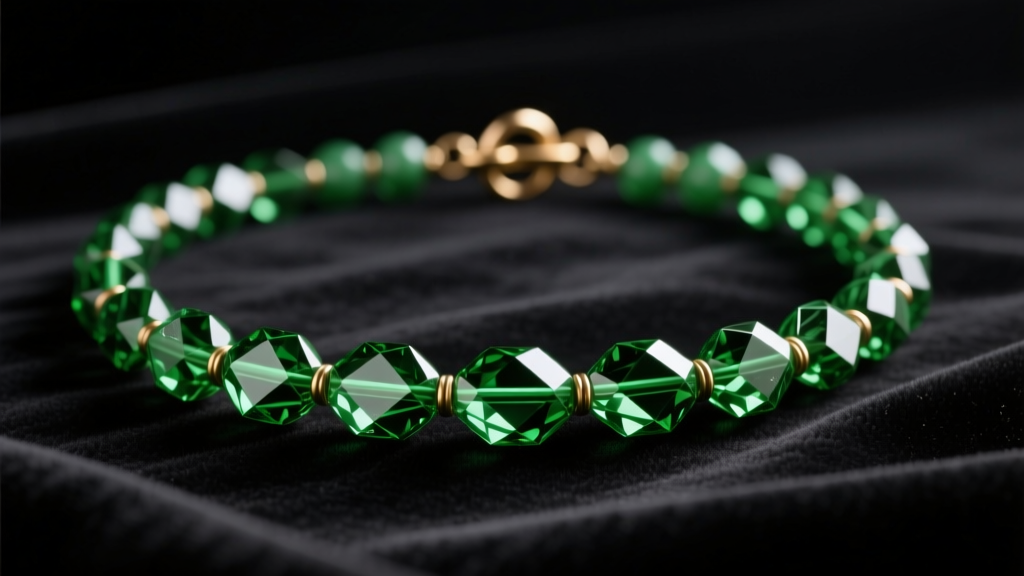
The secondary jewelry market is saturated with modern reproductions masquerading as historical artifacts. For serious collectors and gemologists, authenticating a vintage green glass necklace requires moving beyond superficial visual appraisals. Green glass has been a staple in jewelry manufacturing since the Roman Empire, but the techniques, chemical compositions, and hardware used to create these pieces evolved drastically between the 1880s and the 1970s. According to the Corning Museum of Glass, the coloration in antique glass is rarely accidental; it is the direct result of specific metallic oxide additives that serve as chemical fingerprints for dating and valuation. This guide provides a technical framework for analyzing material composition, identifying era-specific mold characteristics, and evaluating the metallurgical hardware of vintage green glass necklaces.
Material Composition: What Makes the Glass Green?
The first step in authentication is identifying the chemical agent used to achieve the green hue. Different eras favored different colorants, which directly impacts the glass's refractive index (RI), specific gravity (SG), and ultraviolet (UV) fluorescence.
Uranium Glass (Vaseline Glass)
Highly sought after by collectors, uranium glass achieves its distinctive yellow-green hue through the addition of uranium dioxide (UO2) in proportions ranging from 0.1% to 2%, and occasionally up to 25% in rare Victorian pieces. The definitive test for uranium glass is UV fluorescence. However, expert authentication requires a 365nm UV blacklight. Standard 395nm UV flashlights emit too much visible purple light, which can mask the bright, neon-green fluorescence characteristic of true uranium glass. Furthermore, a Geiger counter will register a slight elevation in background radiation (typically 0.20 to 0.50 µSv/h above baseline), confirming the presence of radioactive isotopes without posing a health risk to the wearer.
Copper, Iron, and Chrome Oxides
If a vintage green glass necklace does not fluoresce under 365nm UV light, the coloration is likely derived from transition metals. Emerald green glass from the late 19th and early 20th centuries was frequently colored using chromium oxide, yielding a deep, rich green with a higher refractive index (approx. 1.52 - 1.54). Olive and forest greens were typically achieved using iron oxide combined with sulfur. Copper oxide was used to create opaque, turquoise-leaning greens, particularly in Venetian and Bohemian beadwork. Identifying these requires a polariscope to check for strain patterns and a refractometer to measure the RI, distinguishing handmade lampwork beads from mass-molded factory glass.
Era-Specific Identification Markers
Once the chemical composition is understood, the physical manufacturing marks provide the most reliable dating evidence. The National Depression Glass Association emphasizes that mold lines, pontil marks, and facet polishing techniques are critical for pinpointing a necklace's decade of origin.
Victorian and Edwardian Eras (1837–1910)
Victorian green glass necklaces, particularly those featuring uranium glass, were often hand-cut and polished. Look for deep, sharp facets with slightly rounded edges due to hand-polishing on wooden wheels. The beads will exhibit minor asymmetries. Stringing materials from this era were primarily silk thread, which degrades over time. If a purported Victorian necklace is strung on modern nylon-coated stainless steel beading wire, it has either been restrung (lowering its value) or is an outright reproduction.
Art Deco and Depression Glass (1920s–1930s)
The 1920s and 30s introduced pressed glass and mechanized mold-blowing. Depression-era green glass necklaces will feature prominent, continuous mold seams running along the edges of the beads. Unlike hand-cut crystal, these seams are rarely polished away entirely. Art Deco geometric patterns (like the 'Royal Lace' or 'Miss America' patterns) were pressed into the molds. Authentic pieces will show slight 'straw marks' or surface ripples from the rapid cooling of the glass in the mold, whereas modern reproductions will have perfectly smooth, machine-polished surfaces.
Mid-Century Modern and Czechoslovakian Glass (1950s–1970s)
Post-WWII green glass necklaces heavily feature Czechoslovakian molded glass beads from the Jablonec region. These beads are characterized by intricate, high-relief floral or leaf motifs with exceptional mold detail. A key identifier for mid-century pieces is the Aurora Borealis (AB) coating, invented in 1955. If a green glass bead features an AB finish, it cannot predate the mid-1950s. Furthermore, mid-century stringing often utilized early synthetic polymers or cotton-blend cords, which exhibit different wear patterns than Victorian silk.
Technical Authentication Framework
When evaluating a vintage green glass necklace in the field or at an estate sale, follow this sequential testing protocol to avoid costly misattributions:
- Visual Mold Analysis: Use a 10x jeweler's loupe to inspect the bead equators for mold seams. Sharp, unpolished seams indicate pressed Depression glass; seamless, highly polished facets suggest hand-cut Victorian glass or modern CNC-machined reproductions.
- UV Fluorescence Testing: Apply a 365nm UV light in a shaded environment. Note the color and intensity of the glow. Bright neon green indicates uranium; a dull or absent glow points to iron, copper, or chrome colorants.
- Thermal Conductivity Test: Glass is an amorphous solid and feels distinctly cool to the touch compared to plastic or resin. Press the bead against your lower lip or the inside of your wrist; modern resin reproductions will quickly absorb body heat, while vintage glass will remain cool.
- Acoustic Resonance: Gently tap two beads together. Vintage lead or uranium glass produces a distinct, high-pitched 'clink' with a long decay, whereas modern soda-lime glass or plastic yields a dull, short 'clack'.
Hardware and Chain Analysis: The Hidden Clues
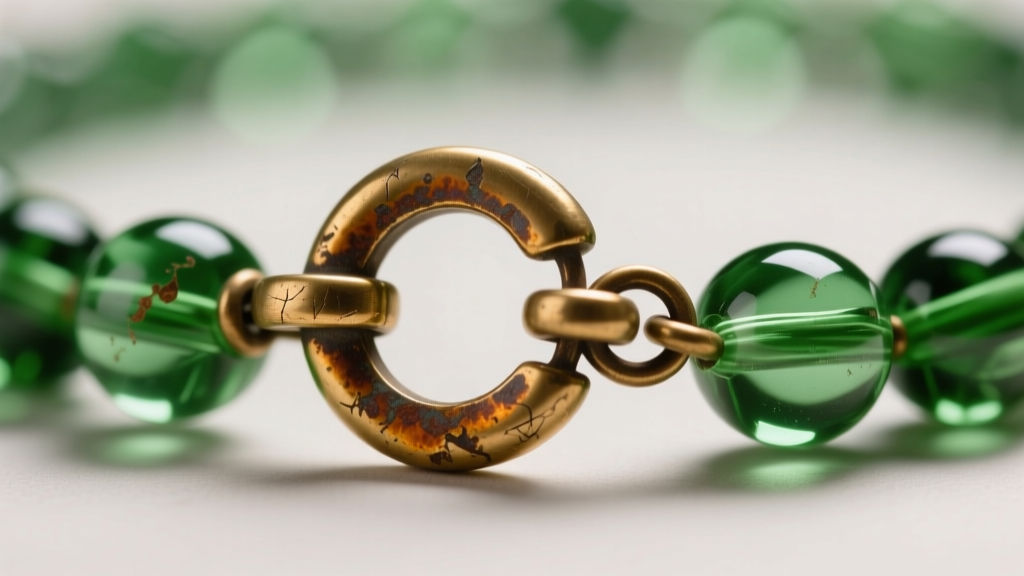
The glass beads are only half the equation. The metallurgical hardware—clasps, jump rings, and chain links—often provides the most definitive proof of age. Reproducers frequently use authentic vintage beads but string them on modern chains with modern clasps. According to archival jewelry records from the Victoria and Albert Museum, clasp technology evolved in distinct phases.
| Hardware Component | Pre-1930s (Victorian/Edwardian) | 1930s–1940s (Art Deco/Retro) | Post-1950s (Mid-Century) |
|---|---|---|---|
| Primary Clasp | C-Clasp (no safety catch), Padlock | Barrel Clasp, Box Clasp with safety | Lobster Clasp, Spring Ring |
| Jump Rings | Unsoldered, thick gauge brass | Soldered, oval-shaped gold-filled | Machine-stamped, split rings |
| Chain Gauge | 1.5mm - 2.5mm (14-12 gauge) link | 1.0mm - 1.5mm (16-14 gauge) snake | 0.8mm - 1.2mm (18-16 gauge) cable |
| Metal Markings | Rarely stamped, acid tested | '1/20 12K GF', 'Sterling' | '925', '14K', Maker's marks |
Pay close attention to the wear patterns on the metal. A genuine vintage chain will show uniform patina and microscopic friction wear where the links rub together. Artificially aged reproductions often feature chemically induced patina that pools in the crevices but lacks the directional polishing wear found on authentic antique chains.
Conservation and Restoration Protocols
Owning a vintage green glass necklace comes with strict conservation responsibilities. The most common failure mode in antique glass jewelry is 'glass sickness' or crizzling—a network of fine surface cracks caused by the leaching of alkali metals from the glass matrix when exposed to high humidity. If crizzling is detected, the necklace must be stored in a climate-controlled environment with a relative humidity (RH) strictly maintained between 40% and 45%.
Never clean vintage uranium or Depression glass in an ultrasonic cleaner. The high-frequency cavitation can exacerbate micro-fractures and strip original surface polish. Instead, use a mild solution of distilled water and a non-ionic surfactant (like Orvus WA Paste), applied with a soft, natural-bristle brush. Avoid getting the stringing material wet, as moisture trapped inside the bead holes will accelerate the degradation of both the silk thread and the interior glass surface.
Market Valuation and Pricing Tiers
The valuation of a vintage green glass necklace is highly dependent on the intersection of material rarity, hardware originality, and provenance. In the current collector's market, pricing generally falls into three distinct tiers:
- Tier 1: Depression Glass and Mass-Molded ($45 – $150): Necklaces from the 1930s featuring common green patterns (like 'Sharon' or 'Cameo') with replacement clasps or restringing. Value is driven by pattern completeness and bead condition.
- Tier 2: Mid-Century Czechoslovakian and Art Deco ($200 – $600): Intricate molded leaf or floral beads from Jablonec, or geometric Art Deco pieces with original gold-filled hardware and intact silk stringing.
- Tier 3: Victorian Uranium and Hand-Cut Crystal ($800 – $2,500+): Authentic 19th-century uranium glass necklaces with original C-clasps, hand-cut facets, and verifiable provenance. Pieces featuring graduated bead sizes and intricate filigree spacers command premium auction prices.
Ultimately, authenticating a vintage green glass necklace is an exercise in forensic material science. By combining UV spectroscopy, mold-line analysis, and hardware typology, collectors can confidently separate historical masterpieces from modern pastiches, ensuring their investments are both historically significant and financially sound.


