Baroque Pearls Necklace: Technical Guide to Grading and Care
Discover the technical details of buying a baroque pearls necklace. Learn about nacre thickness, luster grading, drill holes, and silk knotting.

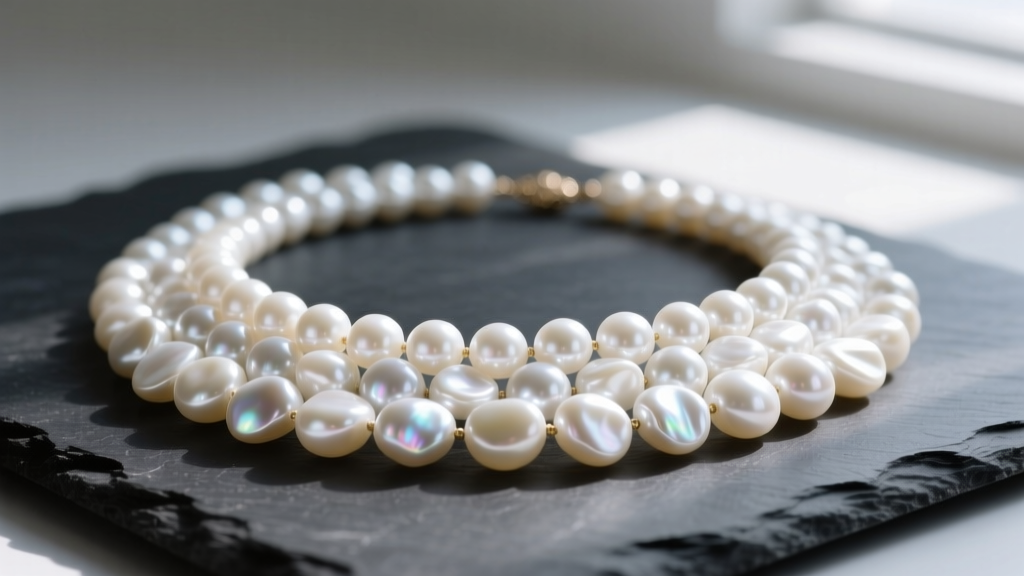
The Gemological Anatomy of a Baroque Pearls Necklace
When evaluating a baroque pearls necklace, collectors and gemologists look far beyond the organic, free-form silhouettes that define these gems. Unlike perfectly spherical Akoya or round South Sea pearls, baroque pearls are born from irregularities within the mollusk's pearl sac. This non-concentric deposition of aragonite platelets and conchiolin (the organic protein binder) results in unique, asymmetrical shapes ranging from subtle ovals to deeply ridged, abstract forms. Understanding the technical specifications of these pearls is critical for making an informed acquisition.
According to the Gemological Institute of America (GIA), pearl value is determined by seven distinct factors. For baroque specimens, shape is inherently non-symmetrical, shifting the evaluative weight heavily onto luster, nacre thickness, and surface characteristics.
Technical Grading: Nacre Thickness and Luster Quality
The longevity and visual depth of a baroque pearls necklace depend entirely on nacre quality. Nacre is the crystalline substance secreted by the mollusk. In nucleated saltwater pearls, a bead nucleus is implanted, and the nacre grows over it. A high-quality Tahitian or South Sea baroque pearl should possess a minimum nacre thickness of 1.5mm to 2.0mm. If the nacre is too thin (under 0.8mm), the pearl may exhibit "blinking" (where the nucleus is visible through the nacre) or premature peeling.
The Luster and Orient Scale
Luster refers to the sharpness of light reflections on the pearl's surface, while orient is the iridescent play of colors just below the surface. Because baroque pearls feature undulating ridges and valleys, they often display superior orient compared to round pearls, as light refracts through multiple angles of the aragonite layers.
- Excellent Luster: Reflections are sharp, bright, and distinct. The surface acts almost like a convex mirror.
- Very Good Luster: Reflections are bright but slightly softer at the edges.
- Good/Fair Luster: Reflections are hazy, diffused, or chalky. Avoid necklaces with chalky luster, as this indicates poor crystallization or post-harvest degradation.
Freshwater vs. Saltwater Baroque: A Gemological Comparison
The market for a baroque pearls necklace is segmented primarily by origin. Freshwater baroque pearls are typically tissue-nucleated, meaning they are composed of solid nacre from core to surface. Saltwater variants rely on a mother-of-pearl bead nucleus. Below is a technical breakdown of the primary categories available in the current market.
| Pearl Type | Origin | Typical Size Range | Nacre Composition | Avg. 18" Strand Price |
|---|---|---|---|---|
| Edison Freshwater | China | 11mm - 15mm | Bead-nucleated, thick nacre | $400 - $1,200 |
| Keshi (Saltwater) | Japan / Australia | 4mm - 10mm | Non-nucleated, solid nacre | $800 - $3,500 |
| Tahitian Baroque | French Polynesia | 9mm - 14mm | Bead-nucleated, dark bodycolor | $1,500 - $6,000+ |
| South Sea Baroque | Australia / Indonesia | 12mm - 18mm | Bead-nucleated, satin luster | $3,000 - $15,000+ |
Note: Keshi pearls are a byproduct of the culturing process where the mollusk rejects the bead nucleus but continues to secrete nacre around the tissue graft, resulting in a 100% solid nacre baroque pearl.

Detecting Color Treatments and Irradiation
As the demand for exotic colors rises, the market has seen an influx of treated baroque pearls. Freshwater pearls are frequently dyed to mimic the dark, peacock-green hues of Tahitian baroque pearls or the deep golden tones of South Sea variants. Gemologists utilize a combination of magnification and spectroscopy to detect these enhancements.
When inspecting a dark baroque pearls necklace suspected of being dyed freshwater, use a 10x jeweler's loupe to examine the drill holes. Dyed pearls often exhibit "color banding" or concentrated pools of dye along the drill channel and surface blemishes. Furthermore, natural Tahitian baroque pearls display a complex, multi-colored orient (often a mix of green, pink, and silver), whereas dyed freshwater pearls typically present a flat, monochromatic, or overly uniform dark gray appearance. Irradiation, another common treatment used to darken Akoya and freshwater baroque pearls, alters the manganese content within the pearl, resulting in a metallic, bluish-gray bodycolor that lacks the depth of naturally colored saltwater pearls.
Construction Mechanics: Silk, Drill Holes, and Hardware
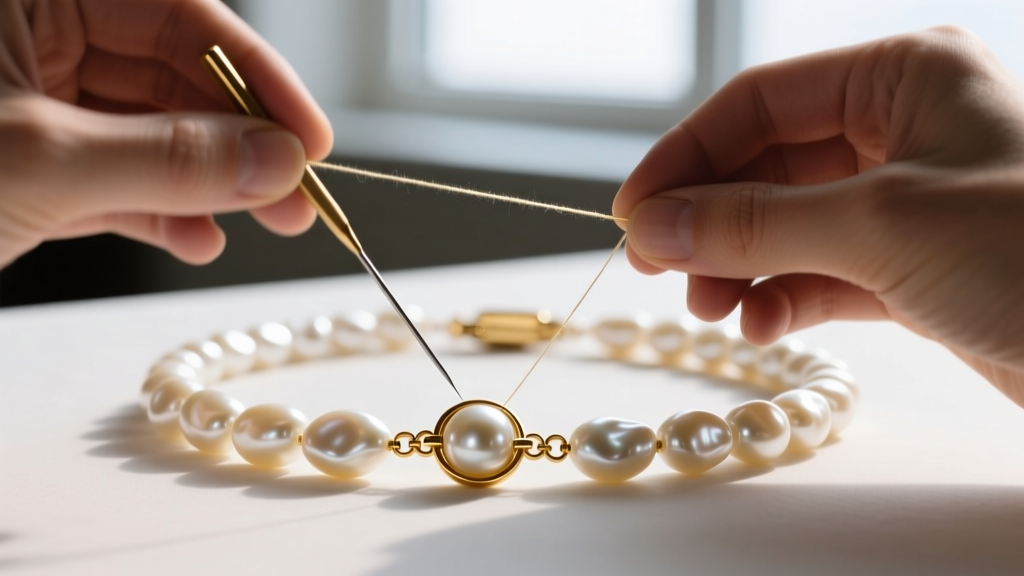
A premium baroque pearls necklace requires meticulous stringing techniques to accommodate the uneven weight distribution of irregular pearls. Mass-market strands often use nylon or polyester threads, which stretch over time and fail to hold tight knots. Expert stringers use 100% natural silk thread.
Evaluating Drill Hole Integrity
Because baroque pearls are asymmetrical, drilling them requires immense precision. The drill must follow the pearl's natural center of gravity to ensure the necklace hangs correctly. Look for holes that are 0.8mm to 1.0mm in diameter. Inspect the exit points of the drill holes: "blowouts" (chipped or flaked nacre around the hole) are a sign of rushed manufacturing and will eventually lead to the pearl cracking under the tension of the silk knot.
The Importance of French Wire (Gimp)
The transition from the silk thread to the metal clasp is the most vulnerable point of any pearl necklace. High-end construction utilizes French wire (also known as gimp)—a microscopic, hollow coil of fine silver or gold wire. The silk passes through this coil before looping through the clasp ring, preventing the metal from sawing through the delicate silk fibers over years of friction.
Proportions, Sizing, and Neckline Pairing
Styling a baroque pearls necklace requires an understanding of visual weight. Due to their ridges and uneven surfaces, baroque pearls catch light differently than round pearls, making them appear visually "heavier" and more textured.
- 8mm - 10mm (Princess Length, 18 inches): Ideal for V-neck and scoop-neck blouses. The moderate size allows the irregular shapes to act as a subtle, organic accent without overwhelming the collarbone.
- 11mm - 14mm (Matinee Length, 24 inches): Best suited for crew necks, turtlenecks, and evening wear. The larger surface area maximizes the display of orient and peacock overtones.
- Layering Protocols: When layering a baroque strand with metallic chains, ensure a minimum 2-inch length differential to prevent the pearls' surface from scratching against harder metals like 14k gold or platinum.
Long-Term Maintenance and Restringing Protocols
Pearls rank at a mere 2.5 to 3.0 on the Mohs hardness scale, making them highly susceptible to chemical and physical damage. The conchiolin protein in the nacre is particularly vulnerable to the acids found in human sweat, perfumes, and cosmetics.
"Never use ultrasonic cleaners, steam cleaners, or ammonia-based jewelry solutions on a baroque pearls necklace. The high-frequency vibrations will shatter the delicate nacre layers, and ammonia will permanently strip the pearl's natural orient." - GIA Pearl Care Guidelines
Restringing Schedule: If worn weekly, a silk-knotted baroque pearls necklace should be professionally restrung every 18 to 24 months. You can test the integrity of your stringing by gently pulling the thread between two pearls; if there is more than 1mm of slack or visible stretching, the silk has degraded and requires immediate replacement to prevent catastrophic strand failure.


