Technical Guide to Batman Necklace Alloys & Casting
Explore the metallurgy, casting techniques, and patina chemistry behind high-end Batman necklaces. A technical guide for collectors and artisans.

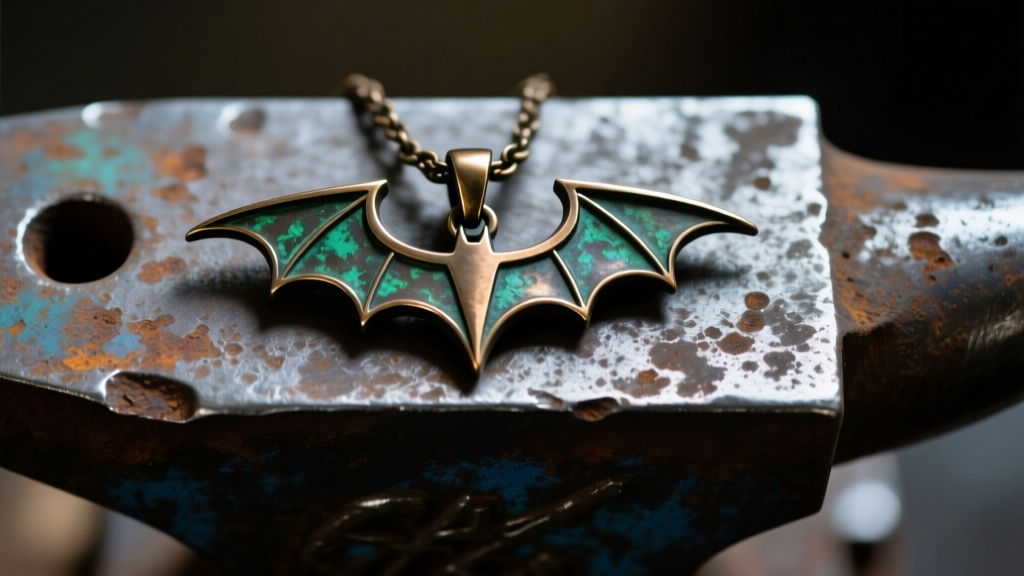
The Evolution of the Batman Silhouette in Fine Jewelry
For decades, the quintessential Batman necklace was relegated to the realm of mass-produced, die-cast zinc merchandise. However, as comic memorabilia has crossed over into high-end artisan jewelry, the technical demands of crafting the iconic bat symbol have evolved dramatically. Creating a screen-accurate, durable, and aesthetically striking bat pendant requires a deep understanding of metallurgy, fluid dynamics during casting, and surface chemistry. This guide deconstructs the engineering behind premium Batman necklaces, offering collectors and jewelers a rigorous look at what separates a fragile novelty from a masterwork of wearable art.
"The transition from 1989 movie merchandise to modern bespoke jewelry means we no longer accept porosity or soft alloys. A premium bat symbol demands sharp wingtips, deep chest recesses, and structural integrity that can withstand daily wear."
Metallurgical Breakdown: Choosing the Right Alloy
The foundation of any high-end pendant is its base metal. The sharp, aggressive angles of the Batman logo—specifically the pointed ears and scalloped wingtips—require an alloy with excellent fluidity and low shrinkage. According to metallurgical standards outlined by the Copper Development Association, different alloys behave vastly differently when forced into the intricate crevices of a bat-shaped mold.
| Alloy Type | Composition / Grade | Shrinkage Rate | Best Use Case |
|---|---|---|---|
| Zamak 3 (Zinc) | Zn + 4% Al, 0.03% Mg | ~1.1% | Mass-market, low-cost replicas (prone to zinc pest) |
| Silicon Bronze | CDA 655 (96% Cu, 3% Si) | ~1.5% | Artisan pieces requiring high fluidity for sharp wingtips |
| Sterling Silver | 925 Ag (92.5% Ag, 7.5% Cu) | ~1.25% | Premium collector pieces, excellent for dark oxidation |
| Platinum | 950 Pt (95% Pt, 5% Ru) | ~1.8% | Ultra-luxury, extreme durability, heavy weight |
While Zamak is ubiquitous in cheap mall-kiosk jewelry, it suffers from intergranular corrosion (commonly known as "zinc pest") if trace lead or tin impurities are present. For a lasting Batman necklace, artisan jewelers prefer Silicon Bronze or 925 Sterling Silver. Silicon bronze flows exceptionally well into sharp corners, ensuring the bat's ears remain razor-sharp right out of the flask, minimizing post-casting filing which can ruin the silhouette's symmetry.
Failure Modes in Mass-Produced Pendants
When evaluating vintage or commercial Batman pendants, structural engineers and jewelers look for specific failure modes inherent to poor manufacturing:
- Gas Porosity: Caused by turbulent pouring or inadequate venting in die-casting. This manifests as tiny surface pits on the bat's chest plate, weakening the structural cross-section.
- Cold Shuts: Occurs when the molten metal cools too quickly before filling the extreme points of the wings, resulting in rounded, blunt ear tips.
- Bail Shearing: The bail (the loop connecting the pendant to the chain) is often cast too thin. A solid bronze bat symbol can weigh upwards of 45 grams; a bail with a cross-sectional thickness of less than 2.0mm will eventually fatigue and snap under dynamic movement.
Lost-Wax Casting Techniques for Screen Accuracy
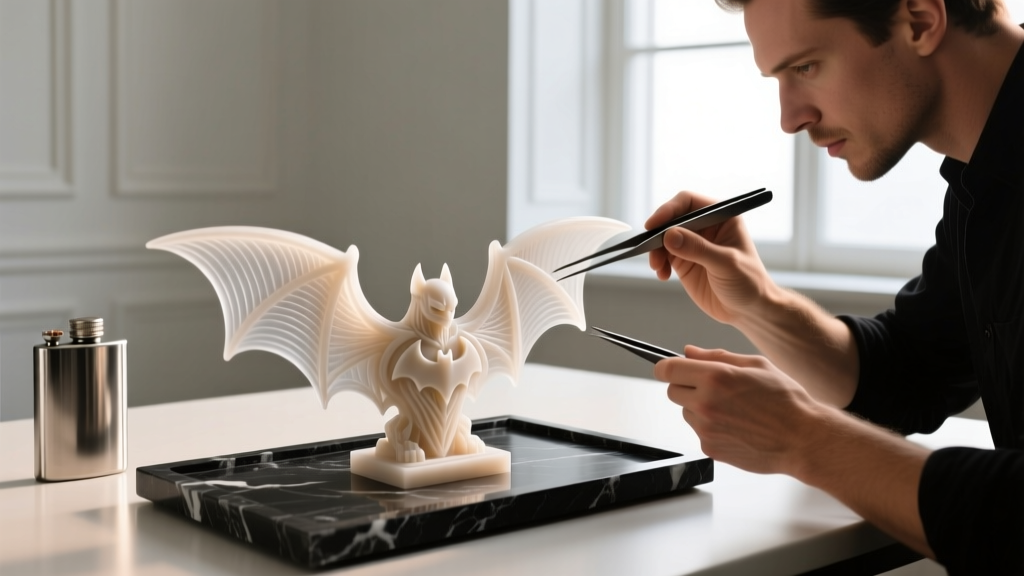
To achieve the precise, symmetrical geometry of the Batman emblem, modern jewelers utilize lost-wax investment casting, often starting with high-resolution 3D-printed castable resin waxes. The Rio Grande technical guides emphasize that scaling the CAD model is critical to compensate for metal shrinkage. For 925 sterling silver, the 3D model must be scaled up by exactly 1.0125% to ensure the final cast matches the digital blueprint.
Spruing and Gating the Wings
The spruing process—attaching wax channels to the model so molten metal can flow in and gases can escape—is where many bat pendants fail. The wingtips act as thermal sinks. If a sprue is too thin, the metal freezes before reaching the tip. Expert casters use a combination of a thick central sprue (3mm) attached to the bat's chest, and auxiliary 1.5mm vent sprues attached directly to the outer wings to allow air displacement. The flask burnout schedule typically requires holding at 1350°F for two hours to completely vaporize the resin, followed by a drop to 900°F to prevent thermal shock when the 1600°F molten silver is introduced via centrifugal or vacuum casting.
Patina Chemistry: Achieving the Gotham Grit
A polished, mirror-finish Batman necklace often looks flat and lacks the brooding, tactical aesthetic associated with the character. Achieving the "Gotham grit" requires controlled chemical oxidation. For sterling silver and copper-based bronzes, Liver of Sulfur (a mixture primarily composed of potassium sulfide) is the industry standard.
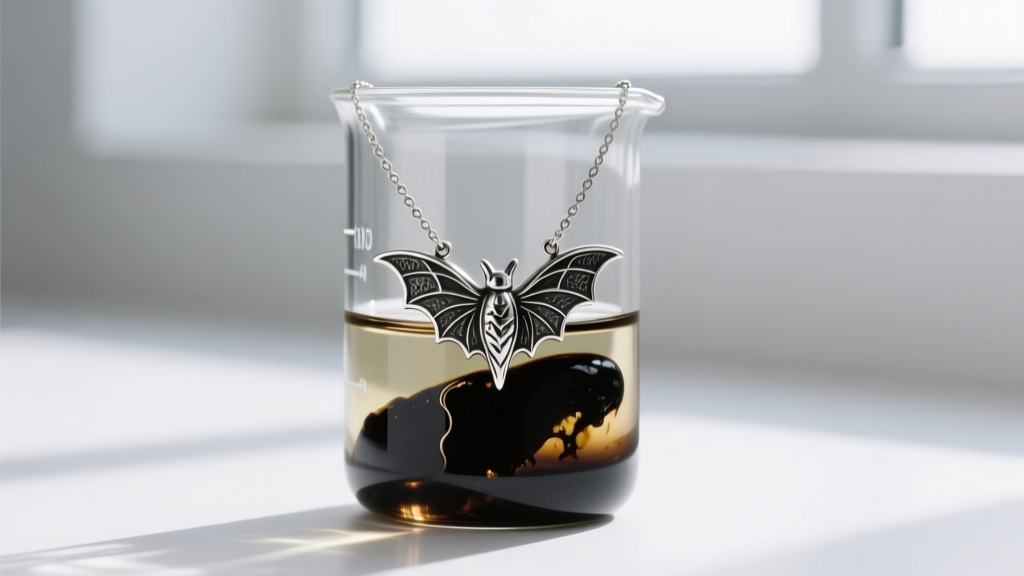
The chemical reaction between the sulfur and the copper alloyed within the sterling silver creates a layer of black copper sulfide. To control this, artisans use a highly diluted solution (approximately 1:100 ratio of Liver of Sulfur to warm distilled water) and submerge the pendant for short, monitored intervals. Once the desired depth of blackness is achieved in the recessed muscle lines of the bat symbol, the piece is quenched in cold water with a pinch of baking soda to neutralize the acid. The high-relief areas are then hand-polished with a rouge cloth, leaving the recesses pitch-black and creating a striking, three-dimensional contrast that highlights the anatomical detailing of the emblem.
Chain Mechanics and Dynamic Load Support
A heavy, solid-metal Batman pendant requires a chain engineered for dynamic load. A 50-gram pendant resting on the chest exerts 50 grams of static force. However, when the wearer walks, runs, or bends over, the kinetic swinging can generate dynamic forces exceeding 150 grams on the clasp and jump rings. According to precious metal durability standards referenced by the Gemological Institute of America (GIA), soft metals like pure silver or low-karat gold chains will stretch and deform under this repetitive stress.
For a heavy bronze or silver bat necklace, the chain must meet the following specifications:
- Gauge and Width: A minimum wire thickness of 14-gauge (1.6mm) and an overall chain width of 4.0mm to 5.0mm.
- Link Style: Rope, Figaro, or heavy Curb chains. Avoid hollow-box chains or delicate cable chains, which will kink and snap.
- Clasp Engineering: Standard pot-metal lobster clasps are insufficient. The necklace must feature a solid, machined stainless steel or 14k white gold lobster clasp with a heavy-duty internal spring, or a custom-machined toggle clasp with a locking mechanism to prevent accidental disengagement.
Conclusion: Investing in Wearable Engineering
The modern Batman necklace is far more than a piece of pop-culture memorabilia; it is an exercise in precision metallurgy and structural jewelry design. By understanding the nuances of silicon bronze fluidity, the chemistry of sulfide patinas, and the physics of dynamic chain loads, collectors can identify true artisan pieces that will endure. Whether forged in darkened bronze or oxidized sterling silver, a technically sound bat symbol pendant stands as a testament to the intersection of comic book iconography and master-level metalworking.


