Beaded Necklaces Ideas: Material & Durability Guide
Discover how material properties dictate the drape and durability of your designs. Explore expert beaded necklaces ideas, wire gauges, and failure modes.

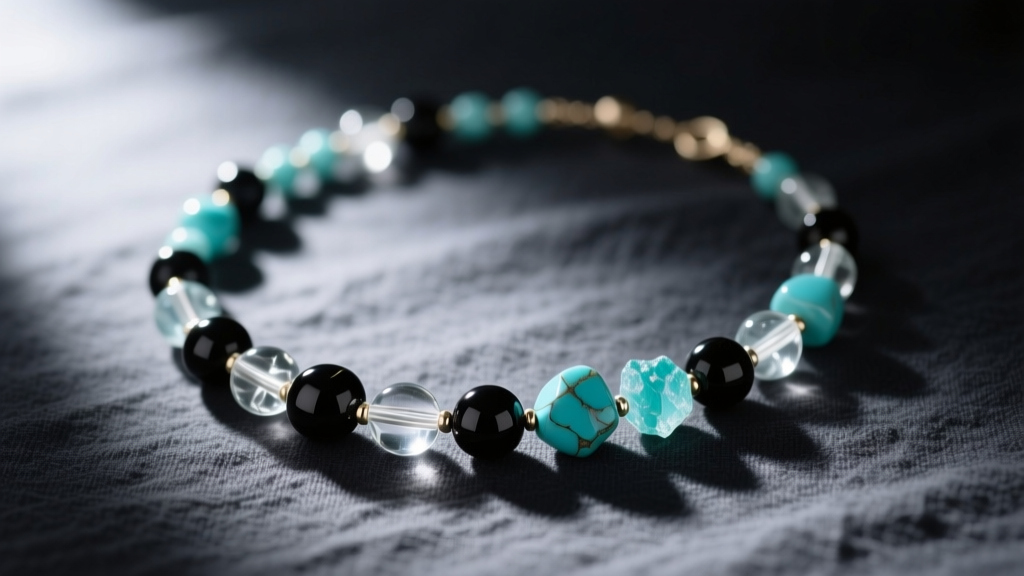
Beyond the Palette: The Material Science of Beadwork
When brainstorming beaded necklaces ideas, most hobbyists and emerging designers focus entirely on color palettes, bead shapes, and pendant pairings. While aesthetics are crucial, the true difference between an amateur craft project and a durable, fine-jewelry piece lies in material science. A necklace is a suspended structural system. Every bead exerts gravitational pull, friction, and torsional stress on the stringing medium. As we navigate the jewelry landscape in 2026, understanding the specific gravity, Mohs hardness, and chemical vulnerabilities of your chosen materials is no longer optional—it is the foundation of professional beadwork.
The Physics of Drape: Specific Gravity Explained
Have you ever followed a tutorial for one of your favorite beaded necklaces ideas, only to find the finished piece hangs stiffly or pulls uncomfortably on your neck? The culprit is usually a misunderstanding of Specific Gravity (SG). SG measures the density of a material relative to water. It dictates how a bead interacts with gravity and, consequently, how the necklace drapes against the collarbone.
- Heavyweights (SG 4.0 - 5.2): Hematite, pyrite, and solid metal beads. These materials pull the stringing wire taut, creating a sharp, deep V-shape. They require heavy-duty wire and reinforced clasps.
- Mid-Weights (SG 2.4 - 2.8): Quartz, glass, agate, and turquoise. These offer a natural, fluid drape that follows the contour of the neck without excessive pulling.
- Lightweights (SG 1.0 - 1.4): Acrylic, polymer clay, and wood. These beads resist gravity. If strung too loosely, they will kink and stick out at odd angles rather than draping smoothly.
According to the Gemological Institute of America (GIA), understanding gemstone density is critical not just for identification, but for structural jewelry design. Mixing a lightweight acrylic bead with a heavy hematite bead on the same strand without adjusting your wire tension will result in uneven wear and premature kinking.
Material Hardness & Wearability Matrix
The Mohs scale of mineral hardness determines how well your beads will survive daily wear. When beads rub against one another—a constant occurrence in a flexible necklace—softer materials will be slowly sanded away by harder ones. Never string untreated turquoise (Mohs 5-6) directly next to faceted quartz (Mohs 7) without a soft spacer bead, or the quartz will eventually drill through the turquoise.
| Material Category | Mohs Hardness | Vulnerability | Ideal Stringing Method |
|---|---|---|---|
| Freshwater Pearl | 2.5 - 4.5 | Acids, perfumes, abrasion | Silk thread (knotted) or 0.012" wire |
| Czech Glass | 5.5 - 6.0 | Hard impacts, chipping | 0.018" nylon-coated wire |
| Quartz / Agate | 7.0 | Thermal shock, extreme pressure | 0.018" to 0.024" steel wire |
| Polymer Clay | 2.0 - 3.0 | UV fading, snapping if under-baked | Flexible nylon thread or soft wire |
| Hematite (Natural) | 5.5 - 6.5 | Brittle, heavy weight stress | 0.024" 49-strand wire |
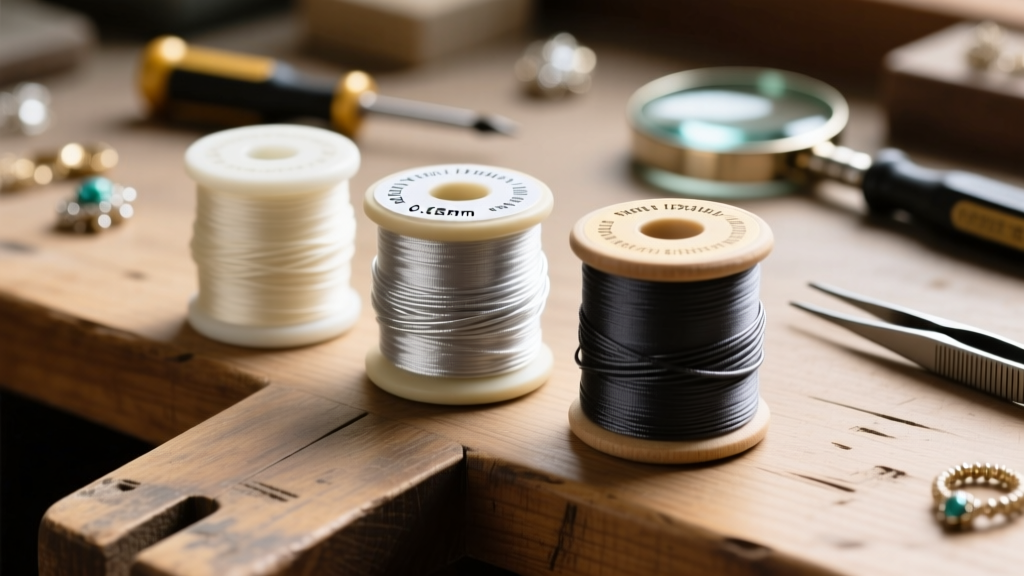
The Anatomy of Stringing Materials
The most common failure point in beaded jewelry is the stringing material. Modern professional beadwork relies heavily on micro-woven stainless steel wire encased in a nylon sheath. However, not all beading wires are created equal. The Fire Mountain Gems Encyclopedia emphasizes that the number of strands inside the nylon coating dictates the wire's kink-resistance and drape.
Decoding Wire Strand Counts
- 7-Strand Wire: Economical but stiff. It has a low tensile yield point, meaning once it kinks, it cannot be straightened. Best reserved for rigid, structured collars or beginner practice.
- 19-Strand Wire: A middle-ground option offering decent flexibility and moderate kink resistance. Ideal for standard glass and crystal bead weaving.
- 49-Strand Wire: The industry standard for fine beaded jewelry. The micro-woven steel core mimics the drape of silk thread while maintaining the tensile strength of steel. It is highly kink-resistant and essential for heavy gemstones.
Selecting the Correct Gauge (Diameter)
Choosing the right thickness is a balancing act between hole size and structural integrity.
- 0.012" - 0.014" (Extra Fine): Strictly for pearls, seed beads, and delicate gemstones with microscopic drill holes. Cannot support heavy pendants.
- 0.018" (Medium): The universal workhorse. Fits through 90% of standard glass, crystal, and stone beads while providing ample tensile strength for everyday wear.
- 0.024" (Heavy): Reserved for large-holed metal beads, heavy jasper, and multi-strand necklace clasps.
Crimping Metallurgy: Where Necklaces Fail
You can select the finest 49-strand wire and the most exquisite gemstones, but if your crimp fails, the necklace is destroyed. A crimp bead is a tiny metal tube that is crushed onto the wire to secure the clasp. The metallurgy of your crimp is vital.
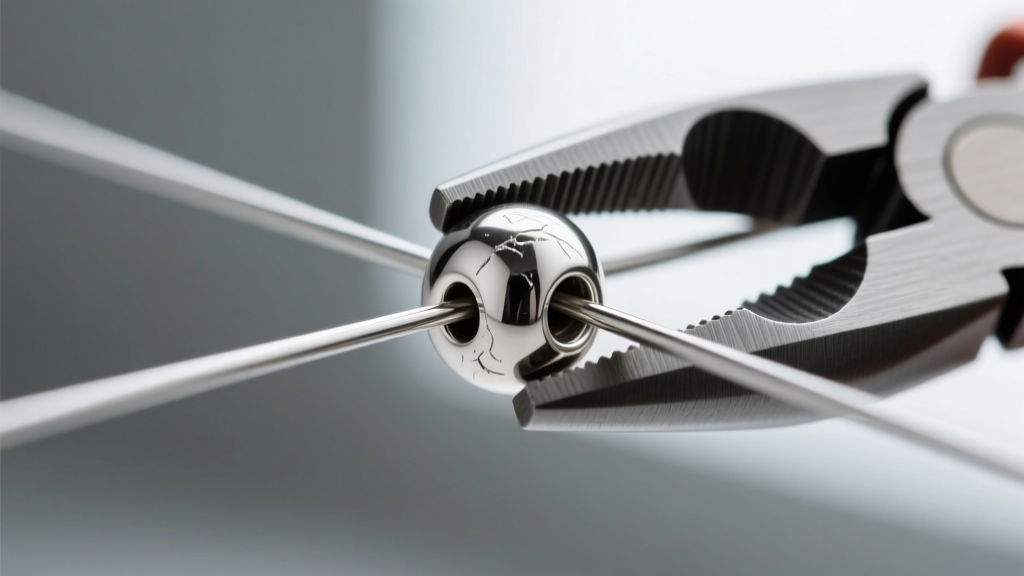
The Problem with Pure Silver and Base Metals
Many designers mistakenly believe that using pure silver (999 fine) crimps is a mark of quality. In reality, pure silver is too soft; it lacks the "memory" and grip required to bite into the nylon coating of the beading wire. Over time, the wire will slip through a pure silver crimp, leading to catastrophic failure. Conversely, cheap base-metal crimps (like plated brass) can become brittle and shatter when compressed with crimping pliers.
The Professional Standard: Sterligum and Sterling
For high-end beaded necklaces ideas, professionals use either Sterling Silver (925) paired with a specialized crimping tool that folds the metal rather than just crushing it, or Sterligum. Sterligum crimps feature a silver-plated exterior with a proprietary gum or copper core that grips the wire aggressively without cracking under pressure. Always use a 1.5mm x 2mm tube crimp for 0.018" wire, and ensure you leave a 1/8-inch "tail" of wire inside the first few beads to allow for natural movement and tension shifts.
2026 Sourcing & Environmental Factors
As the jewelry industry evolves, so do the materials available to designers. In 2026, we are seeing a massive shift toward lab-grown opal beads and ethically sourced, UV-stabilized polymer clays. When sourcing beads, always request the dye lot number for dyed stones like howlite or agate. Synthetic dyes can degrade when exposed to the pH levels of human sweat or prolonged UV exposure, leading to uneven fading across the necklace strand.
Furthermore, be wary of "coated" gemstones. Aura-treatments and titanium-coatings on quartz beads are visually stunning but have a Mohs hardness that differs from the core stone. Friction against adjacent beads will eventually wear the coating off at the drill holes, leaving a dull, metallic ring that ruins the aesthetic of the piece.
Final Framework for Your Next Design
The most successful beaded necklaces ideas are those that balance aesthetic vision with structural engineering. Before you string a single bead, map out your specific gravity, verify the Mohs hardness of adjacent stones, select a 49-strand wire in the correct gauge, and invest in high-quality alloy crimps. By treating your beadwork as an exercise in material science, you elevate your designs from fragile crafts to enduring, wearable art.


