How to Choose Necklace Holder Stands for Tangle-Free Storage
Learn how to choose the right necklace holder stands to prevent chain tangling, metal tarnishing, and clasp damage with our beginner-friendly guide.

Why Your Jewelry Box is Ruining Your Chains
If you have ever spent ten minutes painstakingly picking apart a bird's nest of gold chains, you have experienced the frustration of improper storage. For beginners building a jewelry collection, investing in dedicated necklace holder stands is not just an aesthetic choice; it is a structural necessity. According to a landmark physics study by Dorian Raymer and Douglas Smith on the spontaneous knotting of agitated strings, confinement and agitation are the primary catalysts for knot formation. When chains are tossed into a drawer or a standard jewelry box, the kinetic energy from opening and closing the drawer forces the ends of the chains to weave through their own links, creating complex mathematical knots.
Necklace holder stands eliminate this confinement, allowing gravity to keep the chains taut and separated. However, not all stands are created equal. A poorly designed stand can cause toppling, scratch delicate pendants, or even accelerate chemical tarnishing. This guide breaks down the exact specifications, materials, and dimensions you need to choose the perfect display and storage solution for your necklaces.
Anatomy of a Perfect Necklace Holder Stand
When evaluating a stand, you must look past the decorative elements and focus on the physics of weight distribution and dimensional clearances. A beginner-friendly stand must excel in two critical areas: base stability and branch geometry.
Base Weight and Tipping Mechanics
The most common failure mode of cheap necklace stands is kinetic tipping. When you hang a heavy pendant—such as a solid gold medallion or a large gemstone cluster—the center of gravity shifts. To prevent the stand from toppling when bumped or when unclasping a chain, the base must adhere to a strict weight ratio. As a general rule, the base should weigh at least four times the maximum weight of the heaviest necklace you intend to hang. For example, if your heaviest piece is a 40-gram sterling silver Cuban link chain, your stand's base should weigh a minimum of 160 grams. Look for bases made from solid hardwoods, cast iron, or weighted resin rather than hollow plastics or lightweight MDF (Medium-Density Fiberboard).
Branch Diameter and Clasp Clearance
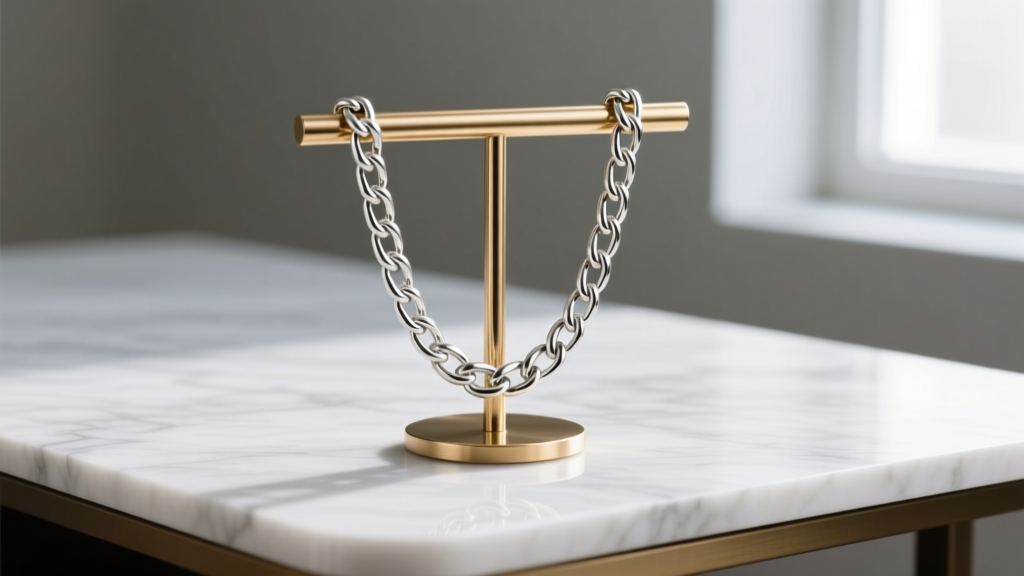
The horizontal branches or T-bars where the chains rest must be precisely sized. Standard lobster clasps and springring clasps are attached via jump rings that typically have an inner diameter of 3mm to 5mm. If the branch dowel is thicker than 4mm (approximately 5/32 of an inch), you will be forced to pry the jump ring open to mount the necklace, which permanently weakens the metal and risks losing the pendant. Always verify that the hanging pegs or branches have a diameter of 3mm or less to ensure smooth, effortless mounting and removal.
Material Chemistry: Woods, Metals, and Tarnish Risks
The material of your necklace holder stand directly interacts with the micro-climate around your jewelry. Certain woods and fabrics emit volatile organic compounds (VOCs) and acids that accelerate tarnishing and degrade organic gems. The Gemological Institute of America (GIA) emphasizes that proper storage environments are critical for preserving the luster of silver and the nacre of pearls.
| Material | Acidity / Tarnish Risk | Best Used For | Average Price Range |
|---|---|---|---|
| Solid Oak | High (Emits acetic acid & tannins) | Fashion jewelry, stainless steel | $25 - $60 |
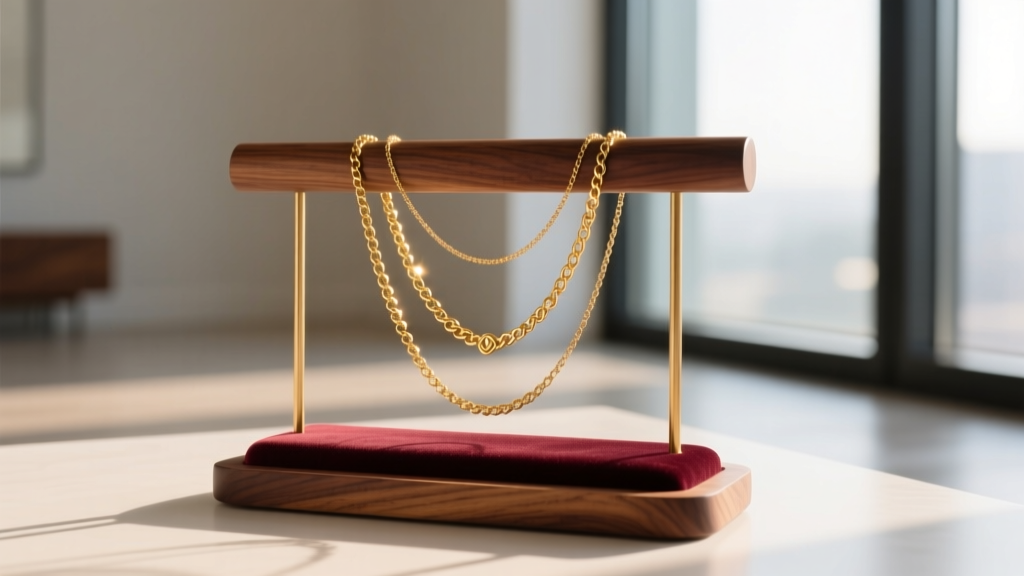
| Solid Walnut / Maple | Low (Safe when sealed with polyurethane) | Sterling silver, gold, pearls | $40 - $120 |
| Brushed Brass / Steel | None (Inert metals) | Heavy chains, modern aesthetics | $30 - $85 |
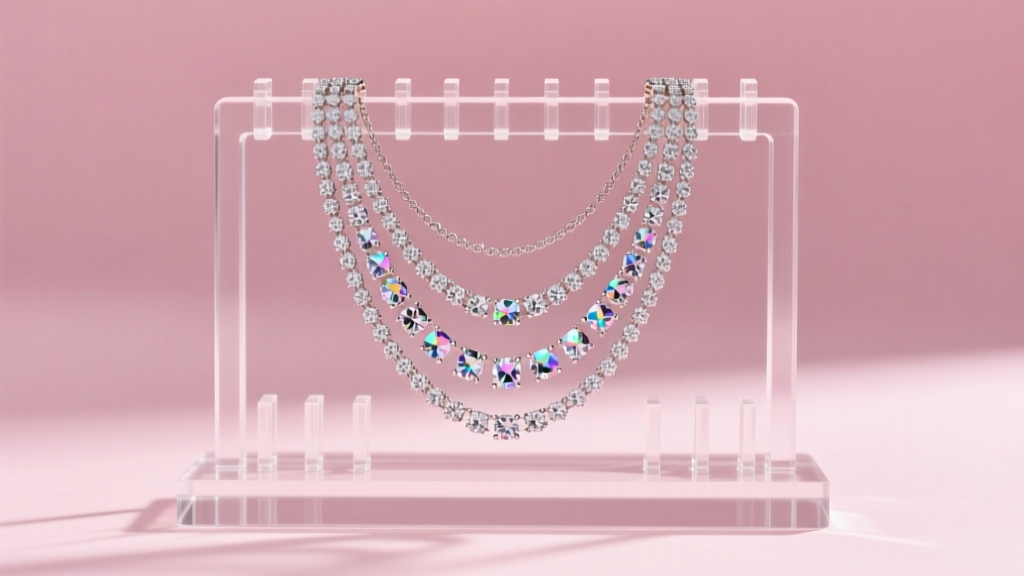
| Acrylic / Lucite | None (Completely inert) | Layered chains, retail display | $15 - $45 |
According to conservation standards utilized by the Smithsonian Institution, organic materials like pearls and coral are highly susceptible to acidic off-gassing from unsealed woods, requiring strictly inert storage environments.
A Note on Fabrics: If your stand features velvet or felt lining, ensure it is explicitly labeled as "anti-tarnish" or "jewelry-safe." Standard craft felts often contain sulfur dyes and acidic sizing agents that will cause sterling silver to blacken within weeks. Untreated cotton flannel or Pacific Silvercloth are the safest alternatives for padded bases.
Sizing Guide: Matching Stand Height to Chain Length
A stand that is too short will cause your longer chains to pool on the base, defeating the purpose of hanging storage and leading to bottom-heavy tangles. To ensure adequate clearance, you must match the stand's vertical drop space to your standard necklace lengths. According to Jewelers of America, maintaining proper clearance prevents clasp hardware from resting on abrasive surfaces.
- Choker (14-16 inches): Requires a minimum drop space of 10 inches. Ideal for short, branched desktop stands.
- Princess (18 inches): Requires a minimum drop space of 14 inches. The most common length; standard T-bar stands accommodate this easily.
- Matinee (20-24 inches): Requires a minimum drop space of 18 inches. Look for taller, floor-standing or elevated dresser stands.
- Opera (28-36 inches): Requires a minimum drop space of 24+ inches. These require specialized tall valet stands or wall-mounted hanging solutions.
Pro Tip: Always add 2 to 3 inches to your required drop space to account for the physical length of the pendant itself. A 20-inch matinee chain holding a 2-inch teardrop pendant needs a full 22 inches of vertical clearance to avoid scraping the base.
Common Beginner Mistakes and Troubleshooting
Even with the right stand, improper usage can lead to damage. Here are three common mistakes beginners make and how to correct them:
- Overcrowding the Branches: Hanging more than three chains on a single horizontal peg causes the chains to slide together and tangle at the clasps. Maintain at least 1.5 inches of lateral space between each necklace.
- Ignoring the Bottom Pads: Many wooden and metal stands come with cheap foam adhesive pads on the bottom. These degrade and leave sticky residue on your dresser. Replace them immediately with high-density silicone or woven felt bumper pads to protect your furniture and provide a non-slip grip.
- Hanging by the Clasp: If a chain is too short to drape over the branch, beginners often hook the lobster clasp directly onto the peg. This puts continuous tension on the clasp's internal spring mechanism, eventually causing it to fail. Always drape the chain links over the peg.
Maintenance and Cleaning Your Stand
Necklace holder stands collect household dust, skin oils, and environmental pollutants, which can transfer back onto your clean jewelry. Establish a monthly maintenance routine. For wooden stands, use a microfiber cloth and a light application of carnauba wax to maintain the seal and prevent the wood from drying out and cracking. For acrylic and metal stands, a simple wipe-down with a 50/50 mixture of distilled water and isopropyl alcohol will remove oils without leaving streaks. Avoid harsh glass cleaners on acrylic, as the ammonia can cause the plastic to cloud and micro-fracture over time.
Additionally, inspect the stand's hardware bi-annually. If your stand uses screwed-in T-bars or pegs, temperature fluctuations and the repeated kinetic motion of removing necklaces can loosen the threads. A quick tightening with an appropriate Allen key or screwdriver will prevent a peg from snapping off under the weight of a heavy gold chain.
By understanding the physics of tangling, the chemistry of materials, and the precise dimensions required for your specific collection, you can select a necklace holder stand that serves as both a beautiful display and a functional preservation tool. Investing in the right stand today will save you hours of frustration and protect your jewelry's structural integrity for decades to come.


