Bicycle Chain Necklace Guide: Metallurgy and Link Mechanics
Explore the metallurgy, link tolerances, and tensile strength of the bicycle chain necklace. Compare upcycled steel to cast silver replicas for daily wear.

The Intersection of Industrial Cycling and Fine Jewelry
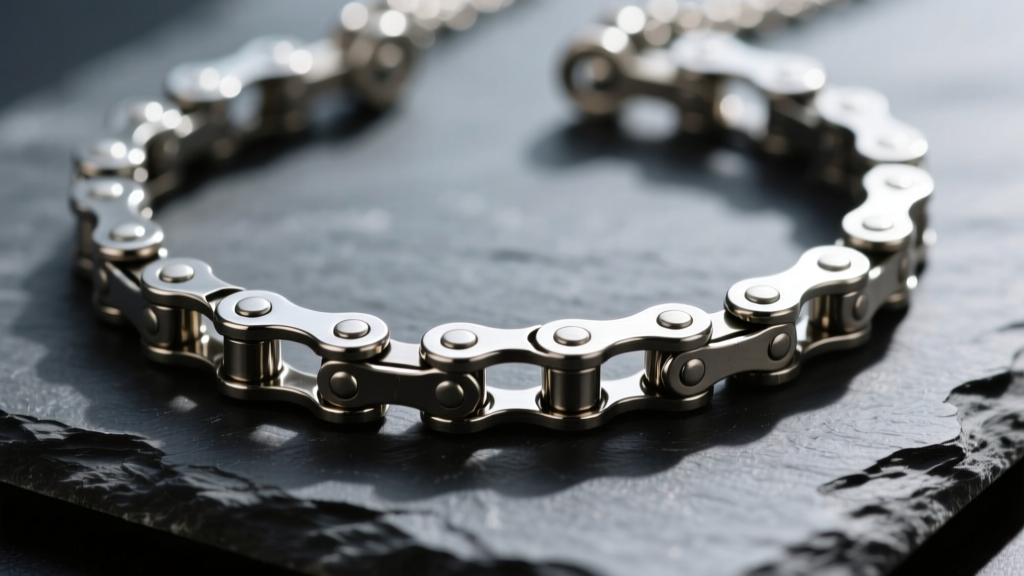
The bicycle chain necklace represents a fascinating collision of mechanical engineering and personal adornment. Originally popularized in the 1990s as a grunge-era upcycling trend, the modern iteration of this accessory has evolved into a highly technical niche within contemporary jewelry design. As of 2026, the market is distinctly bifurcated into two categories: authentic upcycled high-carbon steel chains and precision-cast jewelry replicas. Understanding the metallurgical properties, link articulation tolerances, and sheer stress limits of these pieces is critical for both designers and consumers seeking durability and aesthetic precision.
Unlike standard cable or curb chains, which utilize micro-links to achieve fluid drape, a bicycle chain relies on a rigid, large-pitch link architecture. This structural reality dictates everything from the necklace's weight distribution to its clasp requirements. In this deep dive, we examine the material science and mechanical engineering that define a high-quality bicycle chain necklace.
Upcycled Steel vs. Cast Replicas: A Metallurgical Breakdown
The fundamental decision when acquiring or designing a bicycle chain necklace is the base material. Authentic drivetrain chains are engineered to withstand immense pedaling torque, while jewelry replicas prioritize skin safety and drape.
High-Carbon Steel and Tensile Limits
Genuine bicycle chains are typically stamped from high-carbon steel alloys, such as AISI 1050 or 1060. These metals are heat-treated to achieve a Brinell hardness that resists elongation under load, boasting tensile strengths that frequently exceed 10,000 Newtons (the baseline for modern 11-speed and 12-speed chains). When upcycled into jewelry, this extreme durability means the chain will never snap under normal human handling. However, the industrial greases (often PTFE or molybdenum disulfide-based) used in cycling must be completely stripped via ultrasonic degreasing, and the steel must be sealed with a micro-thin PVD (Physical Vapor Deposition) coating or electroplated in zinc or nickel to prevent rapid oxidation against the skin's moisture.
Jewelry-Grade Alloys: Sterling Silver and Brass
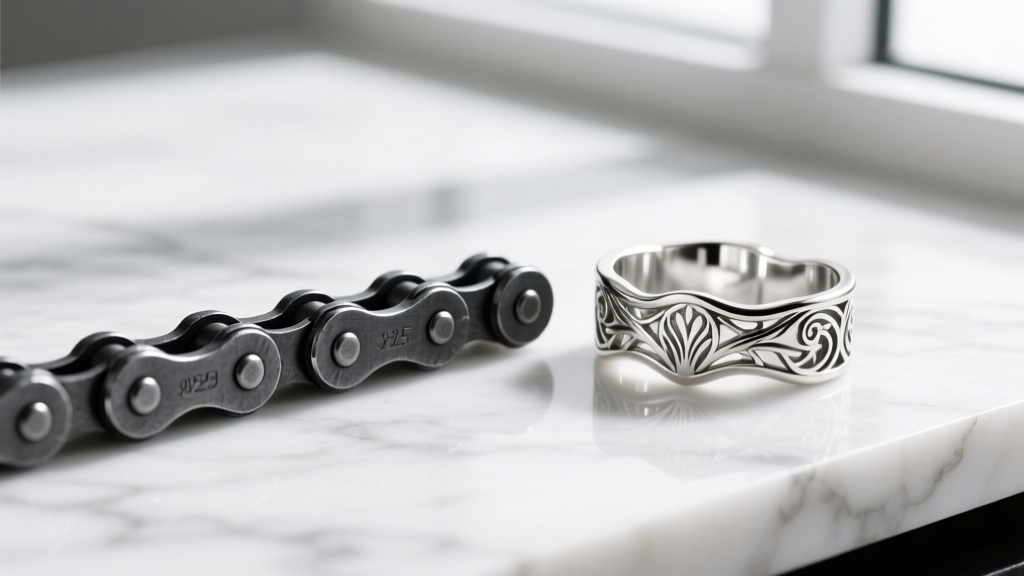
Because a standard 1/2-inch pitch steel bicycle chain weighs approximately 300 grams per meter, an 18-inch upcycled necklace can weigh upwards of 140 grams. To mitigate this neck fatigue, jewelers cast replicas using 925 sterling silver or C26000 cartridge brass. According to the Gemological Institute of America (GIA), 925 silver offers excellent hypoallergenic properties and a luxurious luster, though its tensile yield is a fraction of heat-treated steel. Cast replicas allow designers to scale the visual proportions of the chain down to a 3/8-inch or 1/4-inch pitch, reducing the overall weight to a more wearable 20 to 40 grams while maintaining the iconic roller-and-plate silhouette.
Link Articulation and Tolerance Engineering
The defining characteristic of any chain is its pitch—the distance from the center of one pin to the center of the next. Standard bicycle chains operate on a strict 1/2-inch (12.7mm) pitch. This large link size creates a unique mechanical behavior known in geometry as the 'polygon effect.' Because the links are long and rigid, the necklace does not form a perfect circle around the neck; instead, it forms a multi-sided polygon. This affects how the chain lays against the collarbone, often requiring precise sizing to ensure the links sit flat rather than jutting outward at the vertices.
| Specification | Upcycled Steel (1/2' Pitch) | Cast Silver Replica (3/8' Pitch) | Stamped Brass (1/4' Pitch) |
|---|---|---|---|
| Link Pitch | 12.7 mm | 9.5 mm | 6.35 mm |
| Average Weight (18') | 135 - 150g | 35 - 45g | 15 - 22g |
| Tensile Strength | > 10,000 N | ~ 1,200 N | ~ 800 N |
| Max Articulation Angle | ~ 45 degrees | ~ 60 degrees | ~ 90 degrees |
| Skin Sensitivity | High (Requires PVD coating) | Low (Hypoallergenic) | Moderate (Copper reactivity) |
As noted by Park Tool's technical documentation on chain basics, the lateral flex and articulation angle of a bicycle chain are strictly limited by the width of the inner and outer plates. In jewelry applications, this limited articulation means the necklace will not drape like a traditional rope chain. Designers must account for this rigidity by incorporating flexible jump rings at the clasp junctions to prevent severe torque on the closure mechanism.
Clasp Mechanics and Failure Modes
The most common point of catastrophic failure in heavy steel bicycle chain necklaces is the clasp. Standard jewelry lobster claws, typically rated for 5 to 15 pounds of shear stress, will quickly deform or snap when subjected to the pendulum-like momentum of a 140-gram steel chain.
Magnetic vs. Pin-Lock Systems
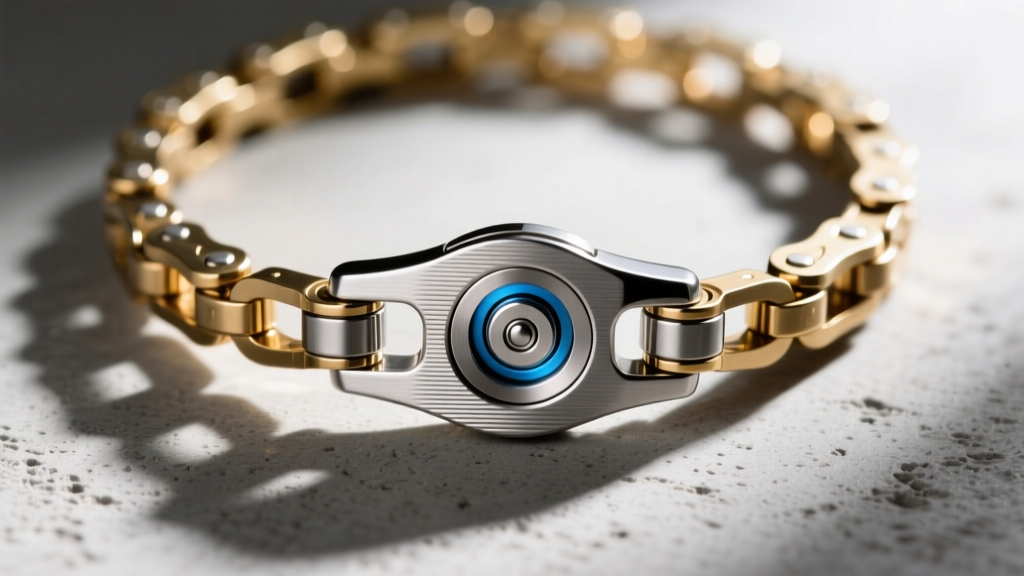
To resolve this, expert jewelers utilize custom-machined clasps. Neodymium magnetic clasps (N52 grade) encased in CNC-milled titanium or stainless steel housings are currently the industry standard for heavy upcycled chains. These provide a secure hold capable of withstanding over 40 pounds of lateral pull while allowing for easy one-handed operation. Alternatively, custom pin-lock systems—where a threaded titanium rod screws through the final chain link pins into the clasp body—offer the highest security, effectively making the clasp as strong as the chain itself.
Corrosion Resistance and Maintenance Protocols
Maintenance protocols differ vastly depending on the material. Upcycled steel chains are highly susceptible to galvanic corrosion and ambient humidity. Even with a PVD coating, micro-abrasions from daily wear can expose the raw high-carbon steel beneath. Owners must avoid ultrasonic cleaners, which can degrade protective sealants, and instead use a soft microfiber cloth with a mild, non-abrasive jewelry polishing compound. If the chain features functional rollers (rather than solid cast pins), a microscopic application of dry PTFE lubricant on the pins will prevent squeaking and internal oxidation without transferring grease to clothing.
For 925 sterling silver replicas, standard tarnish prevention applies. Storing the piece in an anti-tarnish sulfur-absorbing pouch is mandatory, as the intricate crevices between the inner and outer plates make manual polishing of tarnished silver incredibly difficult. Brass replicas will develop a natural patina over time due to copper oxidation; this can be embraced for a vintage aesthetic or periodically stripped using a mild citric acid bath.
Sizing and Neckline Pairing
Due to the aforementioned polygon effect, sizing a 1/2-inch pitch bicycle chain necklace requires mathematical precision. You cannot simply add or remove half a link. Sizing must be done in full 1-inch increments. Consequently, high-end manufacturers include a secondary, fine-gauge extension chain at the clasp to allow for micro-adjustments in length.
Expert Insight: When styling a heavy, wide-pitch bicycle chain necklace, pair it with structured, high-neck garments like turtlenecks or collared shirts. The rigid structure of the fabric supports the weight of the chain and prevents the steel links from catching on delicate knits or silk blends, which can easily snag on the exposed chain pins.
Ultimately, the bicycle chain necklace is far more than a novelty accessory. It is a demanding piece of mechanical jewelry that requires a thorough understanding of metallurgy, weight distribution, and tolerance engineering. Whether you opt for the indestructible nature of upcycled AISI 1060 steel or the refined drape of a scaled-down 925 silver casting, respecting the mechanical origins of the chain ensures a piece that is both structurally sound and aesthetically striking.


