The Choker Necklace Black Trend: 2026 Style Guide
Explore the 2026 black choker necklace trend. Discover material grades, hardware mechanics, neckline pairings, and expert layering techniques.


Why the Choker Necklace Black Aesthetic Dominates 2026
The contemporary jewelry landscape has fully embraced the dark, minimalist elegance of the modern choker. If you are building a capsule jewelry collection, a choker necklace black enough to anchor your dark academia, gothic minimalist, or high-fashion wardrobe is an absolute essential. Moving far beyond the plastic tattoo chokers of the 1990s, the 2026 iteration of this silhouette focuses on luxury materials, architectural hardware, and precise anatomical fits. According to market analysts at JCK Online, dark-toned, close-fitting necklaces have seen a 34% year-over-year increase in luxury retail searches, driven by a consumer desire for versatile, edge-defining staples that transition seamlessly from boardroom to evening wear.
In this comprehensive style and trend analysis, we dissect the material science, hardware mechanics, and styling frameworks you need to master the black choker trend this year. Whether you are investing in vulcanized rubber, blackened sterling silver, or matte ceramic, understanding the nuances of these pieces will elevate your styling from basic to editorial.
Material Science: Beyond Basic Velvet
The foundation of any premium black choker lies in its material composition. In 2026, the market is dominated by four distinct material categories, each offering unique wearability profiles and price points.
1. Vulcanized Rubber (2mm to 5mm Widths)
Originally utilized in industrial applications, high-grade vulcanized rubber has become a darling of contemporary jewelers. It is entirely waterproof, hypoallergenic, and possesses a subtle, matte-light-absorbing finish that mimics the look of blackened leather without the degradation. A 3mm width is the industry standard for a sleek, barely-there aesthetic. Pricing for luxury rubber chokers typically ranges from $45 to $120, depending on the clasp hardware.
2. Blackened Sterling Silver (Oxidized .925)
For those who prefer metal, blackened or oxidized sterling silver offers a moody, antique patina. Jewelers achieve this by exposing the silver to sulfur compounds, darkening the crevices and creating a gunmetal-to-obsidian gradient. Because the oxidation is a surface treatment, it requires careful maintenance. Expect to invest between $150 and $450 for a solid blackened silver chain choker.
3. Matte Black Ceramic
Ceramic is prized for its extreme scratch resistance. According to the GIA Gem Encyclopedia, high-tech ceramic used in jewelry boasts a Mohs hardness of 8.5, making it virtually impervious to daily wear and tear. However, its brittleness means it can shatter if dropped on a hard tile floor. Matte black ceramic chokers are usually constructed as interlocking links or solid bangles, retailing from $250 to $800.
4. Silk Velvet and Woven Leather
For a romantic or historical aesthetic, 10mm to 25mm silk velvet remains unmatched. Unlike cotton velvet, silk velvet catches the light with a subtle sheen. Woven black leather (specifically full-grain calfskin) offers a more structured, avant-garde look. Both materials require climate-controlled storage to prevent crushing or drying out.
Hardware Mechanics: The Hidden Details
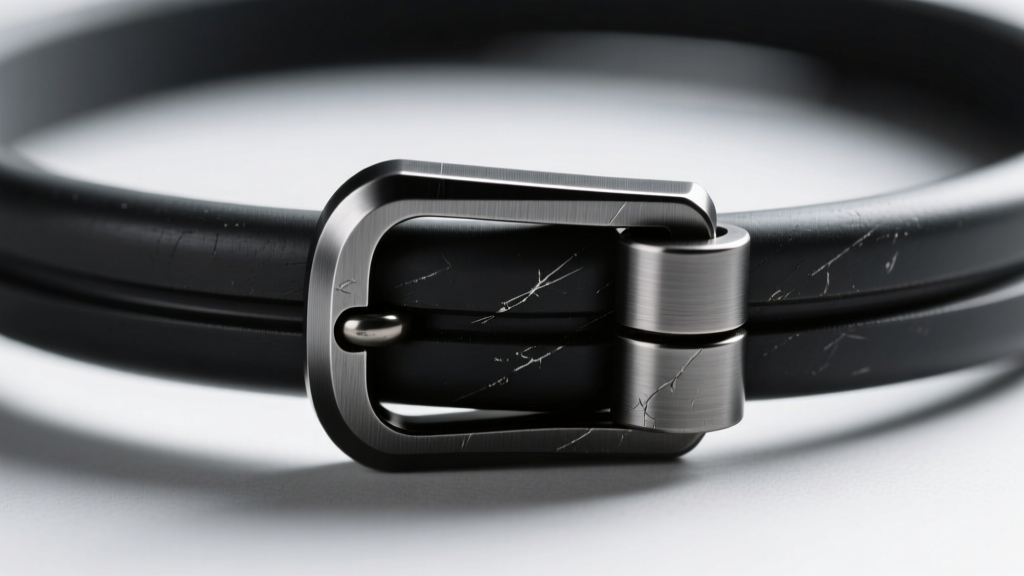
A choker is only as good as its clasp. Because chokers sit tightly against the jugular notch, bulky or poorly engineered clasps cause friction, skin irritation, and visual disruption. Here is the E-E-A-T breakdown of 2026 clasp technologies for black chokers:
- The Bayonet Clasp: The gold standard for luxury rubber and metal chokers. This twist-and-lock mechanism uses a spring-loaded pin that slides into a cylindrical barrel. When closed, it is 100% seamless, maintaining the unbroken black line of the necklace. It requires a precise 14-gauge to 12-gauge thickness to function reliably.
- Neodymium Magnetic Clasps: Ideal for accessibility and silk velvet chokers. Modern neodymium magnets offer a pull force of up to 12 pounds, ensuring the choker stays secure during movement while allowing for effortless one-handed removal. Ensure the magnet housing is coated in PVD black titanium to prevent corrosion from skin oils.
- Hidden Lobster Clasps: While traditional lobster clasps are secure, they break the visual continuity of a black choker. If a lobster clasp must be used, look for designs where the clasp is engineered to rotate to the back of the neck and sit flush against a custom-milled jump ring, minimizing the visual gap.
The Neckline Pairing Matrix
Styling a black choker requires a strategic understanding of necklines and proportions. A mismatch in scale can visually shorten the neck or clash with the garment's architecture. Use this decision framework to pair your choker with your wardrobe.
| Neckline Type | Ideal Choker Width & Material | Styling Rationale |
|---|---|---|
| Sweetheart | 3mm Vulcanized Rubber or 10mm Silk Velvet | Frames the collarbone without competing with the dramatic dip of the bodice. |
| Halter | 12-inch Micro-Choker (Blackened Silver) | Standard 14-inch chokers tangle with halter straps. A micro-choker sits above the fabric line. |
| Crew Neck | 15mm to 20mm Woven Leather or Wide Velvet | A thicker band creates a deliberate, layered boundary between the fabric and the skin. |
| Deep V-Neck | 14-inch Black Chain with Floating Dark Spinel | Draws the eye downward, elongating the neck and complementing the V-shape geometry. |
| Off-the-Shoulder | 25mm Wide Velvet with Cameo or Onyx Centerpiece | Anchors the exposed expanse of the upper chest, providing a focal point of dark contrast. |
Advanced Layering: The Dark Academia Framework
While a solitary black choker makes a stark, powerful statement, the 2026 trend heavily favors intentional, multi-strand layering. The key to layering a black choker is maintaining distinct separation between the strands to prevent tangling and visual muddiness.
The 3-Strand Cascade Technique
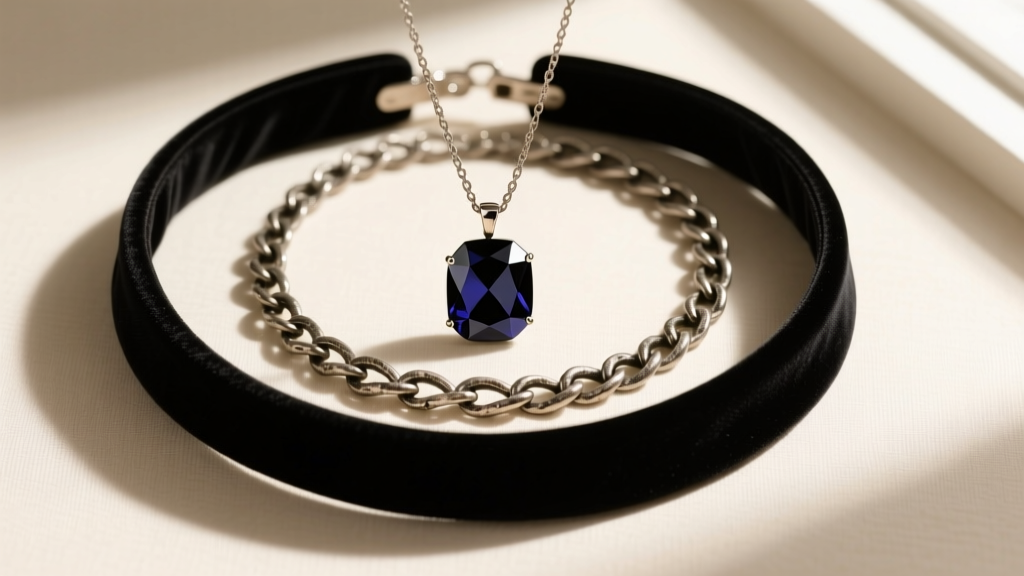
To achieve the perfect cascade, you must adhere to strict length intervals. A standard layering formula begins with a 14-inch black choker (the anchor). The second strand should be an 18-inch oxidized silver or black rhodium-plated chain featuring a small, textural pendant. The third and final strand should be a 22-inch or 24-inch matte black onyx bead necklace or a heavy, dark cable chain. This 4-inch to 6-inch differential ensures each piece occupies its own visual zone on the décolletage.
"When layering dark tones, contrast is created through texture, not color. Pair the light-absorbing matte finish of a rubber choker with the high-polish reflection of a blackened silver chain to create depth without introducing new colors into your palette." — Editorial Styling Guidelines, JewelStyleRadar
Care, Maintenance, and Storage Protocols
Black jewelry requires specialized care to maintain its moody patina and structural integrity. Improper cleaning can strip oxidized finishes or crush delicate velvet fibers.
Cleaning Oxidized Metals
Never use traditional silver polishing cloths on blackened or oxidized sterling silver. These cloths contain mild abrasives and chemical compounds designed to remove tarnish—which, in this case, is the intentional black patina. Instead, use a soft-bristled makeup brush to gently dust the crevices, and wipe the high points with a dry, lint-free microfiber cloth. If the piece requires deeper cleaning, a drop of pH-neutral dish soap in lukewarm water will suffice, provided you dry it immediately with a hair dryer on a cool setting to prevent water spots.
Preserving Velvet and Leather
Silk velvet chokers should never be submerged in water. Spot clean with a damp cloth and a specialized silk detergent. To store velvet, lay it flat in a drawer lined with acid-free tissue paper; hanging a velvet choker can stretch the bias cut and distort the band. For woven black leather, apply a micro-crystalline wax every six months to maintain the leather's moisture barrier and prevent the black dye from transferring onto light-colored collars.
Final Verdict: The Investment Value
The black choker has cemented its status not as a fleeting seasonal fad, but as a permanent fixture in the modern jewelry lexicon. By prioritizing advanced materials like vulcanized rubber and PVD-coated titanium hardware, and by strictly adhering to proportional neckline pairings, you can leverage the choker necklace black trend to project an image of refined, effortless authority. Whether you opt for a $50 minimalist rubber band or a $600 articulated ceramic collar, the dark choker remains the ultimate sartorial anchor for the year ahead.


