Black Diamond Necklace Womens Guide: Cuts, Carats & Settings
Explore the gemology, structural settings, and chain mechanics of a black diamond necklace. Womens technical guide to carbonado vs. treated stones.

The Gemology of Black Diamonds: Carbonado vs. Treated vs. CVD
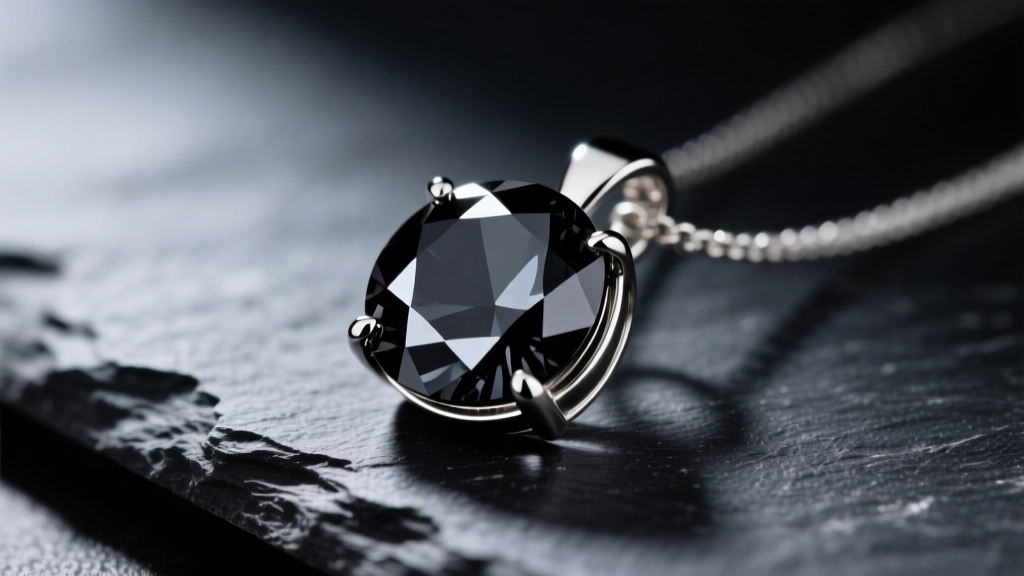
When evaluating a black diamond necklace womens collectors and jewelry enthusiasts must first understand the gemological origins of the stone. Unlike traditional white diamonds, which are valued for their lack of color and high refractive index, black diamonds derive their appearance from massive light absorption. According to the Gemological Institute of America (GIA), there are three distinct categories of black diamonds on the 2026 market, each with vastly different structural properties and price points.
Natural Carbonado: The Polycrystalline Anomaly
Natural black diamonds, known as carbonados, are found almost exclusively in Brazil and the Central African Republic. Unlike monocrystalline diamonds, carbonado is a polycrystalline aggregate composed of millions of microscopic diamond crystals bound together by a matrix of graphite and amorphous carbon. This structure makes carbonado incredibly tough—highly resistant to chipping along cleavage planes—but also inherently porous. The dark color is caused by numerous dark inclusions (graphite, pyrite, or hematite) that permeate the stone.
Irradiated Natural Diamonds
The majority of commercial black diamonds are actually low-clarity white diamonds (typically I2 or I3 clarity grades) that have been subjected to neutron irradiation. This process creates lattice defects that absorb visible light. A subsequent heating process stabilizes the color, resulting in a uniform, opaque black stone. While chemically identical to high-clarity white diamonds, their structural integrity can sometimes be compromised by the intense radiation and heat treatment.
Lab-Grown CVD Black Diamonds
By 2026, Chemical Vapor Deposition (CVD) technology has perfected the creation of lab-grown black diamonds. By introducing high levels of boron gas during the growth phase, manufacturers create stones that are structurally identical to natural blue or black diamonds. These stones are non-porous, lack the graphite inclusions of carbonado, and are significantly more affordable.
Technical Specifications & Market Grading Metrics
Because black diamonds are completely opaque, the traditional GIA D-to-Z color scale and clarity grading systems do not apply. Light does not pass through the stone to reveal inclusions, nor does it reflect back to the viewer. Therefore, grading focuses entirely on carat weight, cut precision, and surface luster. The American Gem Society (AGS) emphasizes that cut quality in opaque stones is measured by symmetry and polish rather than light return.
| Metric | Natural Carbonado | Irradiated Natural | Lab-Grown CVD |
|---|---|---|---|
| Crystal Structure | Polycrystalline | Monocrystalline | Monocrystalline |
| Mohs Hardness | 10 (but porous) | 10 | 10 |
| Typical Treatments | None (Natural) | Neutron Irradiation + Heat | Boron Doping |
| 2026 Price Range (per ct) | $1,500 - $3,500 | $300 - $800 | $100 - $300 |
| GIA Report Type | Identification & Origin | Color Origin Report | Lab-Grown Dossier |
Lapidary Choices: Why Brilliant Cuts Fail on Opaque Stones
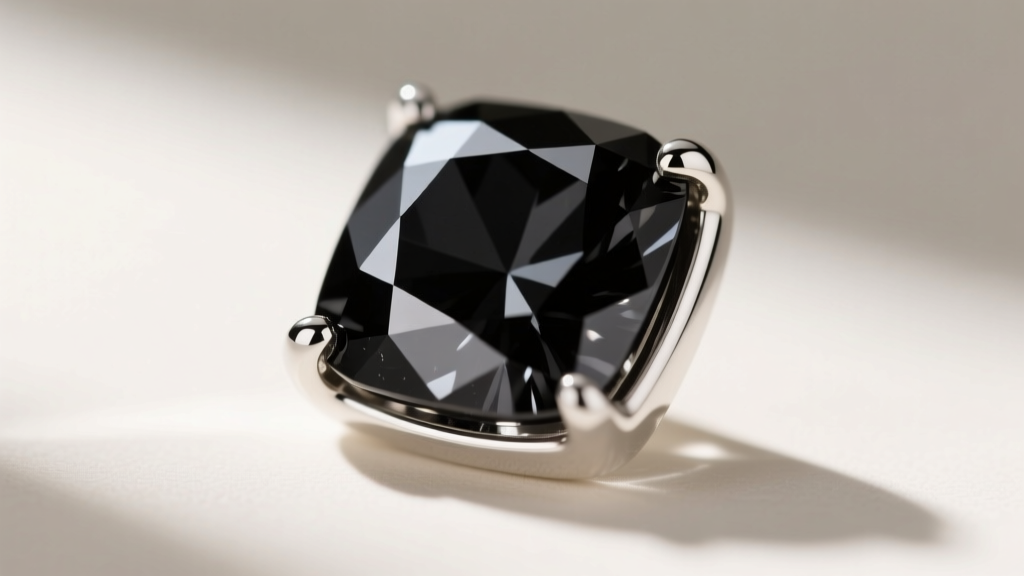
A common mistake in mass-market jewelry is cutting black diamonds into standard 57-facet round brilliants. The brilliant cut is engineered for total internal reflection—bouncing light off the pavilion facets and back through the crown. Because black diamonds absorb light, a brilliant cut yields no optical benefit and merely wastes precious rough material.
The Superiority of Rose and Step Cuts
Expert lapidaries maximize the visual impact of black diamonds through cuts that emphasize surface luster and geometric silhouette:
- Rose Cut: Featuring a flat base and a domed, faceted crown, the rose cut increases the surface area of the stone. This creates a subtle, metallic luster that catches ambient light across the crown facets, giving the stone a velvety, greasy sheen that is highly prized in avant-garde jewelry.
- Step Cuts (Emerald & Asscher):strong> These cuts rely on broad, flat planes. On an opaque black diamond, step cuts create an architectural, mirror-like surface that reflects the environment around the wearer, leaning heavily into the Art Deco revival trends dominating 2026.
- Cabochon: A smooth, unfaceted dome that highlights the stone's natural polish and is particularly effective for highly porous carbonado stones that might chip during faceting.
Structural Settings & Metallurgy for Opaque Stones
Setting a black diamond requires a departure from traditional prong mechanics. The girdle (the outer edge) of a natural carbonado is often highly porous and friable. Applying the localized pressure of a 4-prong or 6-prong setting can cause micro-fractures or catastrophic chipping over time, especially when subjected to the dynamic impacts of daily wear.
Bezel vs. Flush Settings
The optimal setting for a black diamond pendant is a full bezel. A bezel setting wraps a continuous ribbon of metal around the entire girdle, distributing pressure evenly and protecting the vulnerable edges from impact. Furthermore, because black diamonds do not emit fire or scintillation, they rely entirely on contrast to define their shape. A highly polished bezel in 18k white gold or 950 platinum creates a stark, high-contrast boundary that makes the opaque stone visually 'pop' against the skin.
Metallurgical Contrast
To enhance the Vantablack-like absorption of the stone, jewelers utilize specific alloys. 18k white gold (75% gold, alloyed with palladium) is typically flash-plated with rhodium. Rhodium has a reflectivity index that provides a brilliant white frame, maximizing the visual separation between the metal and the stone. Yellow gold, while traditional, often muddies the visual boundary of a black diamond unless the piece is designed with a specific vintage aesthetic in mind.
Chain Gauge & Suspension Dynamics
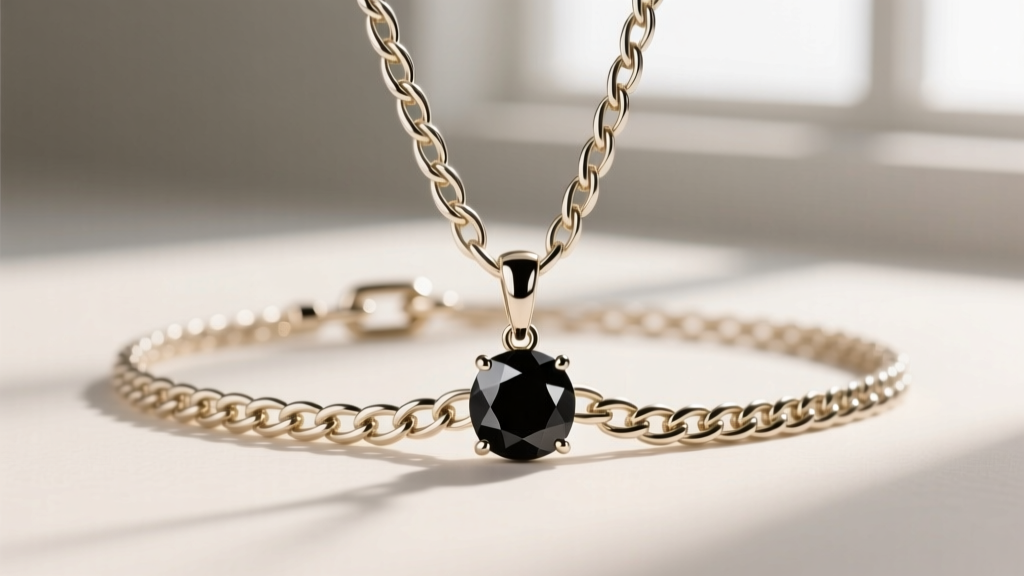
The suspension mechanics of a black diamond necklace are frequently overlooked, leading to catastrophic failure modes. A 3-carat carbonado set in a 950 platinum bezel and bail weighs approximately 2.8 grams. While this static weight seems negligible, the dynamic load—caused by the wearer turning quickly, catching the pendant on a garment, or sudden deceleration—can exert forces up to 8 times the static weight on the chain links.
Chain Weave Tensile Analysis
Selecting the correct chain gauge and weave is critical for heavy pendants:
- Cable Chain (0.8mm - 1.0mm): Standard for lightweight pendants. However, under dynamic shock, the single soldered links of a cable chain are prone to snapping at the solder joint. Not recommended for black diamond pendants exceeding 1.5 carats.
- Box Chain (1.2mm): Offers excellent tensile strength due to its interlocking square links. However, box chains are highly susceptible to kinking. Once a box chain kinks, the structural integrity of that specific link is permanently compromised.
- Wheat Chain (1.5mm): The gold standard for heavy pendants. The woven, multi-directional links distribute kinetic stress across a wider surface area. A 1.5mm solid 14k or 18k wheat chain boasts a break strength exceeding 12 kg, providing a massive safety margin for a 3-gram pendant while maintaining a fluid, textile-like drape.
Authentication and the 2026 Market Landscape
As lab-grown CVD black diamonds continue to saturate the market, the price gap between treated natural stones and lab-grown stones has widened. Consumers seeking a black diamond necklace womens styles must demand proper documentation. The GIA does not issue traditional grading reports for carbonado; instead, they provide a Colored Diamond Identification and Origin Report, which explicitly states whether the stone is natural, treated, or lab-grown.
When investing in natural carbonado, buyers should look for stones with a high degree of polish and minimal surface pitting. While porosity is a hallmark of natural carbonado, excessive surface pits can trap skin oils and cosmetics, dulling the stone's luster over time. Regular ultrasonic cleaning is generally safe for treated and CVD stones, but natural carbonado should be cleaned with a soft brush and mild degreaser to prevent the porous matrix from absorbing harsh chemical solvents.
Conclusion
A black diamond necklace is not merely a stylistic choice; it is a study in advanced gemology, structural engineering, and optical contrast. By prioritizing rose or step cuts, utilizing protective bezel settings in high-contrast white metals, and selecting a high-tensile wheat chain, wearers can ensure their jewelry is as technically sound as it is visually striking. Whether choosing a rare extraterrestrial carbonado or a flawless boron-doped CVD stone, understanding these technical parameters is the key to mastering the dark elegance of black diamond jewelry.


