Black Golden Necklace Guide: Ruthenium Plating & Alloys
Discover the metallurgy behind the black golden necklace. We analyze ruthenium plating, black rhodium, and gold alloys for lasting dark luxury.

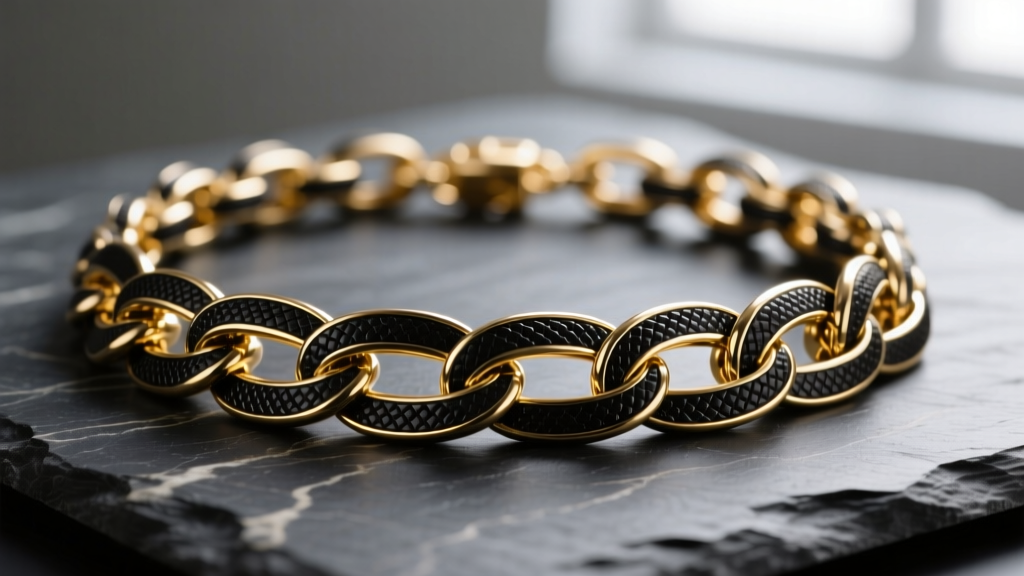
The Metallurgy of Black Gold: Separating Fact from Fiction
The term 'black gold' is one of the most widely misunderstood concepts in modern jewelry metallurgy. When consumers search for a black golden necklace, they are often under the impression that black gold is a naturally occurring alloy or a standard karat mixture like yellow, white, or rose gold. In reality, pure gold (Au) is inherently yellow. While alloying gold with copper creates rose gold, and alloying it with nickel, palladium, or silver creates white gold, there is no traditional karat alloy that yields a true black hue.
To achieve the striking, dark aesthetic of a black golden necklace, master jewelers and metallurgists must rely on advanced surface treatments, electroplating, or physical vapor deposition (PVD). The base of the jewelry is typically 14k or 18k yellow or white gold, which is then subjected to chemical or physical processes that alter the surface light absorption. Understanding these processes is critical for buyers, as the longevity, scratch resistance, and maintenance requirements of the necklace depend entirely on the specific blackening technique employed by the manufacturer.
Ruthenium vs. Black Rhodium: The Electroplating Debate
The most common method for creating a black golden necklace in the luxury sector is electroplating the gold substrate with a Platinum Group Metal (PGM). The two primary contenders for this process are Ruthenium and Black Rhodium. While both yield dark finishes, their chemical properties and wear characteristics differ drastically.
Ruthenium Plating
Ruthenium (atomic number 44) is a rare transition metal that naturally possesses a dark, gunmetal-gray to deep black color. When used in a galvanic bath, ruthenium is electrodeposited onto the gold surface. A standard ruthenium plating on a high-quality necklace ranges from 0.2 to 1.5 microns in thickness. On the Vickers Hardness (HV) scale, ruthenium scores approximately 230 HV, making it significantly harder and more scratch-resistant than the underlying 18k gold (which typically sits around 120 HV to 140 HV). This hardness makes ruthenium the premier choice for everyday chains and pendants that endure friction against the skin and clothing.
Black Rhodium Plating
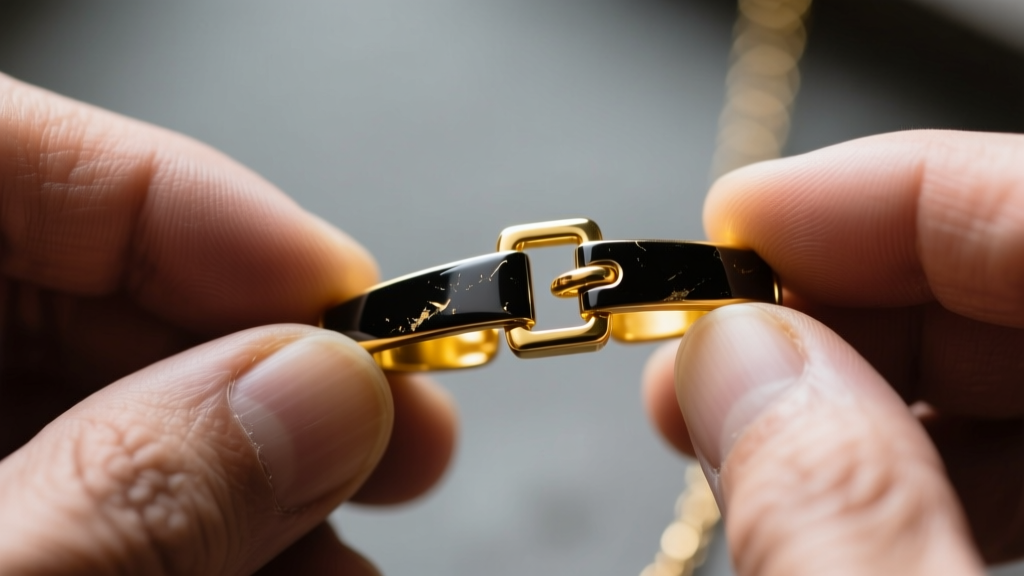
Rhodium (atomic number 45) is naturally a brilliant, silvery-white metal—the same metal used to plate white gold to give it a mirror finish. To create 'black rhodium,' jewelers introduce specific darkening agents, such as tin sulfate or organic sulfur compounds, into the rhodium sulfate electroplating bath. These compounds alter the crystalline structure of the deposited layer, causing it to absorb light rather than reflect it. However, black rhodium is inherently softer than ruthenium and more prone to micro-scratches. Over time, the high-friction areas of a black rhodium necklace (such as the clasp and the links resting against the collarbone) will wear through to the underlying gold much faster than a ruthenium-plated piece.
Advanced Surface Treatments: PVD and DLC Coatings
As of 2026, the jewelry industry has seen a massive shift toward Physical Vapor Deposition (PVD) and Diamond-Like Carbon (DLC) coatings, technologies borrowed from the aerospace and luxury watchmaking sectors. Unlike electroplating, which uses a liquid chemical bath and electrical current, PVD is a vacuum-based process where solid carbon or titanium is vaporized into a plasma and bombarded onto the gold necklace at a molecular level.
DLC coatings are exceptionally hard, often exceeding 7000 HV. However, applying a ultra-hard DLC coating over a relatively soft gold substrate creates a phenomenon known in materials science as the 'eggshell effect.' If the gold necklace is subjected to a heavy impact or bent out of shape, the soft gold underneath will deform, causing the rigid, ultra-hard DLC surface layer to crack or chip. Therefore, PVD and DLC blackened necklaces are best suited for rigid pendants or structural collar pieces rather than highly flexible, delicate chains.
Technical Comparison of Blackening Methods
| Method | Material Base | Coating Thickness | Vickers Hardness (HV) | Wear Resistance |
|---|---|---|---|---|
| Ruthenium Electroplating | Pure Ruthenium | 0.2 - 1.5 microns | ~230 HV | High (Excellent for chains) |
| Black Rhodium | Rhodium + Darkeners | 0.5 - 2.0 microns | ~150 HV | Moderate (Requires care) |
| DLC via PVD | Carbon Plasma | 0.1 - 0.5 microns | 3000 - 7000 HV | Extreme (But prone to chipping) |
| Oxidized Gold Alloys | Gold + Cobalt/Chromium | Surface Oxidation | ~400 HV | Low (Rare, mostly experimental) |
Gemstone Integration: Black Diamonds and Onyx
A black golden necklace is rarely a standalone metal piece; it is frequently anchored by dark gemstones that complement the moody aesthetic of the metal. Black diamonds and black onyx are the most prevalent choices, but their geological origins and treatment histories vary wildly.
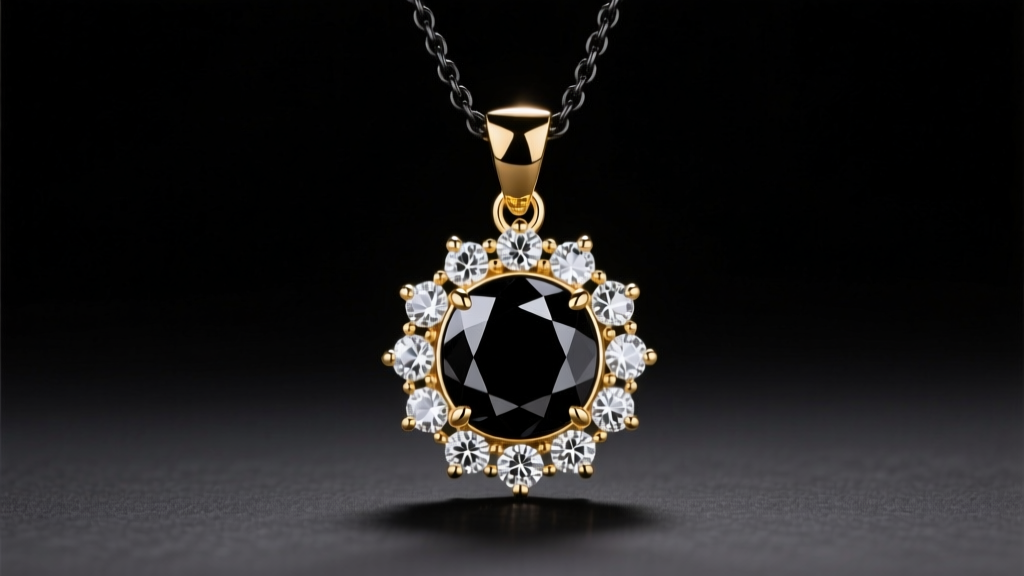
Natural black diamonds, often referred to as carbonado, are polycrystalline aggregates that are completely opaque due to numerous dark inclusions (graphite and sulfides). However, the vast majority of black diamonds used in commercial black golden necklaces are treated. According to the Gemological Institute of America (GIA), most commercial black diamonds start as low-clarity, heavily fractured gray or yellowish diamonds. They are subjected to high-energy neutron irradiation in a nuclear reactor, followed by high-temperature annealing. This process graphitizes the fractures, turning the stone a uniform, opaque black. When purchasing a black diamond pendant, buyers should always request a GIA or AGS report to verify whether the stone is natural carbonado or irradiated, as this significantly impacts the valuation and resale market.
Care, Maintenance, and Re-plating Protocols
Maintaining a black golden necklace requires a strict departure from standard gold care routines. The chemicals that keep yellow gold bright can actively destroy blackened surface treatments.
- Avoid Ultrasonic Cleaners: The high-frequency cavitation bubbles in ultrasonic baths can cause micro-fractures in PVD coatings and strip thin layers of black rhodium.
- Chlorine is the Enemy: Swimming pools and hot tubs contain chlorine, which reacts with the alloying metals in the gold substrate and can compromise the adhesion of the ruthenium or rhodium plating, leading to peeling.
- Polishing Restrictions: You cannot use standard jeweler's rouge or abrasive polishing cloths on a black golden necklace. Abrasives will instantly remove the micron-thin black layer, revealing the yellow or white gold beneath.
When a black golden necklace inevitably shows wear—typically around the clasp mechanism or the bail of the pendant—it must be sent back to a specialist for re-plating. The re-plating process is labor-intensive. The jeweler must first strip the remaining black plating via reverse electrolysis or careful mechanical buffing to ensure a perfectly smooth substrate. If the old plating is not completely removed, the new layer will adhere unevenly, resulting in a blotchy finish. As noted by Jewelers of America, regular maintenance and professional inspections are key to preserving the integrity of specialized plated jewelry. Expect to pay between $75 and $150 for a professional strip-and-replate service on a standard chain, a cost that should be factored into the long-term ownership of blackened gold pieces.


