Black Titanium Necklace Value: 2026 Cost & Durability Guide
Discover the true value of a black titanium necklace. We break down Grade 2 vs Grade 5 costs, PVD coating durability, and 2026 pricing tiers.

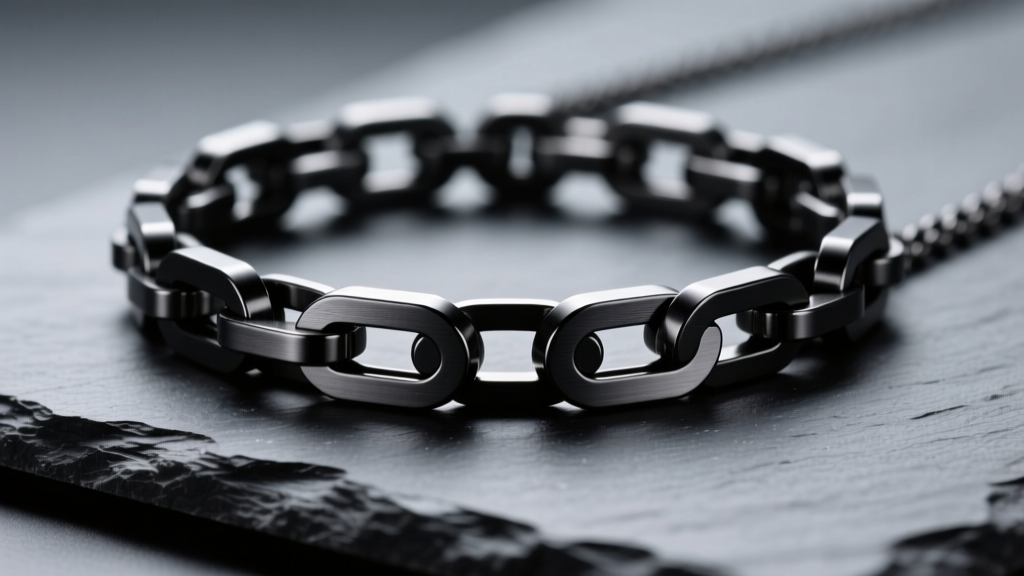
The True Cost of Black Titanium: Beyond the Price Tag
When shopping for a black titanium necklace, consumers are often met with a baffling price spectrum. You can find seemingly identical matte black chains and pendants selling for as little as $18 on fast-fashion marketplaces, while specialized artisan jewelers charge upwards of $250 for similar-looking pieces. As we navigate the 2026 jewelry market, understanding the true value of black titanium requires looking past the aesthetic and diving deep into metallurgy, coating technologies, and manufacturing realities.
Titanium is not a precious metal like gold or platinum; it holds virtually no intrinsic scrap value. Therefore, when you purchase a titanium necklace, you are paying entirely for the craftsmanship, the engineering of the hardware, and the durability of the surface treatment. In this comprehensive value assessment, we will break down exactly where your money goes, helping you distinguish between a disposable fashion accessory and a lifelong, durable piece of jewelry.
The Metallurgy of Value: Grade 2 vs. Grade 5 Titanium
The foundation of any titanium necklace's value lies in the specific alloy used. According to the International Titanium Association, there are dozens of titanium grades, but the jewelry industry predominantly relies on two: Grade 2 and Grade 5. The difference in raw material cost is negligible, but the difference in machining cost is massive, directly impacting the retail price and long-term durability of your necklace.
| Titanium Grade | Composition | Hardness (HV) | Machining Cost | Best Application | Expected Price Range |
|---|---|---|---|---|---|
| Grade 2 (CP) | 99% Pure Titanium | ~150 | Low | Stamped pendants, lightweight chains, wire-wrapping | $20 - $60 |
| Grade 5 (Ti-6Al-4V) | 90% Ti, 6% Al, 4% V | ~350 | High (Requires CNC & Carbide tooling) | Geometric pendants, heavy Cuban links, precision clasps | $85 - $250+ |
Grade 2 (Commercially Pure) is relatively soft for a metal. It can be easily stamped, bent, and soldered using traditional jewelry techniques. If you are buying a simple, flat dog-tag pendant or a lightweight rope chain, Grade 2 is perfectly adequate and offers excellent budget value.
Grade 5 (Aerospace Grade) is alloyed with aluminum and vanadium, making it more than twice as hard as Grade 2. It destroys standard steel jewelry tools, requiring expensive CNC milling machines and tungsten carbide bits to shape. When you pay a premium for a high-end black titanium necklace, you are paying for the machine time and tool wear required to cut Grade 5 titanium into sharp, precise, and burr-free geometric links.
The Color Conundrum: How Black Titanium is Actually Made
Titanium is naturally a vibrant silver-grey. It does not occur in black. To achieve the highly sought-after gunmetal or matte black finish, manufacturers must alter the surface of the metal. How this is done is the single biggest indicator of a necklace's long-term value and failure rate.
PVD vs. IP vs. Electroplating: A Durability Breakdown
The Ganoksin Jewelry Making Community notes that modern jewelry finishing has largely moved away from wet chemical processes in favor of vacuum-based technologies. Here is what you need to look for when assessing value:
- Electroplating (The Value Trap): Cheap necklaces often use black rhodium or black ruthenium electroplated over a base metal or low-grade titanium. This coating is incredibly thin (often less than 0.1 microns), prone to flaking, and will turn your skin green or grey as it degrades. Avoid this at all costs.
- IP (Ion Plating): A step up, IP uses an electrical charge to bond a thin layer of black material to the surface. It is common in mid-tier fashion jewelry but will still wear through at high-friction points (like the clasp) within 6 to 12 months of daily wear.
- PVD (Physical Vapor Deposition): This is the gold standard for black titanium. In a vacuum chamber, materials like Titanium Carbonitride (TiCN) are vaporized and bonded to the necklace at a molecular level. A high-quality PVD coating is 0.5 to 2.0 microns thick and boasts a Vickers hardness of up to 3000 HV—making the surface coating significantly harder than the titanium core. PVD will not flake or peel; instead, it wears away microscopically over years, revealing the natural silver titanium beneath.
Hidden Value Killers: Hardware and Failure Modes
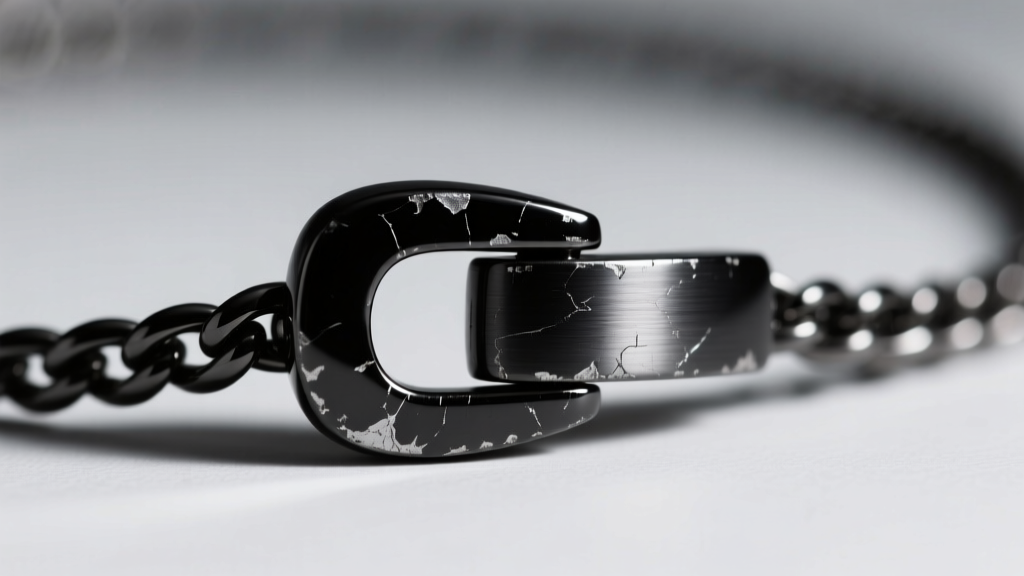
A common mistake when evaluating a black titanium necklace is focusing entirely on the chain links or the pendant while ignoring the hardware. The clasp and the jump rings are the most critical failure points in any titanium piece.
The Clasp Friction Problem: Titanium is notorious for galling—a form of wear caused by adhesion between sliding surfaces. When a titanium spring inside a titanium lobster clasp is subjected to repeated friction, it can seize or snap. High-value manufacturers solve this by using a marine-grade stainless steel internal spring mechanism housed within a PVD-coated titanium exterior shell. If a brand cannot tell you what metal their clasp spring is made of, assume it is a low-value point of failure.
Link Grinding and 'Silver Dust': If you purchase a black PVD-coated Cuban link chain, understand that the links will constantly grind against one another. Over time, this friction will wear away the black coating on the interior of the links, creating a fine silver dust that can transfer to your shirts. To maximize the visual longevity of a black titanium necklace, opt for rope chains, box chains, or snake chains, where surface-to-surface friction is minimized.
Hypoallergenic Value: The Hidden Medical Benefit
One area where a black titanium necklace provides immense, often overlooked value is in its biocompatibility. For the estimated 10-15% of the population that suffers from contact dermatitis triggered by nickel or copper, finding affordable, stylish jewelry is a constant struggle. Titanium is completely inert and widely used in surgical implants (ASTM F136 standards).
Unlike 'black gold'—which is often just white gold (containing nickel) plated with black rhodium that eventually wears off and causes allergic reactions—a PVD-coated black titanium necklace remains 100% hypoallergenic even if the black coating eventually wears thin. You are investing in a guaranteed, lifetime-safe material that will never react with your skin chemistry, regardless of sweat, lotions, or ocean water exposure.
2026 Market Pricing Tiers: What Should You Actually Pay?
Based on current manufacturing costs and Rio Grande Jewelry Supply material indexes, here is a realistic framework for assessing the value of a black titanium necklace in today's market:
Tier 1: Fast Fashion & Dropshipped ($15 - $35)
What you get: Grade 2 (or worse, titanium-steel blends), electroplated or thin IP black coating, hollow or semi-solid links, and fragile lobster clasps. Value Verdict: Poor. These pieces are essentially disposable. The coating will chip within months, and the clasps are prone to snapping.
Tier 2: Mid-Range Specialty Brands ($45 - $95)
What you get: Solid Grade 2 titanium, 1.0 to 1.5-micron PVD coating, decently machined links, and reliable stainless-steel-spring clasps. Value Verdict: Excellent for daily wear. This is the sweet spot for buyers who want the sleek black aesthetic without paying for aerospace-grade machining. Brands in this tier often offer 1-year coating warranties.
Tier 3: Artisan & CNC Machined Grade 5 ($120 - $250+)
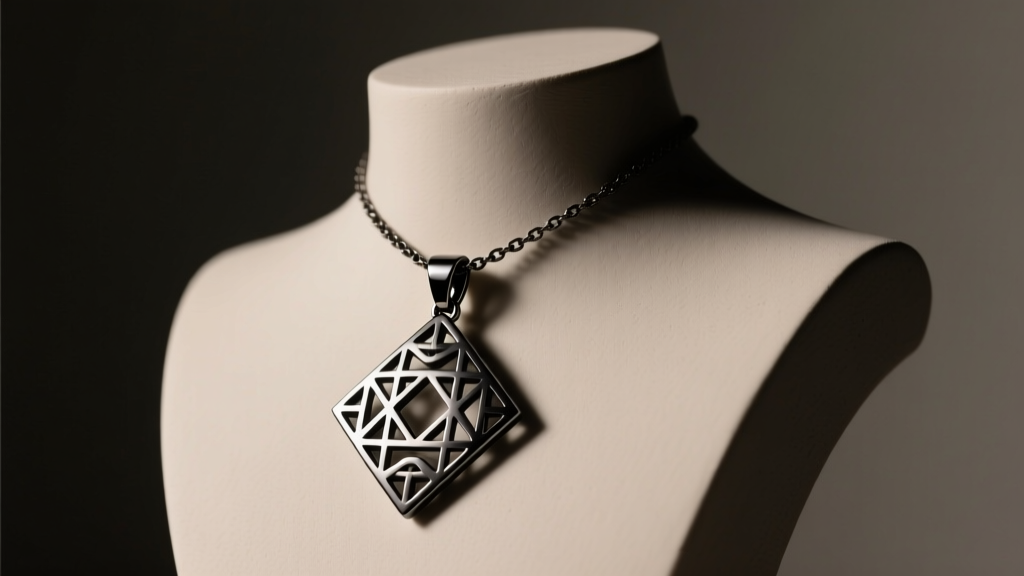
What you get: Grade 5 (Ti-6Al-4V) titanium, precision CNC-milled pendants with sharp geometric edges, heavy solid links, 2.0-micron premium PVD coating, and often magnetic neodymium clasps with titanium sleeves. Value Verdict: High value for enthusiasts and collectors. You are paying for permanent structural integrity, bespoke design, and a piece that will easily outlast a gold chain of similar weight.
Final Verdict: Is a Black Titanium Necklace Worth the Investment?
If you are looking for an asset that retains resale value, a black titanium necklace is a poor investment. However, if you are evaluating value through the lens of cost-per-wear, durability, and hypoallergenic safety, it is arguably the best value proposition in modern men's and minimalist jewelry.
To ensure you get your money's worth, demand transparency from the seller. Verify that the piece utilizes PVD coating rather than electroplating, confirm the clasp mechanism uses a steel spring to prevent galling, and choose Grade 5 if you are investing in a heavy, geometric pendant. By understanding the metallurgy and surface treatments behind the matte black finish, you can confidently purchase a necklace that will maintain its edge and integrity for decades.


