The Bladee Necklace Aesthetic: Heavy Silver & Gothic Pendants
Master the Bladee necklace aesthetic with our technical guide to heavy 925 silver chains, gothic pendant casting, and load-bearing clasps.

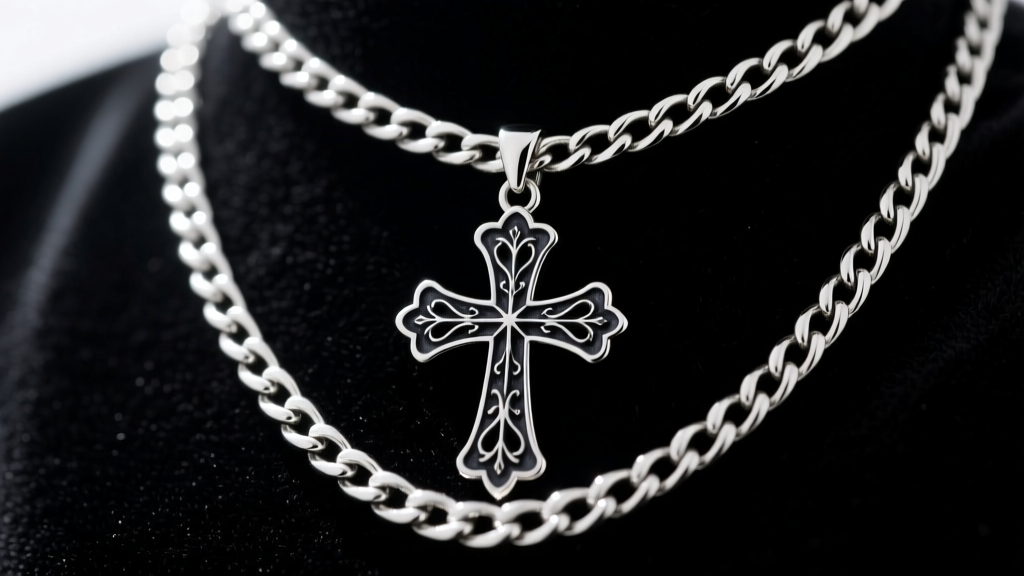
The Anatomy of a True Bladee Necklace
The term "bladee necklace" has evolved from a niche search query into a recognized category of contemporary men's and avant-garde jewelry. Popularized by Swedish artist Benjamin Reichwald (Bladee) and the broader Drain Gang collective, this aesthetic rejects delicate, minimalist jewelry in favor of oversized, heavy-gauge sterling silver, gothic motifs, and cyber-sigilism. As we navigate the custom jewelry landscape in 2026, the demand for these massive, armor-like pieces has pushed independent jewelers to refine their metallurgical and structural engineering techniques.
A genuine piece in this style is not merely a fashion accessory; it is a feat of wearable engineering. We are talking about pendants that routinely exceed 100 grams, suspended on chains that must withstand significant kinetic stress. To build, source, or authenticate a true Bladee-style necklace, one must understand the precise material grades, casting methods, and hardware tolerances required to keep these heavy silver artifacts intact.
Chain Metallurgy: Gauges, Links, and Weight Distribution
The foundation of any heavy silver necklace is the chain. Standard commercial chains will snap under the dynamic load of a 120-gram pendant swinging against the chest. The aesthetic demands thick, imposing links—typically ranging from 8mm to 14mm in width.
Solid vs. Hollow and Silver Alloys
Mass-market jewelry often utilizes hollow-core links to save on precious metal costs. For a Bladee necklace, hollow chains are strictly prohibited. The links must be solid cast or solid soldered. Furthermore, the alloy composition is critical:
- 925 Sterling Silver: The industry standard. Composed of 92.5% pure silver and 7.5% copper. The copper provides the necessary tensile strength to support heavy pendants without stretching.
- 999 Fine Silver: While technically "purer," fine silver is far too malleable. A 999 silver chain will quickly deform, and the jump rings will pull apart under a heavy gothic cross or dagger pendant.
- Argentium Silver: An upgraded alloy containing germanium. While it offers superior tarnish resistance, its higher cost and slightly different working properties make it less common in the underground custom scene, where traditional 925 is preferred for its predictable oxidation.
For a 10mm Cuban link chain, expect a weight of approximately 120 to 180 grams for a standard 22-inch length. When paired with a 100-gram pendant, the total necklace weight easily approaches 300 grams (over half a pound), requiring serious structural integrity.
Pendant Engineering: Gothic Motifs and Lost-Wax Casting
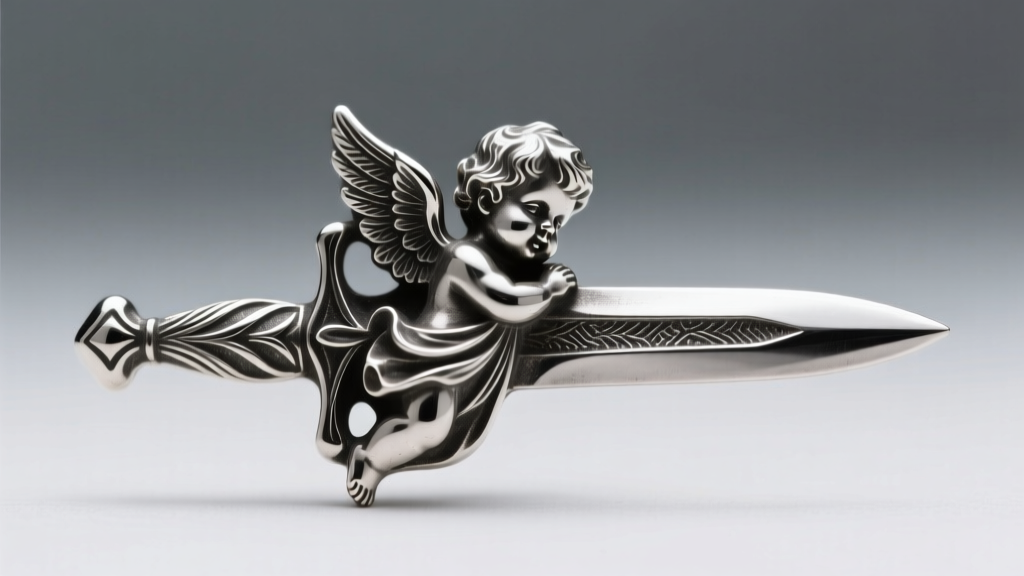
The visual signature of the Bladee necklace aesthetic lies in its pendants: barbed wire hearts, weeping cherubs, ornate gothic crosses, and cyber-sigilism daggers. Because these pieces are highly sculptural and feature deep undercuts, they cannot be stamped from sheet metal. They require advanced lost-wax casting techniques.
The CAD and Casting Process
In 2026, most high-end custom pieces begin in CAD software like MatrixGold. The designer must account for "sprue placement"—the channels through which molten silver flows into the mold. Poor sprue placement results in porosity (tiny air bubbles) inside the silver, creating weak points that can fracture under stress.
Once cast, the piece undergoes aggressive finishing. To achieve the signature grunge/gothic look, jewelers utilize Rio Grande liver of sulfur or specialized blackening solutions. This chemical reaction intentionally oxidizes the copper in the 925 alloy, turning the recessed areas pitch black while the high-polish raised surfaces remain bright silver. This contrast is what gives the intricate gothic typography and floral motifs their three-dimensional depth.
Hardware & Clasps: Preventing Catastrophic Failure
The most common failure point on a heavy silver necklace is the clasp. A standard 12mm lobster clasp attached to an unsoldered jump ring will inevitably fail when subjected to the sudden kinetic shock of a heavy pendant bouncing while the wearer walks or performs.
| Clasp Type | Max Safe Load | Pros & Cons for Heavy Pendants |
|---|---|---|
| Standard Lobster | ~40 grams | Inadequate for heavy pieces. The internal spring mechanism will warp, and the lever arm will bend outward. |
| Oversized Trigger Lobster | ~150 grams | Better, but requires a heavily soldered, thick-gauge jump ring to prevent the ring from pulling apart. |
| Custom Box Clasp | 250+ grams | The gold standard for heavy Cuban chains. Features a tongue-and-groove mechanism with a figure-8 safety catch. |
| S-Lock / Carabiner | 200+ grams | Highly secure and utilitarian, fitting the Y2K/cyberpunk aesthetic perfectly. Must feature a screw-lock gate. |
According to manufacturing standards outlined by organizations like Jewelers of America, any jump ring connecting a heavy pendant to a chain must be laser-welded or torch-soldered completely shut. Relying on tension-closed jump rings for a 100g+ pendant is a guaranteed path to losing a valuable piece of jewelry.
Sourcing and Authenticating Heavy Silver Pieces
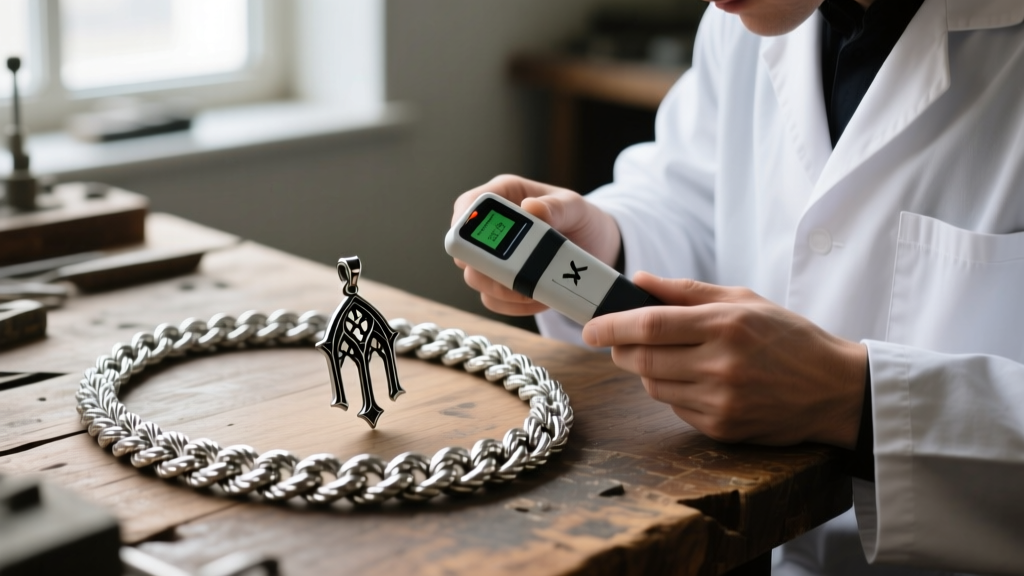
As the Bladee necklace aesthetic has surged in popularity, the market has been flooded with counterfeit pieces. These replicas are often made from zinc alloys, brass, or pot metal, and are merely flash-plated with a microscopic layer of silver. They mimic the look but lack the density, thermal conductivity, and intrinsic value of solid 925 silver.
Verification Techniques
When sourcing vintage or custom pieces from independent jewelers or secondary markets, you must verify the metallurgy:
- Weight and Density: Silver is dense. A 10mm solid silver Cuban chain should feel exceptionally heavy and cold to the touch. Pot metal replicas will feel suspiciously light and will warm to room temperature much faster.
- Magnetic Testing: Silver is diamagnetic. If a chain or pendant exhibits any magnetic pull, it contains iron or nickel and is an immediate fake.
- XRF Spectrometry: For high-value custom pieces, professional jewelers use X-Ray Fluorescence (XRF) guns to determine the exact elemental breakdown of the alloy, confirming the 92.5% silver content without damaging the piece.
- Hallmark Inspection: Look for the "925" stamp, often accompanied by a maker's mark. However, be aware that stamps can be easily forged on cast replicas, so this should be used in conjunction with weight and thermal tests.
Maintenance: Embracing the Oxidized Patina
Unlike traditional fine jewelry, where the goal is to keep the metal perpetually bright, the Bladee aesthetic often embraces a degree of grunge and wear. However, there is a difference between intentional, chemically set oxidation (patina) and accidental, environmental sulfur tarnish that leaves the piece looking dull and yellowish.
To maintain the high-contrast gothic look, avoid ultrasonic cleaners and harsh chemical silver dips. These will strip the intentional black oxidation from the deep crevices of the pendant, ruining the 3D effect. Instead, use a specialized silver polishing cloth (impregnated with mild micro-abrasives) to gently buff only the raised, high-contact areas of the chain and pendant. This preserves the dark recesses while keeping the edges bright, ensuring the necklace continues to project the heavy, dark, and meticulously crafted energy that defines the genre.
"The heavy silver movement isn't just about wearing jewelry; it's about wearing architecture. When a piece weighs a quarter of a kilo, it changes your posture, your presence, and how you move through space." — Independent Custom Jeweler, 2026
Ultimately, mastering the Bladee necklace aesthetic requires a rejection of fast fashion in favor of permanent, heirloom-grade metallurgy. By prioritizing solid 925 alloys, precise lost-wax casting, and load-bearing hardware, collectors can secure pieces that are as structurally sound as they are visually striking.


