Bolero Necklace Buying Guide: What to Look For in 2026
Discover our expert 2026 bolero necklace buying guide. Learn about multi-strand materials, clasp mechanics, sizing, and neckline pairings.


Defining the 2026 Bolero Silhouette
The bolero necklace has experienced a massive resurgence in 2026, transitioning from vintage costume jewelry boxes into the realm of fine, everyday layering. But what exactly defines a bolero necklace? Unlike a standard lariat or a western bolo tie, a true bolero necklace mimics the draped, open-front lapels of a bolero jacket. It typically features a multi-strand, woven, or heavily draped design that sits broadly across the collarbones and upper chest. Some contemporary variations include a central slide or a tie-front closure, but the hallmark of the style is its expansive, structured drape.
When shopping for a bolero necklace, buyers often confuse lightweight single-strand lariats with true multi-strand boleros. A genuine bolero design requires substantial hardware, precise tension balancing across multiple strands, and specialized clasps to support the weight. This buying guide breaks down the exact material grades, clasp mechanics, and structural details you need to evaluate before investing in this statement silhouette.
Material Integrity: Metals, Cords, and Threading
The longevity of a multi-strand bolero necklace relies entirely on its internal threading and metal purity. Because these necklaces often consist of three to seven individual strands of beads or chains, the tensile strength of the stringing material is critical.
Stringing Materials: Silk vs. Braided Nylon
Historically, high-end pearl and seed bead boleros were strung on pure silk cord. However, silk is highly susceptible to stretching under the cumulative weight of multiple strands and degrades rapidly when exposed to sweat and perfumes. In 2026, expert jewelers strongly recommend braided nylon (such as PowerPro or Fireline) or 0.015-inch stainless steel beading wire wrapped in a nylon sheath. These materials offer zero stretch and resist fraying at the crimp beads, which are the most common failure points in multi-strand jewelry.
Metal Purity and Plating Standards
If you are purchasing a gold-toned bolero necklace, you must understand the difference between flash plating, gold vermeil, and gold-filled wire. According to the Gemological Institute of America (GIA), genuine gold vermeil must feature a sterling silver base plated with at least 2.5 microns of 10k, 14k, or 18k gold. Many fast-fashion brands sell 'gold-plated' boleros with a brass base and a mere 0.5-micron flash coating, which will wear off within weeks of friction against the collarbone. Always look for the '925' hallmark stamped on the clasp or slide to verify a sterling silver base beneath the vermeil.
Clasp Mechanics and Failure Points
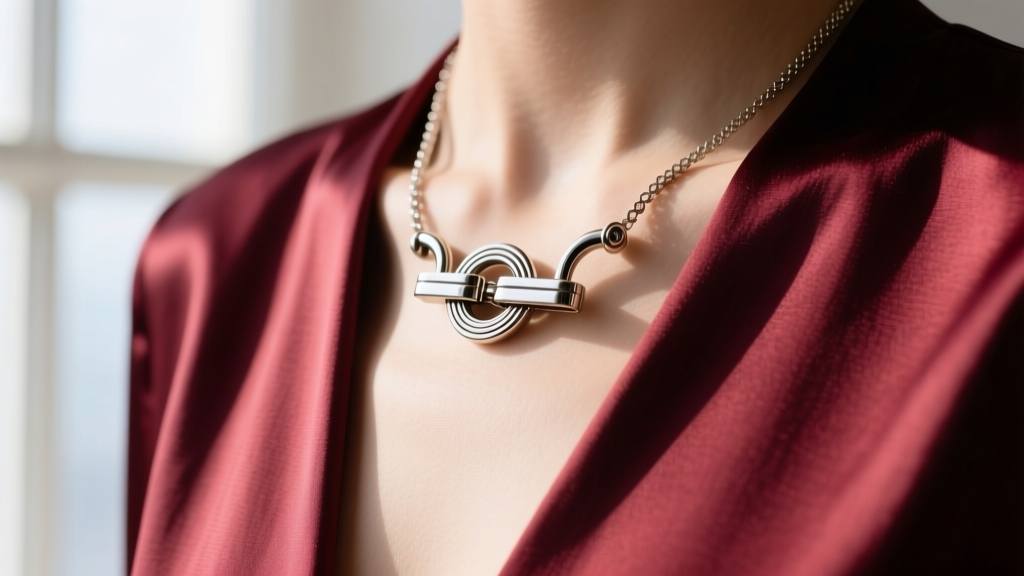
The clasp is the most vulnerable component of any bolero necklace. A multi-strand design can easily weigh between 40 and 80 grams, which is far too heavy for a standard 5mm lobster claw clasp. Using undersized clasps leads to bent jump rings, warped levers, and eventual loss of the piece.
- Magnetic Slide Clasps: The gold standard for heavy bolero necklaces. Look for clasps housing N52 grade neodymium magnets. Cheaper N35 magnets lack the pull-force to secure a 6-strand glass bead necklace and will snap open if caught on a chunky knit sweater.
- Friction Sleeve Slides: These feature a silicone O-ring inside the metal tube that grips the cord or chain. Ensure the silicone is replaceable, as it will naturally degrade and lose friction after 12 to 18 months of daily wear.
- Multi-Strand Toggle Clasps: If the design uses a toggle, the bar must be at least 20% wider than the interior diameter of the ring. For heavy boleros, a standard 15mm toggle is insufficient; seek out heavy-duty 25mm+ toggles with reinforced soldered jump rings.
Bolero Necklace Sizing & Neckline Pairing Matrix
Because bolero necklaces cover a wide surface area of the chest, pairing them with the correct neckline is essential to avoid a cluttered silhouette. Below is a structural pairing guide based on standard jewelry lengths and drape depths.
| Bolero Style / Length | Optimal Neckline Pairing | Styling Notes & Drape Mechanics |
|---|---|---|
| 16-Inch Multi-Strand Choker | Deep V-Neck or Plunge | Sits high on the collarbone; the V-neck provides negative space to balance the visual weight of the strands. |
| 18-Inch Woven Drape | Strapless or Sweetheart | Mimics a draped collar; requires a bare chest or smooth fabric to prevent the strands from catching on seams. |
| 22-Inch Lariat Tie-Front | Boatneck or Bateau | The horizontal line of the boatneck contrasts beautifully with the vertical drop of the lariat tie. |
| 24-Inch Scarf-Style Bolero | High Collar or Turtleneck | Worn over the fabric; requires a smooth, tight-knit base layer so the metal or beads do not snag on loose wool. |
Pricing Tiers and Market Benchmarks
Understanding the pricing landscape prevents overpaying for costume pieces masquerading as fine jewelry. In the current 2026 market, bolero necklaces are segmented into three distinct tiers:
1. Fashion & Costume ($45 - $150): Typically made with brass or copper bases, glass or acrylic beads, and nylon threading. Gold plating is usually under 1 micron. These are excellent for seasonal trend-wearing but will tarnish quickly if exposed to humidity.
2. Demi-Fine & Vermeil ($250 - $650): The sweet spot for most buyers. These feature a solid 925 sterling silver base, 2.5-micron 14k or 18k gold vermeil, and high-quality Miyuki Delica seed beads or freshwater pearls. Clasps are usually N52 magnetic or sterling silver toggles.
3. Fine Jewelry ($1,200 - $4,500+): Crafted entirely from solid 14k or 18k gold chains or wire-wrapped gemstones. These pieces use French wire finishing techniques at the clasp connections to prevent metal-on-metal abrasion and are strung on micro-jewelry cable wire for permanent durability.
Care, Storage, and Tangling Prevention
The number one complaint among bolero necklace owners is severe tangling. When three or more chains or bead strands are stored together, microscopic movements cause them to braid themselves into stubborn knots. To preserve the structural integrity of your bolero piece, never hang it on a standard jewelry tree. Gravity will pull the heavier strands downward, stretching the internal threading unevenly over time.
Instead, store the necklace flat in a lined jewelry box. Place a sheet of acid-free tissue paper between each individual strand before closing the clasp. If your bolero features a magnetic slide clasp, always store it clasped shut; leaving neodymium magnets exposed can attract metallic dust and debris from your environment, which will eventually scratch the gold vermeil finish and weaken the magnetic seal. For deep cleaning, the Jewelers of America recommends using a mild, phosphate-free dish soap and a soft baby toothbrush, avoiding ultrasonic cleaners entirely, as the high-frequency vibrations can shatter tension-set stones and fray silk or nylon threading at the crimp beads.


