Crafting a Real Garlic Necklace: Resin and Metal Techniques
Discover the technical craft behind the botanical garlic necklace. Learn resin encapsulation, electroforming, and chain gauges for organic apothecary jewelry.

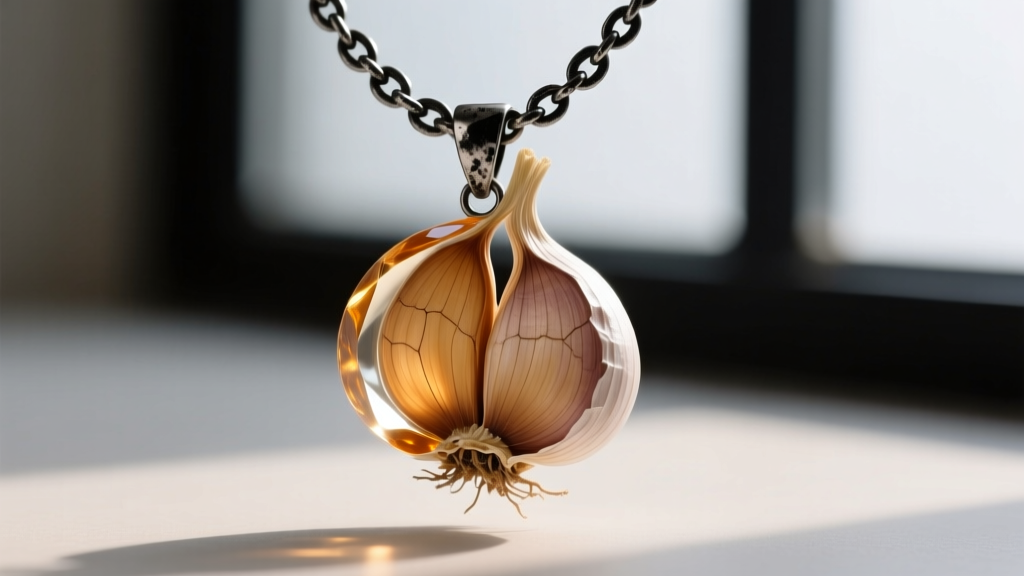
The Intersection of Botanical Preservation and Fine Jewelry
When most people hear the term "garlic necklace," they immediately think of cheap Halloween props or cinematic vampire deterrents. However, in the contemporary apothecary and witchy jewelry market, a genuine botanical garlic necklace represents a masterclass in organic stabilization and metallurgical craftsmanship. As of 2026, the demand for authentic, nature-based talismans has pushed jewelers to develop advanced techniques for preserving volatile organic matter like Allium sativum (common garlic) without sacrificing aesthetic clarity or structural integrity.
Creating a high-end garlic pendant is not as simple as dropping a raw clove into a silicone mold. Garlic contains high moisture levels, active enzymes, and sulfur compounds that will rapidly decay, discolor, and off-gas if improperly treated. This technical deep dive explores the exact material science, preservation protocols, and hardware specifications required to engineer a permanent, wearable garlic necklace.
Phase 1: Desiccation and Chemical Stabilization
The primary enemy of any organic jewelry inclusions is internal moisture. If a garlic clove is sealed with even a 5% residual moisture content, bacterial growth will occur within the encapsulation matrix, turning the clove black and fogging the surrounding medium. According to preservation standards documented by experts at Ganoksin, organic inclusions must undergo rigorous desiccation before any jewelry fabrication begins.
Silica Gel vs. Freeze-Drying
Traditional air-drying is insufficient for garlic, as it causes the clove to shrivel, lose its iconic plump geometry, and develop a leathery, opaque skin. Professional botanical jewelers rely on two primary methods:
- Submersion Desiccation: The clove is peeled and buried in fine-grain, indicating silica gel beads inside an airtight chamber for 14 to 21 days. The silica draws out moisture while allowing the clove to retain its original cellular volume.
- Lyophilization (Freeze-Drying):strong> For commercial-scale production, freeze-drying sublimates the ice directly into vapor under a vacuum. This preserves the garlic's exact dimensions and yields a chalk-white, highly porous clove that is exceptionally receptive to resin penetration.
Once desiccated, the clove must be sealed with a micro-thin layer of cyanoacrylate (CA glue) or a specialized sanding sealer to prevent it from absorbing atmospheric humidity or reacting with the encapsulation medium.
Phase 2: Encapsulation Matrices
With the organic matter stabilized, the jeweler must choose a housing matrix. The two dominant techniques in modern apothecary jewelry are deep-pour epoxy resin and copper electroforming.
Deep-Pour Epoxy Resin Encapsulation
Resin encapsulation provides a glass-like, protective sphere or teardrop around the garlic. However, not all resins are suitable. Standard UV resins cure too rapidly and generate an intense exothermic reaction. This heat spike will literally cook the garlic, releasing sulfur gases that become permanently trapped as micro-bubbles, ruining the clarity of the piece.
Expert Insight: Always use a low-VOC, slow-cure deep-pour epoxy (such as those formulated by ArtResin or similar 2:1 volume ratio epoxies). These formulations cure over 48-72 hours, keeping the exothermic temperature well below the threshold that damages organic tissues.
To achieve flawless, bubble-free clarity, the poured mold must be placed inside a pressure pot set to 40-50 PSI while the resin cures. This atmospheric pressure compresses any microscopic air bubbles trapped in the porous garlic clove to an invisible size.

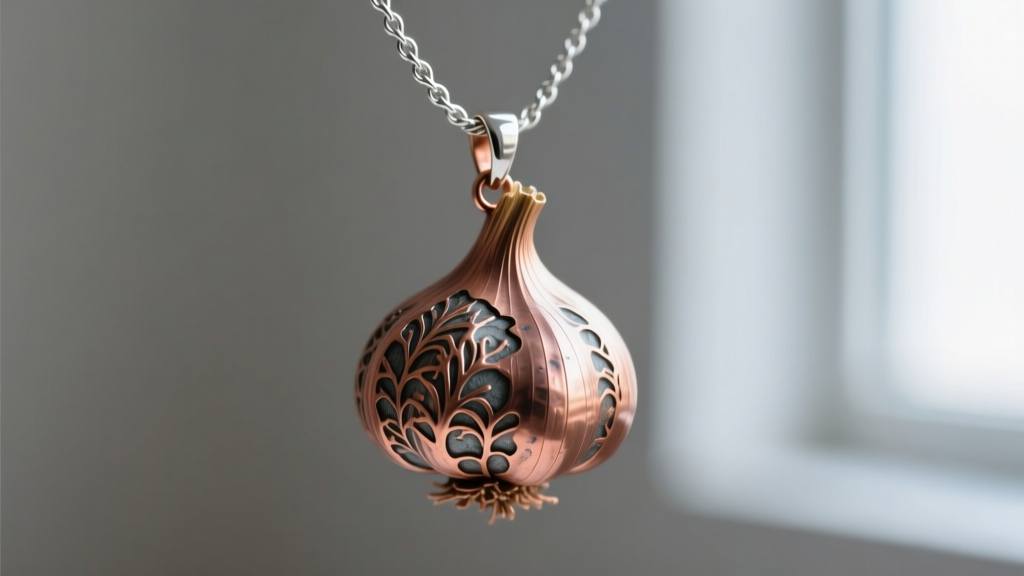
Copper Electroforming on Organic Matter
For a more rustic, gothic, or earthy aesthetic, jewelers utilize electroforming to encase the garlic in a solid shell of pure copper. This process requires painting the desiccated, sealed garlic clove with a conductive copper paint or graphite suspension. Once the conductive layer is dry, the clove is submerged in an electrolytic bath consisting of distilled water, copper sulfate (CuSO4), and a catalyst of sulfuric acid (H2SO4).
By running a low-voltage direct current (typically maintaining a current density of 0.1 amps per square inch), copper ions migrate from the anode and permanently bond to the conductive paint on the garlic. Over 12 to 24 hours, a thick, textured, metallic crust grows organically around the clove, partially or fully encasing it in a durable metal shell. The piece is then removed, neutralized in a baking soda bath, and sealed with a microcrystalline wax or clear lacquer to prevent the copper from oxidizing and turning the wearer's skin green.
Hardware Specifications: Bails, Chains, and Gauges
A botanical garlic necklace is only as durable as its weakest mechanical link. Because resin-encapsulated garlic pendants can be surprisingly heavy (often weighing between 15 and 35 grams depending on the volume of the resin pour), selecting the correct chain gauge and bail hardware is critical. Sourcing high-quality findings from established suppliers like Rio Grande ensures the tensile strength required for daily wear.
| Chain Type | Wire Gauge | Width | Tensile Strength | Best Application |
|---|---|---|---|---|
| Cable | 20g | 1.2mm | ~15 lbs | Lightweight, small resin teardrops |
| Rolo | 18g | 1.5mm | ~25 lbs | Medium electroformed pieces |
| Wheat | 16g | 2.0mm | ~40 lbs | Heavy, multi-clove statement pendants |
For the bail (the loop that connects the pendant to the chain), avoid simple glue-on bails. The chemical bond between cyanoacrylate adhesives and polished resin or wax-sealed copper will inevitably fail due to skin oils and temperature fluctuations. Instead, use a pinch bail embedded directly into the resin during the pouring phase, or a screw-eye bail threaded into a pre-drilled hole and secured with a two-part structural epoxy.
Common Failure Modes and Troubleshooting
Even experienced lapidaries and resin artists encounter specific failure modes when working with allium inclusions. Understanding these pitfalls is essential for quality control:
- Internal Fogging: Caused by incomplete desiccation or sealing. The moisture reacts with the resin's hardener, creating a milky, opaque halo around the clove. Solution: Extend silica drying time by 7 days and apply two coats of CA glue sealer.
- Resin Yellowing: Garlic contains natural pigments that can bleed into certain resin brands, especially when exposed to UV light. Solution: Use a resin formula with advanced HALS (Hindered Amine Light Stabilizers) and UV absorbers.
- Galvanic Corrosion: If an electroformed copper pendant is paired with a sterling silver chain without a protective jump ring barrier, moisture from the skin can create a galvanic cell, rapidly corroding the copper bail. Solution: Always use a stainless steel or brass jump ring to separate dissimilar metals, or apply a thick layer of jewelry-grade lacquer to the contact points.
Sourcing and Ethical Considerations
When crafting a garlic necklace for the commercial market, the origin of the botanical matter matters. Mass-produced, irradiated garlic from commercial supermarkets often lacks the robust cellular structure needed for jewelry preservation. Artisan jewelers frequently source heritage or hardneck garlic varieties from local organic farms. These varieties not only possess larger, more visually striking cloves with deep purple striping, but they also support sustainable agricultural practices. Furthermore, using cloves that are slightly past their culinary prime—but not yet rotting—is an excellent way to upcycle organic waste into permanent, wearable art.
Conclusion
The botanical garlic necklace has transcended its novelty roots to become a legitimate test of a jeweler's technical prowess. By mastering the delicate balance of organic desiccation, exothermic resin management, and precise metallurgical hardware selection, artisans can transform a perishable kitchen staple into an enduring piece of apothecary fine jewelry. Whether you prefer the crystal-clear suspension of a deep-pour epoxy or the rugged, alchemical texture of copper electroforming, the key to success lies entirely in the rigorous preparation of the organic core.


