Budget Guide: Buying a Necklace with Butterfly in 2026
Assess the true value of a necklace with butterfly in 2026. Compare materials, pricing tiers, and enamel types to find the best investment for your budget.

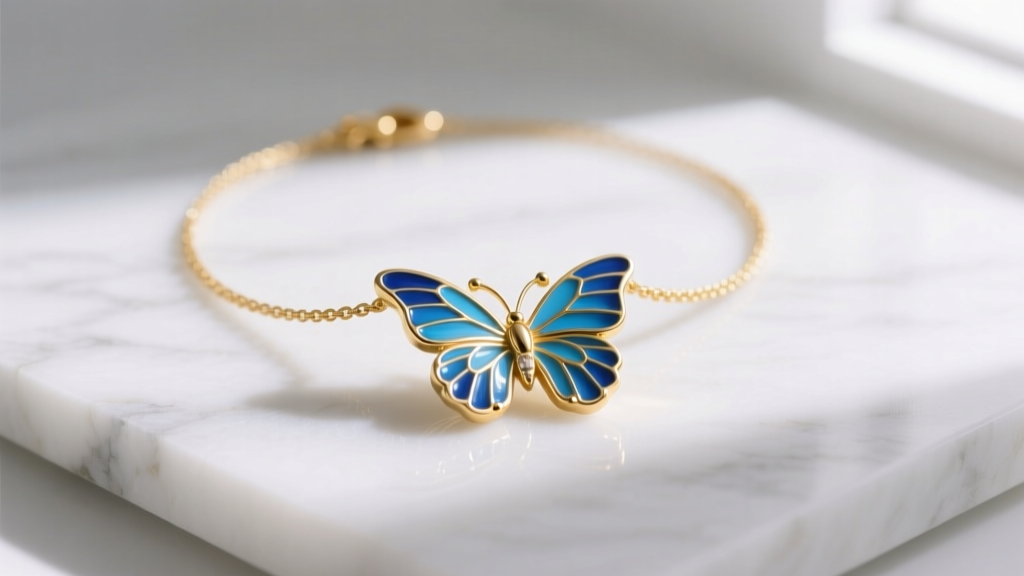
The 2026 Market Landscape for Butterfly Motif Jewelry
The lepidopteran motif has transcended fleeting Y2K nostalgia to become a permanent staple in modern jewelry design. However, as the demand for a necklace with butterfly pendants has surged, the market has become saturated with wildly varying price points. In 2026, consumers are faced with a confusing spectrum: from $18 fast-fashion brass pieces to $2,500 solid 18k gold and diamond masterpieces. For the savvy buyer, the challenge is no longer just finding a beautiful design, but accurately assessing the intrinsic value, material longevity, and structural integrity behind the price tag. This guide breaks down the exact metrics you need to evaluate before investing in butterfly jewelry.
Material Breakdown: What You Are Actually Paying For
The foundation of any necklace's value lies in its core metal and surface treatments. Butterfly pendants, with their intricate wings and recessed crevices, are particularly prone to trapping sweat, cosmetics, and moisture. This makes the choice of metal not just an aesthetic one, but a critical factor in the piece's lifespan.
Base Metals vs. Precious Metals
Budget necklaces (typically under $40) are almost exclusively cast in brass or copper and finished with a microscopic "flash" plating of gold or rhodium. According to the Federal Trade Commission Jewelry Guides, flash plating can be as thin as 0.1 microns. On a butterfly pendant, this plating will wear away from the high-friction edges of the wings within three to six months of daily wear, exposing the base metal to rapid oxidation and causing green skin discoloration.
True value begins at the "demi-fine" tier, which utilizes a 925 sterling silver core. However, buyers must scrutinize gold vermeil claims. Legitimate vermeil requires a minimum of 2.5 microns of gold over sterling silver. Many mid-tier brands in 2026 are quietly dropping their plating thickness to 1.0 microns to cut costs while still marketing heavily to the demi-fine demographic. Always demand a micron specification from the retailer.
The Enamel Factor: Cold Resin vs. Vitreous Enamel
Colorful butterfly wings are frequently achieved through enameling, but this is where the most deceptive pricing occurs in the jewelry market.
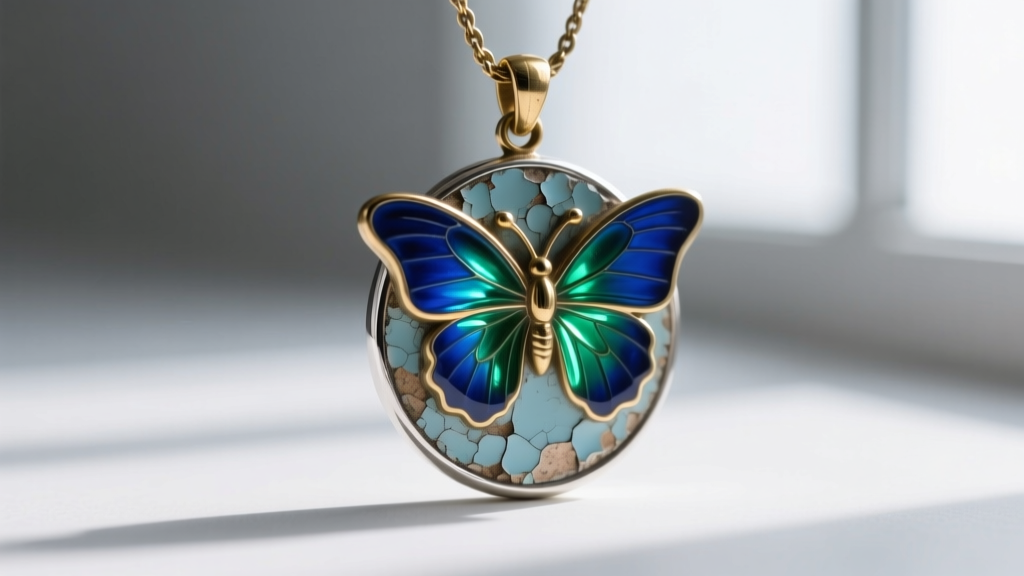
Cold Enamel (Epoxy Resin): Used in 90% of necklaces priced under $150. This is essentially a colored plastic resin poured into the metal bezel. The critical failure mode of cold enamel is shrinkage. Over 12 to 18 months, the resin cures further and shrinks, pulling away from the metal edges. This creates a microscopic gap where moisture enters, tarnishing the silver underneath and eventually causing the "enamel" to pop out entirely.
Vitreous Enamel (Fired Glass): Found in fine jewelry ($400+). This involves fusing powdered glass to the metal in a kiln at temperatures exceeding 1,400°F. Vitreous enamel will not shrink, yellow, or degrade. It is scratch-resistant and maintains its translucent, stained-glass luminosity for generations. If a brand charges premium demi-fine prices ($150-$250) for cold enamel, the piece is fundamentally overpriced.
Price Tier Comparison Chart
Use this matrix to benchmark the fair market value of a necklace with butterfly motifs in the current economic landscape.
| Tier | Core Metal | Enamel / Accents | Expected Lifespan | Fair Price Range (2026) |
|---|---|---|---|---|
| Fast Fashion | Brass/Copper Alloy | Cold Resin / Glued Glass | 3 - 9 Months | $15 - $45 |
| Demi-Fine | 925 Sterling Silver | Cold Resin / 1.0μm Vermeil | 1 - 3 Years | $60 - $130 |
| Premium Demi | 925 Sterling Silver | Vitreous / 2.5μm Vermeil | 5 - 10 Years | $140 - $280 |
| Fine Jewelry | Solid 14k/18k Gold | Vitreous / Pavé Diamonds | Lifetime / Heirloom | $550 - $2,500+ |
Chain and Clasp Hardware: The Hidden Value Indicators
A common trap when purchasing a necklace with butterfly pendant is focusing entirely on the motif while ignoring the chain. A heavy, solid-metal butterfly pendant suspended on a flimsy chain is a structural failure waiting to happen.
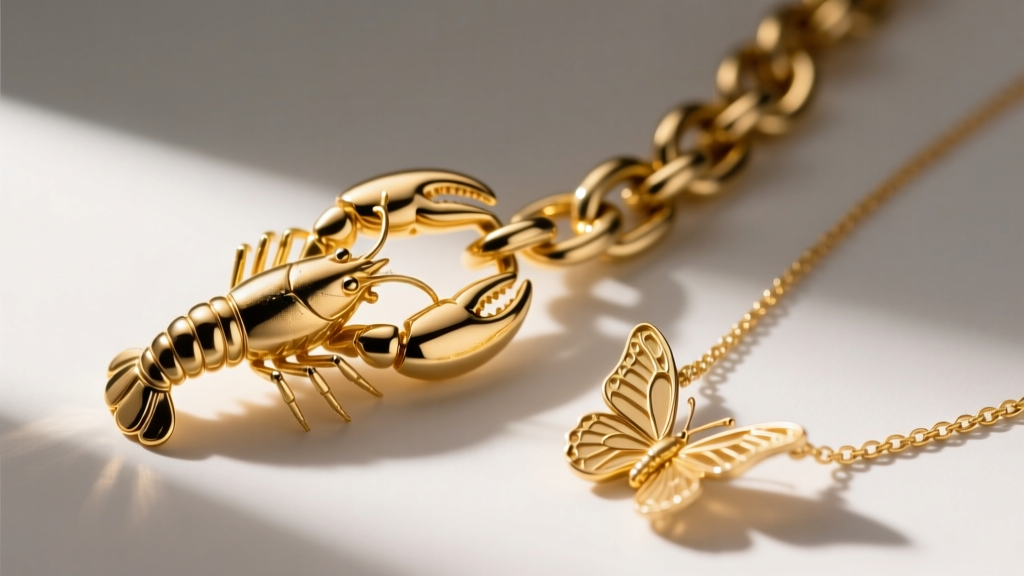
Many mid-tier brands pair beautiful pendants with 0.7mm or 0.8mm flash-plated cable chains to maintain profit margins. These thin chains are highly susceptible to kinking and snapping under the dynamic weight of a pendant. For true value, look for chains with a minimum gauge of 1.2mm to 1.5mm. Rolo chains and box chains offer superior tensile strength compared to standard cable or snake chains, which can easily dent and trap hair.
Furthermore, inspect the clasp. Spring-ring clasps are notoriously difficult to operate and feature thin internal springs that snap under pressure. A high-value necklace will always feature a solid lobster clasp, ideally with a soldered jump ring connecting it to the chain to prevent accidental unthreading.
Gemstone Accents: Micro-Pavé vs. Bezel Settings
When butterfly wings or thoraxes are accented with gemstones, the setting technique dictates the long-term value. Budget and lower-tier demi-fine pieces frequently utilize glue-set stones or 2-prong micro-pavé to maximize sparkle while minimizing labor costs. According to gemological standards outlined by the Gemological Institute of America (GIA), micro-pavé requires precise metal bead coverage to secure stones. In mass-produced butterfly pendants, these beads are often under-polished or too small, leading to rapid stone loss.
If you are spending over $200, demand 4-prong settings for accent stones like sapphires or tsavorites, or opt for bezel settings on the butterfly's body. Bezel settings use a continuous rim of metal to secure the gemstone, offering the highest level of protection against snagging on clothing—a common hazard with the protruding antennae and wingtips of butterfly designs.
How to Spot Overpriced "Demi-Fine" Butterfly Necklaces
The most dangerous purchases in 2026 are those that masquerade as investment pieces. To avoid overpaying, apply this quick value-assessment checklist before checkout:
- The Weight Test: Genuine sterling silver and solid gold have a specific density. If the pendant feels suspiciously light or "hollow," it is likely cast from a cheap zinc alloy or features an overly thin metal shell.
- The Hallmark Check: Look for a stamped "925", "14k", or "18k" on the back of the butterfly pendant or the clasp. Beware of stamps like "925" on pieces that are heavily magnetic—this indicates a brass or steel core with a silver wash.
- The Resin Edge Inspection: Zoom in on product photos. If the colored enamel sits slightly above the metal bezel or has a rounded, plastic-like meniscus, it is cold resin. Vitreous enamel is typically perfectly flush and polished flat against the metal.
- The Antennae Vulnerability: Butterfly antennae are fragile. High-value pieces will cast the antennae in a thicker gauge or integrate them into the bail (the loop that holds the chain) for structural reinforcement.
Final Verdict: Where to Allocate Your Budget
If your budget is under $50, embrace the fast-fashion tier but treat the necklace with butterfly pendant as a seasonal accessory. Remove it before showering and store it in an anti-tarnish bag to extend its brief lifespan.
For the $100 to $250 range, you are in the prime "value zone." Here, you should strictly demand a 925 sterling silver core, a minimum of 2.0 microns of gold vermeil (if not solid gold), and a 1.2mm rolo chain. Do not compromise on the chain quality to afford a slightly larger pendant.
For buyers with budgets exceeding $500, bypass demi-fine entirely and invest in solid 14k or 18k gold with vitreous enamel or ethically sourced diamond pavé. At this tier, the butterfly necklace transitions from a trendy accessory to a lasting heirloom capable of retaining intrinsic metal value and enduring decades of daily wear without structural degradation.


