Expert Cleaning and Care for a Byzantine Cross Necklace
Learn expert techniques to clean, polish, and maintain your Byzantine cross necklace. Discover safe solutions for silver, gold, and woven links.


The Anatomy of Dirt: Why Byzantine Chains Trap Grime
The Byzantine chain is a masterpiece of metalsmithing, characterized by its intricate 4-in-1 or 6-in-1 interlocking link pattern. While this dense, rope-like weave offers exceptional durability and a luxurious drape, it also creates a structural magnet for environmental debris. The tight tolerances between the links—often measuring less than a millimeter in gap width—trap sebum, dead skin cells, cosmetic residues, and airborne dust. When paired with a cross pendant, the complexity increases. The bail (the loop connecting the pendant to the chain) creates a high-friction pivot point. If microscopic silica and grit become trapped in this junction, they act like fine sandpaper, slowly grinding away the metal and compromising the structural integrity of the pendant's suspension.
Proper maintenance of a Byzantine cross necklace requires moving beyond superficial wiping. You must employ targeted chemical and mechanical cleaning protocols that respect the specific metallurgy of your piece while dislodging impacted grime from the deepest crevices of the weave.
Material-Specific Cleaning Protocols
Before applying any cleaning solution, you must identify the base metal of your necklace. Using the wrong chemical agent can result in irreversible surface damage, stripping, or accelerated corrosion.
Sterling Silver (925)
Sterling silver is highly susceptible to tarnishing, a chemical reaction where sulfur compounds in the air and on the skin form silver sulfide (a black or yellowish film). For standard high-polish silver Byzantine chains, an ionic exchange bath is highly effective. Line a glass bowl with aluminum foil (shiny side up), add one tablespoon of baking soda and a pinch of salt, and pour in boiling water. Submerge the chain for 3 to 5 minutes. The sulfur transfers from the silver to the aluminum. Critical Warning: If your cross pendant features intentional oxidation (antiquing) to highlight the intricate details of the cross, do not use this method, as it will strip the dark patina and leave the piece looking flat and washed out.
Solid Gold (14K & 18K)
Gold does not tarnish, but it readily attracts oils and lotions, which dull its luster and clog the Byzantine links. Create a cleaning solution using a pH-neutral dish detergent (such as Dawn Ultra) diluted at a 1:10 ratio with warm distilled water. Avoid tap water, as the dissolved minerals and chlorine can leave microscopic water spots on high-karat gold. Let the necklace soak for 15 minutes to soften the sebum buildup before proceeding to mechanical agitation.
Stainless Steel & Titanium
These modern, hypoallergenic metals are highly resistant to corrosion and tarnish. However, they show fingerprints and smudges easily. A simple wipe-down with a microfiber cloth dampened with 70% isopropyl alcohol is usually sufficient to cut through oils and restore the mirror finish without the need for prolonged soaking.
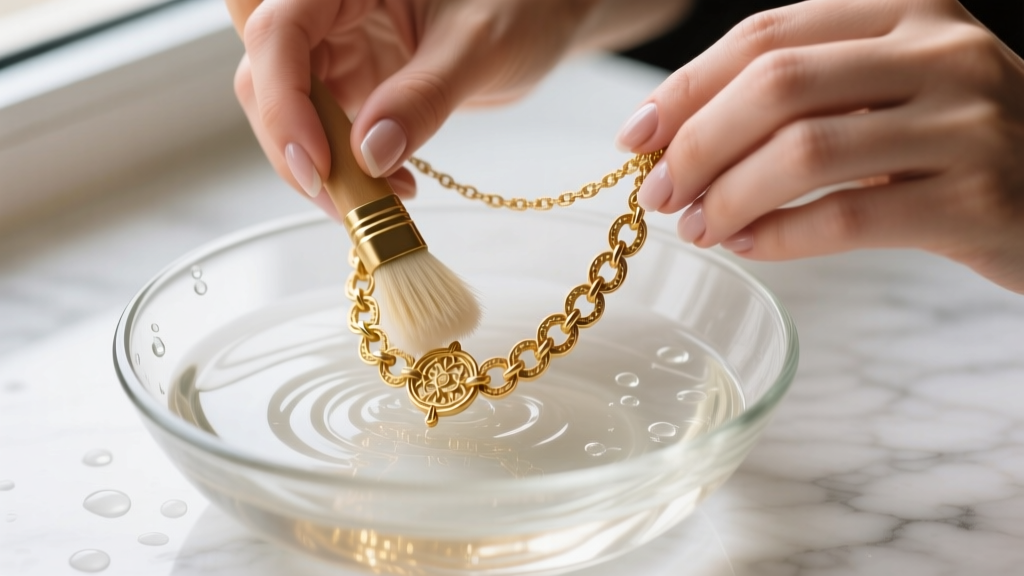
Step-by-Step Deep Cleaning Method
For heavily soiled gold or platinum Byzantine cross necklaces, follow this professional-grade "Soak, Agitate, Flush" methodology recommended by experts at the Jewelers of America.
- The Soak: Submerge the necklace in the warm, pH-neutral soapy solution for 15 to 20 minutes. This breaks down the lipid bonds of skin oils trapped in the woven links.
- The Agitation: Use an extra-soft infant toothbrush (bristle diameter of roughly 0.1mm). Standard adult toothbrushes are too stiff and will inflict micro-scratches on polished metal. Gently brush along the grain of the Byzantine weave, paying special attention to the interior curve of the chain and the bail of the cross pendant.
- The Flush: Rinse the necklace under a gentle stream of lukewarm distilled water. Do not use high water pressure, which can bend delicate outer links if the chain is a lightweight gauge (e.g., under 2.5mm).
- The Dry: Pat the chain dry with a lint-free microfiber cloth. To ensure no moisture remains in the tight link tolerances, use a hairdryer on the "cool" setting to blow out residual water droplets. Trapped moisture can lead to localized corrosion, especially in lower-karat gold alloys or silver.
The Cross Pendant: Navigating Crevices and Gemstones
Cross pendants often feature deep relief carvings, filigree work, or gemstone settings that require specialized care. If your cross is set with diamonds, sapphires, or rubies (Mohs hardness 8-10), they can safely withstand the soaking and brushing methods described above. However, if your pendant features porous or fracture-filled stones such as turquoise, opals, emeralds, or pearls, you must avoid submerging them in water or exposing them to ultrasonic cleaners. The high-frequency vibrations of an ultrasonic bath can shatter emeralds or shake loose the adhesive used in pearl settings.
For gemstone-set crosses, use a damp cotton swab to carefully clean around the prongs and bezels. According to the Gemological Institute of America (GIA), regular inspection of prongs is crucial; if your cotton swab catches on a prong, it indicates the metal has lifted and the stone is at risk of falling out.
Cleaning Agents: What to Use vs. What to Avoid
| Agent Type | Examples | Safe For | Avoid On |
|---|---|---|---|
| pH-Neutral Detergent | Dawn Ultra, Ivory | Gold, Platinum, Steel, Diamonds | Porous stones (if soaked) |
| Ionic Exchange Bath | Aluminum foil + Baking Soda | High-polish Sterling Silver | Oxidized/Antiqued Silver, Pearls |
| Commercial Dips | Tarn-X, Silver Dip | Heavy tarnish (with extreme caution) | Gold, Gemstones, Oxidized Silver |
| Abrasives | Toothpaste, Baking Soda paste | None (Avoid entirely) | All polished metals and stones |
| Solvents | Isopropyl Alcohol, Acetone | Stainless Steel, Titanium | Pearls, Amber, Plated metals |

Long-Term Maintenance and Storage Strategies
How you store your Byzantine cross necklace is just as critical as how you clean it. Because the woven links are prone to tangling and catching on other jewelry, this piece must be stored individually. Never toss it into a communal jewelry box where the cross pendant's prongs can snag on the delicate links of another chain.
Store the necklace in a sealed polyethylene plastic bag (avoid PVC, which emits gases that accelerate silver tarnishing). For sterling silver pieces, include a 3M anti-tarnish strip inside the bag. These strips absorb airborne sulfur compounds and can protect the silver for up to 12 months. Keep the bag in a cool, dark, and dry environment—high humidity and direct sunlight are the primary catalysts for rapid oxidation and material degradation.
Professional Servicing: When to See a Jeweler
While at-home maintenance is excellent for routine cleaning, a Byzantine cross necklace requires professional servicing every 2 to 3 years. A bench jeweler will use a high-pressure steam cleaner to blast out deeply impacted debris that a toothbrush cannot reach. Furthermore, they will inspect the solder points on the Byzantine links and the structural integrity of the cross pendant's bail. If your white gold cross has lost its bright white luster, a jeweler can re-apply a layer of rhodium plating, restoring its factory-fresh brilliance and providing a temporary barrier against skin acids.


