Expert Guide to Choosing a Chinese Turquoise Necklace
Discover the gemological secrets of a Chinese turquoise necklace. Learn about Hubei matrix patterns, stabilization treatments, and grading metrics.

The Gemological Profile of Hubei Turquoise
When evaluating a Chinese turquoise necklace, you are primarily looking at material sourced from the Hubei province, specifically the Yunxian and Zhushan mining districts. Unlike the uniform, matrix-free copper-rich deposits found in some American mines, Hubei turquoise is renowned for its complex geological formation. Chemically, it is a hydrous phosphate of copper and aluminum (CuAl6(PO4)4(OH)8·4H2O), but its localized mineral inclusions create striking visual diversity. According to Mindat.org, the presence of iron, vanadium, and barium in the host rock heavily influences both the color saturation and the matrix patterns that define Chinese turquoise in the global market.
Mohs Hardness and Porosity Metrics
Natural, untreated Hubei turquoise typically registers between 5.0 and 6.0 on the Mohs hardness scale. However, porosity varies wildly even within the same mine shaft. High-altitude extractions tend to yield denser, less porous "nuggets" that take an exceptional polish, while lower-elevation chalk turquoise requires heavy stabilization. Understanding this porosity is critical when selecting a necklace, as it dictates the stone's long-term durability and susceptibility to color shifts from skin oils and cosmetics.
Decoding the Matrix: Spiderweb vs. Solid
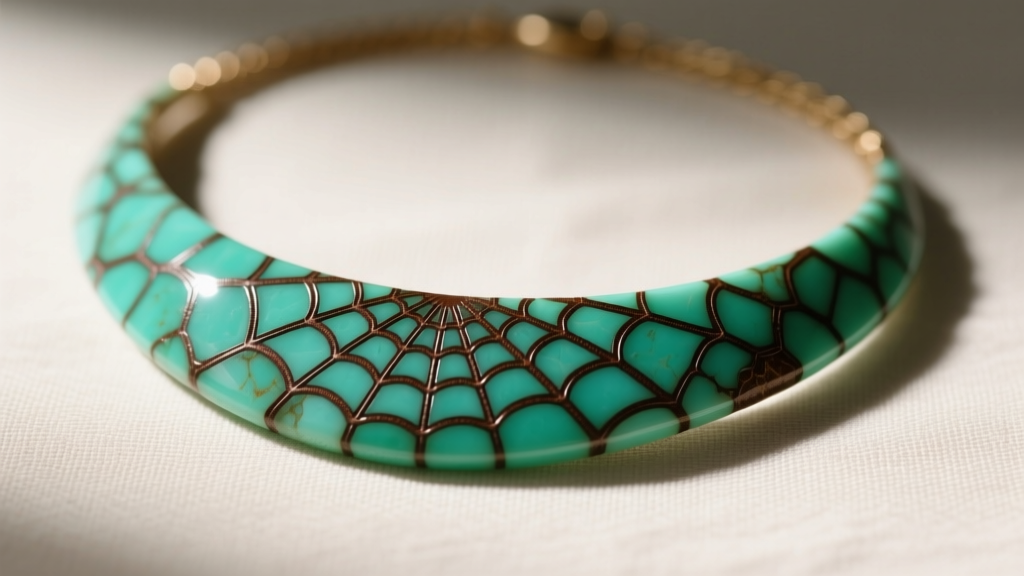
The matrix—the host rock trapped within the turquoise—is a primary value driver for a Chinese turquoise necklace. Hubei deposits are famous for their intricate "spiderweb" patterns.
- Brown Limonite Matrix: The most common and highly prized in Chinese specimens. A tight, uniform, dark brown web against a robin's egg or apple-green background commands premium pricing.
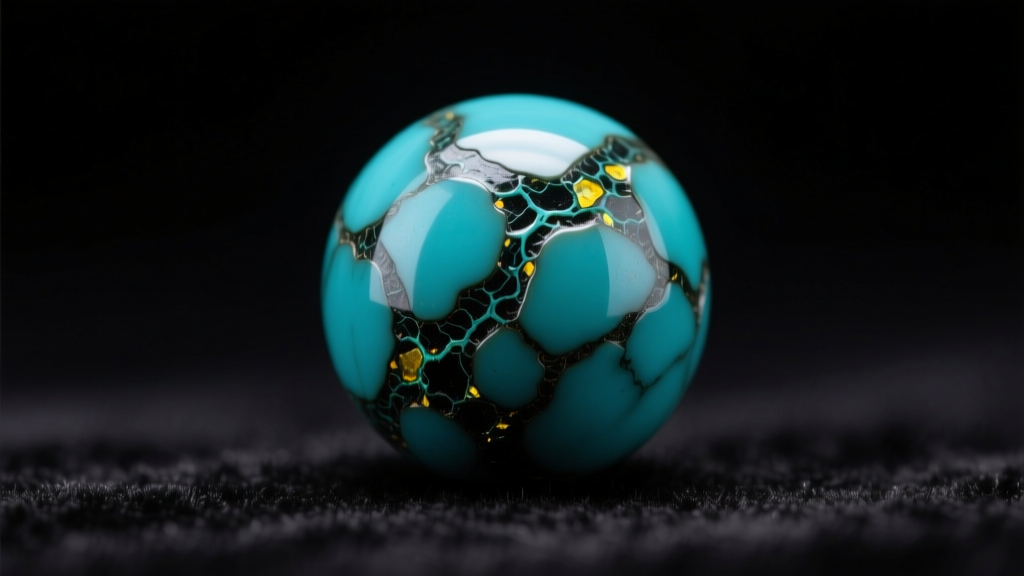
- Black Pyrite/Magnetite Matrix: Less common in Hubei than in Nevada's Lander Blue, but when present, it creates a high-contrast, dramatic aesthetic that appeals to contemporary jewelry designers.
- Sandstone Inclusions: Often appears as a tan or yellowish mottling. While visually interesting, sandstone is softer and more porous than the turquoise itself, creating structural weak points in bead drilling.
Treatment and Stabilization: What You Must Know
Because only a small percentage of mined turquoise is hard enough to be cut and polished without fracturing, stabilization is an industry standard. However, the type of treatment drastically alters the value of your necklace.
Expert Insight: The Zachery treatment method, which uses a proprietary chemical bath to reduce porosity without adding polymers or dyes, is highly respected. However, generic polymer impregnation (epoxy or acrylic resins) is far more common in commercial-grade Chinese turquoise. Always request a gemological report for high-value pieces to verify the absence of artificial dyes.
To identify heavily treated or dyed stones, gemologists use magnification to inspect the drill holes of the beads. If you see a dark blue "ring" around the drill hole while the interior of the bead appears pale or white, the stone has likely been surface-dyed. Furthermore, the Gemological Institute of America (GIA) notes that UV fluorescence can sometimes reveal polymer resins, though this is not a definitive standalone test due to the natural fluorescence of certain host minerals.
Comparative Analysis: Chinese vs. Global Origins
To understand where a Chinese turquoise necklace sits in the broader market, it is helpful to compare it against other major global sources. The table below outlines the technical and market differences as of 2026.
| Origin | Primary Mine Region | Typical Matrix | Avg. Hardness (Mohs) | 2026 Market Price (per gram) |
|---|---|---|---|---|
| Chinese (Hubei) | Yunxian / Zhushan | Brown Limonite Web | 5.0 - 6.0 | $15 - $45 (Natural High-Grade) |
| American | Sleeping Beauty, AZ | None / Minimal | 5.5 - 6.0 | $20 - $60 (Stabilized/Clean) |
| Persian (Iranian) | Nishapur | None / Limonite spots | 5.5 - 6.5 | $30 - $100+ (Natural Robin's Egg) |
| Mexican | Sonora / Zacatecas | Heavy Brown/Black | 4.5 - 5.5 | $5 - $20 (Mostly Stabilized) |
Necklace Construction and Stringing Mechanics
A critical, often overlooked aspect of buying a turquoise necklace is the structural integrity of the stringing. Turquoise beads, particularly those in the 10mm to 16mm range, carry significant weight. Using traditional silk thread is a catastrophic failure mode; silk degrades rapidly when exposed to the slight porosity of the stone, skin acidity, and environmental humidity.
Bead Sizing and Weight Distribution
For a standard 18-inch princess-length necklace featuring 12mm Hubei turquoise beads, the total stone weight will exceed 120 grams. This requires specialized stringing mechanics:
- Stringing Material: Use a 49-strand micro-fused stainless steel wire with a nylon coating (e.g., 0.024-inch diameter). This provides the drape of silk with the tensile strength of steel.
- Drill Hole Abrasion: Hubei turquoise often features sharp, unpolished interior drill holes. To prevent the wire from fraying, jewelers must use sterling silver or 14k gold French wire (bullion) at the clasp connection points.
- Crimp Beads vs. Knotting: If using wire, seamless sterling silver crimp tubes crushed with a micro-crimping tool are mandatory. If the necklace is knotted, synthetic Kevlar cord is the only acceptable alternative to silk.
Pricing Framework and Market Value
The market for Chinese turquoise has shifted dramatically over the last decade. Stricter environmental regulations in Hubei province have led to the closure of several open-pit mines, restricting the supply of raw, untreated material. As of 2026, a natural, high-grade Chinese turquoise necklace featuring tight spiderweb matrix and minimal stabilization will command between $15 and $45 per gram. For a 60-gram necklace, this translates to a retail value of $900 to $2,700.
Conversely, commercial-grade necklaces featuring heavily stabilized, dyed chalk turquoise are mass-produced and typically retail between $40 and $120 for the entire strand. When investing in fine Chinese turquoise, always prioritize the density of the stone, the natural origin of the color, and the precision of the bead drilling over sheer size.


