How to Choose and Style a Custom Family Crest Necklace
Discover how to choose, design, and style a family crest necklace. Learn about heraldry metals, engraving methods, and chain pairings in this guide.

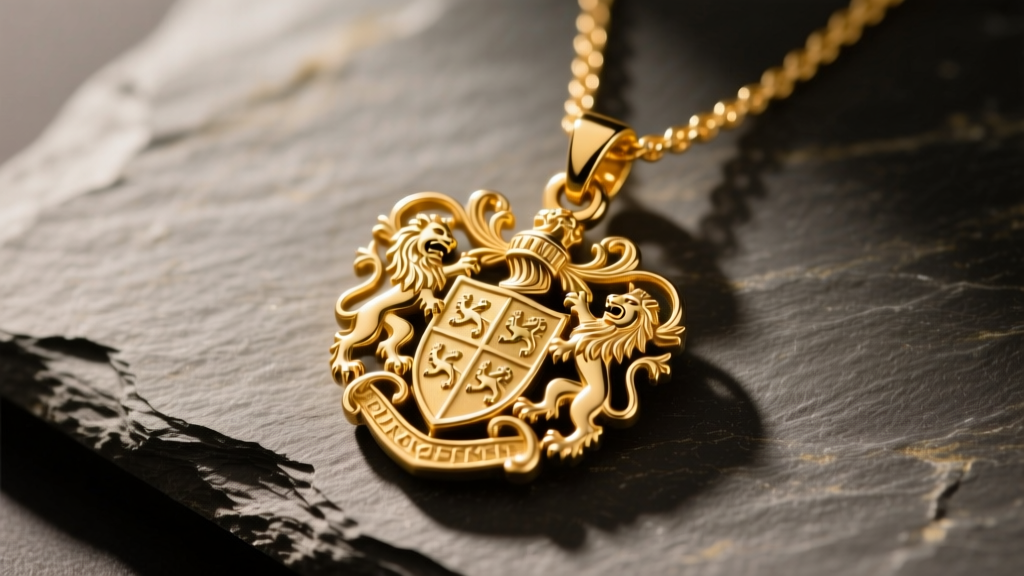
A family crest necklace is more than just a piece of jewelry; it is a wearable archive of your lineage. In recent years, heraldic pendants and signet-style necklaces have seen a massive resurgence, transitioning from traditional menswear staples to versatile, gender-neutral statement pieces. However, commissioning or buying a crest necklace requires navigating a minefield of historical inaccuracies, metallurgical choices, and structural considerations. This beginner-friendly explainer breaks down exactly how to source, design, and wear a family crest necklace with confidence and historical integrity.
Decoding Heraldry: Crest vs. Coat of Arms
Before you commission a pendant, you must understand what you are actually depicting. The terms 'family crest' and 'coat of arms' are frequently used interchangeably by commercial jewelers, but in heraldry, they mean entirely different things.
- The Coat of Arms: This refers specifically to the design on the shield (the escutcheon). It includes the geometric patterns, chevrons, and central motifs.
- The Crest: Technically, the crest is just the three-dimensional figure that sits on top of the helm (helmet) above the shield. Common crests include animals, feathers, or botanical motifs.
- The Full Achievement: This is the entire ensemble, including the shield, helmet, mantling, crest, and motto scroll.
When designing a family crest necklace, attempting to cram a full achievement onto a 22mm pendant usually results in a muddy, illegible design. Most expert jewelers recommend isolating either the shield (coat of arms) or the crest itself, paired with a simplified motto scroll, to maintain visual clarity at a small scale.
The 'Bucket Shop' Warning: Authenticating Your Lineage
Many mall kiosks and online novelty stores sell what heraldic scholars refer to as 'bucket shop' armorials. These vendors map a generic coat of arms to a surname, operating on the false premise that everyone who shares a last name is entitled to the same heraldry. In reality, authentic heraldic achievements are granted to specific lineages and descendants. To ensure your necklace is historically meaningful, consult authoritative genealogical resources like The Heraldry Society or the American College of Heraldry to trace your direct ancestral line before finalizing a design.
Material Choices for Crest Pendants
The metal you choose dictates the pendant's longevity, weight, and how well it holds intricate engraving. Because crest pendants are relatively dense, material costs scale quickly. Below is a breakdown of the most common metals used in heraldic jewelry.
| Metal Grade | Durability & Scratch Resistance | Engraving Quality | Estimated Price Range (22mm Pendant) |
|---|---|---|---|
| Sterling Silver (.925) | Soft; prone to scratching and tarnish | Excellent; highly malleable for deep cuts | $150 - $350 |
| 10k Yellow Gold | High; very hard and durable | Good; slightly brittle for ultra-fine details | $400 - $650 |
| 14k Yellow Gold | Optimal balance of hardness and malleability | Superior; the industry standard for hand engraving | $750 - $1,200 |
| 18k Yellow Gold | Soft; rich color but scratches easily | Exceptional; allows for the deepest, smoothest burin cuts | $1,400 - $2,200+ |
| Bronze / Brass | Moderate; develops a heavy patina over time | Good; great for vintage, oxidized aesthetics | $80 - $200 |
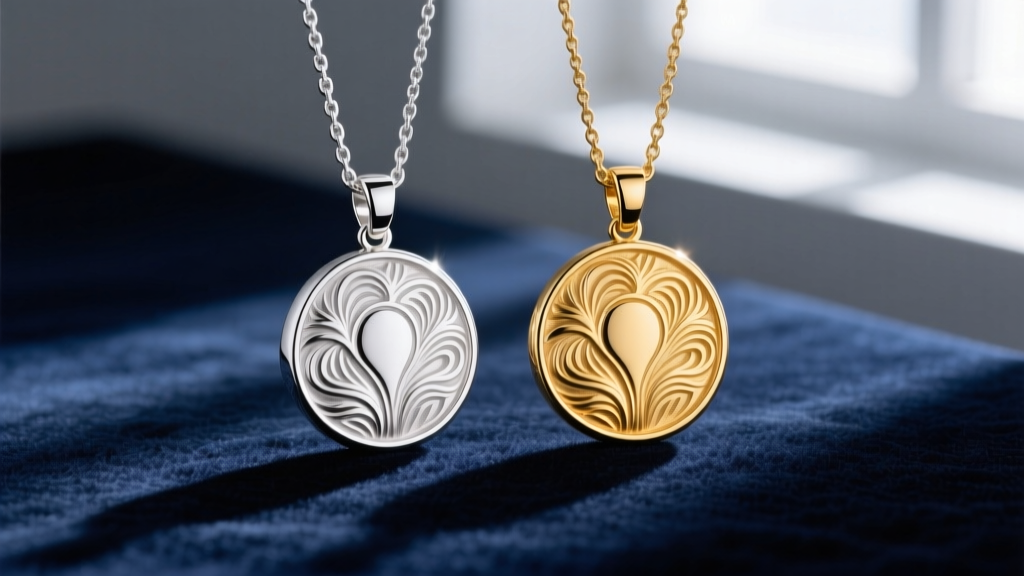
For a piece meant to be passed down as an heirloom, 14k gold is the undisputed champion. It contains 58.5% pure gold, offering enough structural integrity to withstand daily wear without the alloy metals compromising the engraver's ability to carve deep, sweeping lines.
Engraving Methods: Hand vs. Laser
The method used to carve your crest into the metal will drastically alter the final appearance and tactile feel of the necklace.
Laser Engraving
Laser engraving uses a concentrated beam to burn or vaporize the metal. It is highly precise and excellent for replicating complex digital vector files. However, laser engraving is inherently shallow, typically cutting only 0.1mm to 0.3mm deep. While it captures fine lines, it lacks the dimensional depth required to make heraldic beasts or quartered shields truly pop. It also leaves a flat, matte finish at the bottom of the cut.
Hand Engraving (Burin)
Hand engraving is performed by a master artisan using a hardened steel tool called a burin. The engraver physically pushes the tool through the metal, removing material to create depths of 1.0mm to 1.5mm. This allows for two distinct styles:
- Intaglio: The design is cut deeply into the metal. This is the traditional method used if you intend to use your pendant as a wax seal stamp.
- Relief: The background is cut away, leaving the crest raised above the surface. This is vastly superior for a family crest necklace meant purely for visual display, as it catches the light beautifully.
Sizing, Weight, and Chain Pairings
A common mistake beginners make is pairing a heavy, solid-metal crest pendant with a delicate, hollow chain. This inevitably leads to a broken chain and a lost heirloom. Here are the exact specifications you need to match your pendant to the correct hardware.
Pendant Dimensions and Weight
A standard, visually balanced crest pendant measures between 20mm and 25mm in width, and roughly 25mm to 30mm in height (including the bail). In solid 14k gold, a pendant of this size will weigh between 5.5 and 8.5 grams. If the pendant is cast too thin (under 3 grams), it will dent easily and the engraving will lack depth.
Chain Selection and Tensile Strength
Your chain must possess a tensile (breaking) strength that exceeds the weight of the pendant by a safe margin. A 7-gram pendant generates dynamic stress when it swings or catches on clothing. You need a chain with a minimum breaking strength of 15 pounds.
- Solid Cable Chain (2.5mm - 3.0mm): The most secure and classic choice. Ensure the links are soldered closed.
- Figaro Chain (3.0mm): Offers a slightly more ornate, vintage look that pairs exceptionally well with heraldic motifs.
- Rope Chain (2.5mm): Beautiful light reflection, but ensure it is 'solid' rope, not hollow, as hollow rope chains are notorious for kinking and snapping under pendant weight.
Bail Sizing
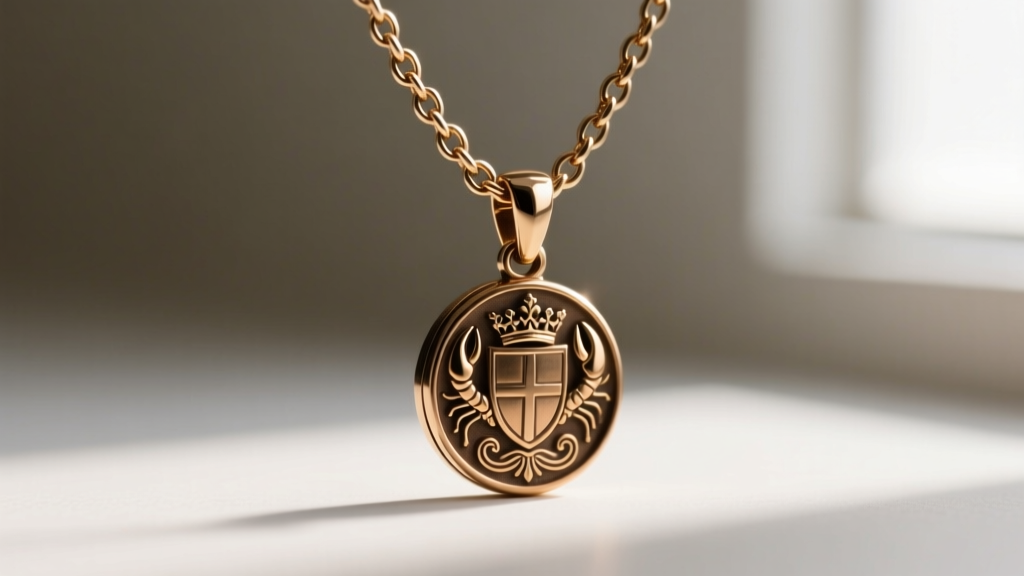
The bail is the loop at the top of the pendant through which the chain passes. If you are buying a pendant and chain separately, verify the bail's inner diameter. A 3.0mm chain requires a bail with an inner clearance of at least 4.5mm to allow the chain to drape naturally without pinching or wearing down the metal.
Styling Your Crest Necklace
Because a family crest necklace carries significant visual weight and historical gravity, styling it requires a balanced approach. For men, a 22mm crest pendant on a 24-inch chain sits perfectly at the sternum, ideal for wearing over a crewneck sweater or an unbuttoned linen shirt. For women, layering a 20mm crest pendant on a 20-inch Figaro chain with a simpler, 18-inch 1.5mm cable chain creates a sophisticated, asymmetrical neckline that anchors the outfit without overwhelming it.
Ultimately, a well-crafted family crest necklace is an investment in personal history. By prioritizing authentic genealogical research, opting for hand-engraved 14k gold, and pairing it with a structurally sound chain, you ensure that your heraldic jewelry will endure for generations to come.


