The Ultimate Guide to Choosing a Father and Son Necklace
Discover how to choose the perfect father and son necklace set. Learn about durable metals, chain styles, and sizing tips for lasting family jewelry.


The Evolution of Matching Family Jewelry
The concept of a father and son necklace has evolved dramatically over the last decade. Gone are the days of overly literal, cheesy puzzle-piece pendants or heavy, uncomfortable chains that kids refuse to wear. Today, modern family jewelry focuses on subtle, minimalist designs that appeal to a man's refined style while remaining safe, durable, and comfortable for an active boy. Whether you are looking for a meaningful heirloom to pass down or a rugged, everyday accessory that can survive the playground, choosing the right matching set requires a deep understanding of metallurgy, chain mechanics, and pediatric safety.
This beginner-friendly guide will walk you through the exact specifications, material grades, and sizing frameworks needed to select a father and son necklace set that looks exceptional and lasts a lifetime.
Decoding Metal Durability: What Survives Childhood and Daily Wear
Children are notoriously hard on jewelry. A necklace worn by an active boy will be pulled, submerged in chlorinated pools, covered in sweat, and snagged on clothing. Therefore, the metal you choose must withstand severe environmental and physical stress. According to the Gemological Institute of America (GIA), understanding metal alloys is critical for predicting longevity and skin reactivity.
316L Surgical Stainless Steel
For budget-conscious buyers who need maximum durability, 316L stainless steel is the undisputed champion. The "L" stands for low carbon, and this specific grade contains molybdenum, which drastically increases resistance to corrosion from sweat and saltwater. It is hypoallergenic, highly scratch-resistant, and will not tarnish. It is the perfect utilitarian metal for a father and son duo who spend their weekends hiking or fishing.
Grade 5 Titanium (Ti-6Al-4V)
Titanium is exceptionally lightweight and boasts a tensile strength that rivals steel. Grade 5 titanium, an aerospace-grade alloy, is virtually impervious to bending or snapping. This is a crucial feature for young children; if a chain snags, a high-quality titanium link is less likely to snap into sharp, dangerous shards compared to softer metals. Furthermore, titanium is 100% nickel-free, making it the safest choice for boys with severe contact dermatitis or metal allergies.
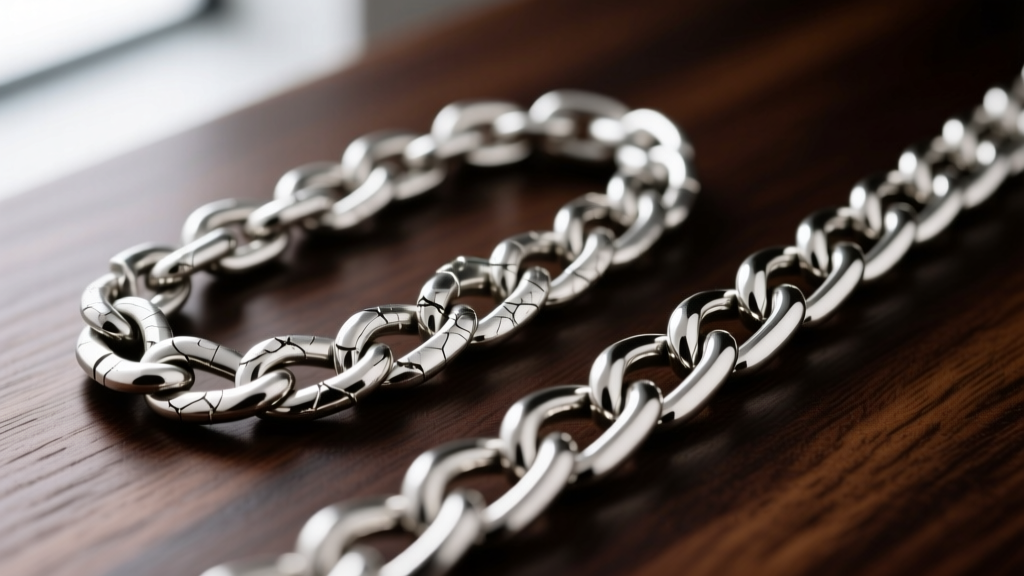
14k Solid Gold vs. Sterling Silver
If you are seeking a traditional heirloom piece, 14k solid gold (58.5% pure gold alloyed with copper and silver for strength) is the standard. It resists tarnish and holds immense intrinsic value. However, avoid sterling silver for young children. Silver is a relatively soft metal that scratches easily, and it oxidizes rapidly when exposed to the sulfur in human sweat, requiring constant polishing that most parents simply do not have time for.
Chain Styles, Thickness, and Safety Mechanics
The chain is the structural backbone of any necklace. When selecting a father and son necklace, you must balance aesthetic cohesion with physical safety. The American Academy of Pediatrics (AAP) consistently warns against the strangulation hazards posed by traditional jewelry clasps for young children. You can review general pediatric safety guidelines via the official AAP parent resources.
Width and Gauge Discrepancies
To create a cohesive look without putting heavy, uncomfortable metal on a child's neck, scale the chain width (gauge) to the wearer's body mass:
- Adult Men (Fathers): 4mm to 6mm width. A 5mm Cuban curb or Figaro chain provides a masculine, substantial drape that sits flat against the chest.
- Young Boys (Ages 5-12): 2mm to 3mm width. A lightweight 2.5mm cable or box chain prevents neck strain and reduces the visual bulk on a smaller frame.
The Breakaway Clasp Requirement
For any child under the age of 10, a standard lobster clasp is a safety liability. If the chain snags on playground equipment, a rigid clasp will not yield, posing a severe choking risk. You must opt for a magnetic breakaway clasp. These clasps use strong neodymium magnets to stay securely closed during normal wear but will instantly pop open if subjected to sudden, forceful tension (usually around 3-5 lbs of pull force). For the father, a standard secure lobster or spring-ring clasp is perfectly fine.

Pendant Concepts That Avoid the Cliché Trap
The most successful father and son necklace sets rely on thematic resonance rather than identical, heavy-handed pendants. The goal is to choose motifs that represent guidance, connection, or shared heritage. Below is a decision matrix for selecting meaningful, modern pendant styles.
| Pendant Concept | Design Execution | Symbolic Meaning | Best Metal Pairing |
|---|---|---|---|
| The Compass | Minimalist circular dial with subtle N/S/E/W engravings. | Guidance, finding your way, and paternal direction. | Brushed Titanium or Steel |
| Coordinates | Rectangular bar necklace engraved with the latitude/longitude of the child's birthplace. | Roots, origin, and the unbreakable bond of family. | 14k Solid Gold |
| Topography Map | Cut-out pendant featuring the elevation lines of a favorite shared hiking trail or hometown. | Shared adventures, nature, and overcoming obstacles. | Oxidized Sterling Silver |
| Minimalist Dog Tag | Matte-finish tag with a single fingerprint or heartbeat line engraving. | Protection, identity, and physical connection. | 316L Stainless Steel |
Sizing Guide: Getting the Length Right
A necklace that is too long will swing into a child's face or catch on doorknobs; one that is too short will feel restrictive and uncomfortable as they grow. Use this precise sizing framework when ordering your set:
- Toddlers (Ages 2-4): 12 to 14 inches. (Note: Necklaces are generally not recommended for children under 3 unless worn strictly under supervision with a breakaway clasp).
- Young Boys (Ages 5-10): 14 to 16 inches. This length sits comfortably just below the collarbone, mimicking a standard crew-neck t-shirt line.
- Pre-Teens and Teens (Ages 11-15): 16 to 18 inches. This accommodates growth spurts and sits similarly to a standard adult choker or short chain.
- Adult Men (Fathers): 20 to 24 inches. A 20-inch chain sits at the collarbone, while a 22 or 24-inch chain rests on the upper chest, which is ideal for wearing over or under a t-shirt.
Pro-Tip: If you are buying a set for a growing boy, look for chains that include a 2-inch extender chain. This allows the necklace to adapt to his growth over several years, maximizing your investment.
Pricing Tiers and Where to Buy
The market for men's and boys' jewelry is vast, but quality varies wildly. Here is what you can expect to pay for a high-quality father and son necklace set:
- Budget Tier ($40 - $90): Expect 316L stainless steel or titanium pieces with standard cable chains and laser-etched pendants. Brands in this space offer excellent durability but lack precious metal value.
- Mid-Range Tier ($150 - $400): This tier introduces 10k or 14k gold vermeil (heavy gold plating over a silver base) or solid 10k gold chains. You will find better craftsmanship, smoother chain links that do not pull chest hair, and custom engraving options.
- Luxury / Heirloom Tier ($600 - $2,000+): Solid 14k or 18k gold chains with hand-finished pendants, bezel-set gemstones, or bespoke topography engravings. These are true generational pieces meant to be passed down when the son reaches adulthood.
Final Thoughts on Creating a Family Heirloom
Choosing a father and son necklace is about more than just matching accessories; it is about forging a tangible link between generations. By prioritizing aerospace-grade titanium or surgical steel for the child's safety, scaling the chain gauge appropriately, and selecting a pendant design rooted in subtle symbolism, you ensure the jewelry will be worn with pride rather than abandoned in a drawer. Invest in quality metals, prioritize breakaway safety features for the younger wearer, and select a design that tells your family's unique story.


