How to Choose the Perfect Necklace with Sweater Outfits
Learn how to choose the perfect necklace with sweater outfits. Discover ideal chain styles, lengths for every neckline, and materials that resist knit friction.


Winter styling requires far more than simple color coordination; it demands a fundamental understanding of textile-metal interaction. When selecting a necklace with sweater fabrics, the wrong choice inevitably leads to snagged yarns, flipped pendants, and accelerated metal degradation. As we navigate the 2026 winter season, the shift towards substantial, architectural jewelry means that lightweight, delicate chains are being replaced by purpose-driven pieces designed to interact seamlessly with heavy knits.
This comprehensive buying guide breaks down the physics of fabric friction, optimal chain profiles, and the specific material grades required to protect both your jewelry and your luxury cashmere or wool garments.
The Physics of Fabric and Metal Interaction
Wool, cashmere, and alpaca fibers possess microscopic overlapping scales. When a delicate chain (typically under 1.5mm in width) rests against these fibers, the metal links act like microscopic saws. The friction generated by normal body movement gradually shreds the yarn, causing pilling and structural damage to the sweater. Conversely, the textile acts as an abrasive on the metal.
Furthermore, winter environments introduce static electricity, particularly in wool-acrylic blends. Static attracts microscopic dust and skin oils directly to the metal surface, accelerating tarnish in sterling silver and dulling high-polish gold. To combat this, the jewelry you choose must have a high surface smoothness and adequate weight to remain stationary against the garment.
Chain Profiles: Gliding vs. Snagging
The structural profile of the chain is the single most critical factor when pairing a necklace with sweater outfits. You must avoid chains with exposed solder joints, helical twists, or porous textures. Below is a structural comparison of common chain types and their viability for winter knits.
| Chain Profile | Width Recommendation | Snag Risk | Ideal Sweater Pairing |
|---|---|---|---|
| Box Chain | 2.5mm - 5.0mm | Low | Merino wool crewnecks, tight knits |
| Paperclip Link | 4.0mm - 8.0mm | Low | Chunky cardigans, heavy cable-knits |
| Snake Chain | 3.0mm - 6.0mm | Medium | Fine-gauge cashmere, silk-blend knits |
| Rope Chain | N/A | Extreme | Avoid entirely with knitted textiles |
| Cable Chain | N/A | High | Avoid unless links are soldered and flat |
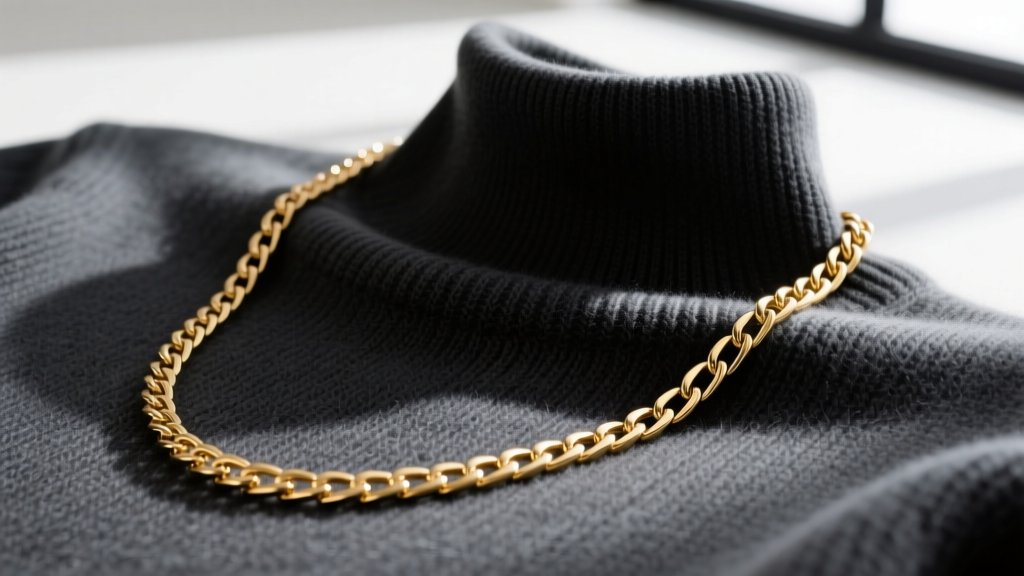
For heavy winter wear, the flat box chain and the elongated paperclip link are superior. Their flat, polished surfaces allow the metal to glide over the textile scales rather than catching them. According to fiber care guidelines from The Woolmark Company, minimizing mechanical friction is essential for preserving the structural integrity of luxury animal fibers.
Neckline Mapping: Crew, V-Neck, and Turtleneck
The architecture of the sweater neckline dictates the required length and pendant drop of the necklace. A mismatch in proportions will result in the jewelry getting swallowed by the fabric or resting awkwardly on the collarbone.
The Crewneck (18 to 20 Inches)
A standard crewneck sits tightly at the base of the throat. An 18-inch princess-length chain will often get tangled in the ribbed collar. Opt for a 20-inch matinee length that rests roughly two inches below the sweater collar. A pendant with a wide horizontal profile (such as a geometric disc or a curved bar) works best here, as it mirrors the horizontal line of the crewneck collar.
The V-Neck (16 to 24 Inches)
V-necks provide a natural frame for the decolletage, but the depth of the V varies wildly. For shallow V-necks, a 16-inch choker with a Y-drop or lariat extension draws the eye downward, elongating the neck. For deep V-necks, a 24-inch chain with a heavy, teardrop-shaped pendant anchors the look. Ensure the pendant weighs at least 8 grams; lighter pendants will swing outward and fail to lay flat against the angled fabric.
The Turtleneck (26 to 30 Inches)
Turtlenecks completely obscure the collarbone, requiring opera-length chains (26 to 30 inches). The critical failure point with turtlenecks is the 'pendant flip'—where a lightweight pendant rests on the convex curve of the bust and flips upside down. To solve this, you must choose a pendant with a low center of gravity and a heavy bail (the loop connecting the pendant to the chain). Pendants weighing between 12 and 18 grams, paired with a 5mm rope or thick box chain, will remain anchored by their own mass.
Material Grades and Gemstone Safety
Not all metals and stones survive the harsh environment of winter clothing. The friction, body heat trapped under heavy layers, and exposure to dyed wools create a hazardous environment for delicate materials.
- Avoid Gold Vermeil on Rough Knits: Vermeil consists of a 2.5-micron layer of gold over sterling silver. The abrasive nature of coarse wool will physically sand this micron layer off over a single season of daily wear, exposing the silver base. Always opt for solid 14k/18k gold, platinum, or PVD-coated stainless steel for heavy sweater layering.
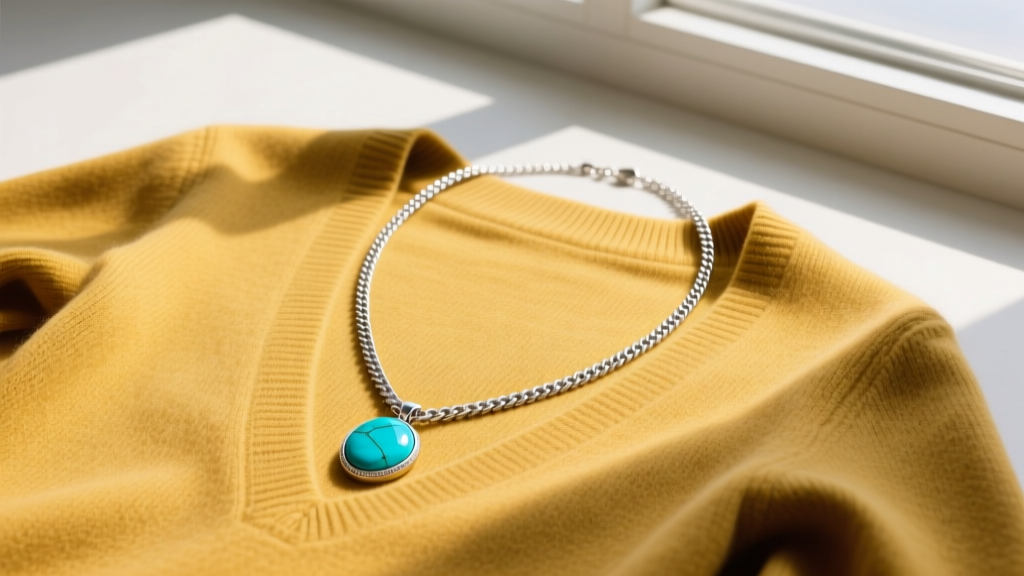
- Porous Gemstone Warning: Stones like turquoise, lapis lazuli, malachite, and pearls are highly porous. The Gemological Institute of America (GIA) notes that these stones can absorb oils, dyes, and chemicals. Wearing raw turquoise directly against a dyed wool sweater can result in irreversible color transfer and micro-scratches from the fibers. Stick to high-Mohs hardness stones (sapphires, diamonds, spinels) or enamel pendants for direct textile contact.
- Sterling Silver and Static: If you prefer sterling silver, ensure it is rhodium-plated. Rhodium provides a hard, non-tarnishing barrier that resists the sulfur compounds and static-attracted dust prevalent in heated winter environments.
Clasp Mechanics and Winter Accessibility
An often-overlooked aspect of buying a necklace with sweater outfits is the clasp mechanism. Winter weather introduces cold-stiffened fingers and the frequent use of gloves, making standard 5mm lobster clasps incredibly frustrating to operate.
When purchasing chains specifically for winter layering, look for oversized spring ring clasps (10mm or larger) or integrated magnetic neodymium clasps. Magnetic clasps are a game-changer for winter accessibility, allowing you to secure a heavy 24-inch chain behind a thick turtleneck collar in seconds without removing your gloves or requiring fine motor dexterity. Ensure the magnetic clasp is crafted from solid metal with a secure internal locking mechanism to support the heavier gram weights required for winter chains.
Advanced Layering Over Heavy Knits
Layering over thick sweaters requires a strict adherence to the 'Rule of Three Inches'. If your first chain sits at 20 inches, the second must sit at 23 inches, and the third at 26 inches. Any closer, and the heavy metal links will grind against one another, causing severe scratching and tangling in the sweater fibers.
Pro Tip for 2026: Instead of layering three separate chains, invest in a single, heavy multi-strand collar or a modular paperclip chain that allows you to detach and reconfigure links. This provides the visual weight of layering without the mechanical friction of multiple chains destroying your cashmere.
Ultimately, choosing the right necklace for winter is an exercise in material science and proportion. By prioritizing smooth chain profiles, adequate gram weights, and high-hardness gemstones, you ensure that your jewelry elevates your winter wardrobe without compromising the integrity of your luxury knits.


