The Clair d Lune Necklace: Gemology and Metalwork Deep Dive
Explore the technical gemology and metalwork behind the clair d lune necklace, from adularescence grading to vintage glass oxide coatings.

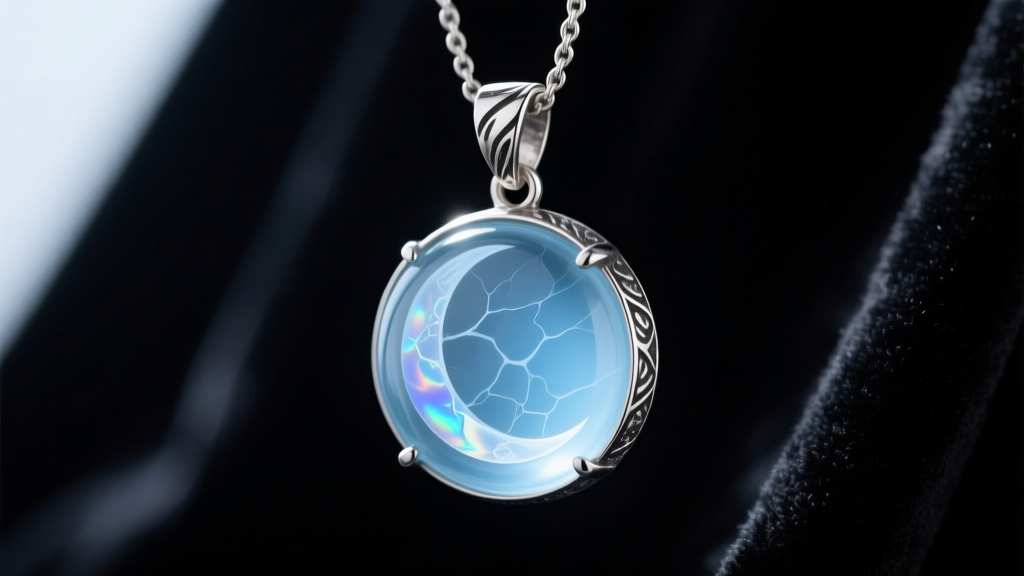
The term clair d lune (often stylized as clair de lune) translates directly to "moonlight." When collectors, appraisers, and master jewelers discuss a clair d lune necklace, they are typically referring to one of two distinct material categories: natural adularescent feldspars (specifically blue sheen moonstone) or vintage iridescent lead glass. Understanding the technical divide between these materials is crucial for accurate appraisal, bespoke restoration, and high-end jewelry design. This deep dive explores the optical physics, material chemistry, and precision metalwork required to craft and maintain these luminescent pendants.
The Gemology of the Moonlight Effect
In natural gemology, the "moonlight" effect is known as adularescence. This optical phenomenon is most prominently displayed in high-grade moonstone, a variety of the feldspar-group mineral orthoclase. The ethereal glow of a natural clair d lune necklace pendant is not caused by surface reflection, but by the internal scattering of light.
Exsolution Lamellae and Light Scattering
During the cooling process of moonstone in igneous rocks, orthoclase and albite separate into alternating, microscopic layers. These layers are known as exsolution lamellae. When light enters the stone, it hits these ultra-thin layers (often only a few micrometers thick) and scatters. According to the Gemological Institute of America (GIA), the thickness of these lamellae dictates the color of the schiller. Layers thinner than 0.5 micrometers produce a highly prized blue sheen, while thicker layers produce a white or silvery sheen. For a pendant to be classified as top-tier "clair d lune," the blue schiller must be visible across a wide range of viewing angles, not just a single focal point.
The Chemistry of Vintage Clair de Lune Glass
Not every clair d lune necklace features natural feldspar. In the late 19th and early-to-mid 20th centuries, European glassmakers developed "clair de lune" glass to mimic the moonstone effect at a fraction of the cost. This material is a technical marvel of historical chemistry.
The base of this vintage glass is typically a high-lead crystal (containing 24% to 32% PbO), which provides a high refractive index (RI of 1.60+) and exceptional clarity. The signature pale blue-grey iridescence is achieved through the introduction of metallic oxides—most commonly bismuth or titanium dioxide—during the glass melting process. As the glass cools, these metallic compounds crystallize on the surface or within the outer layers of the bead or cabochon, creating a thin-film interference effect similar to oil on water. Unlike natural moonstone, which scatters light internally, vintage clair de lune glass relies on surface and sub-surface interference.
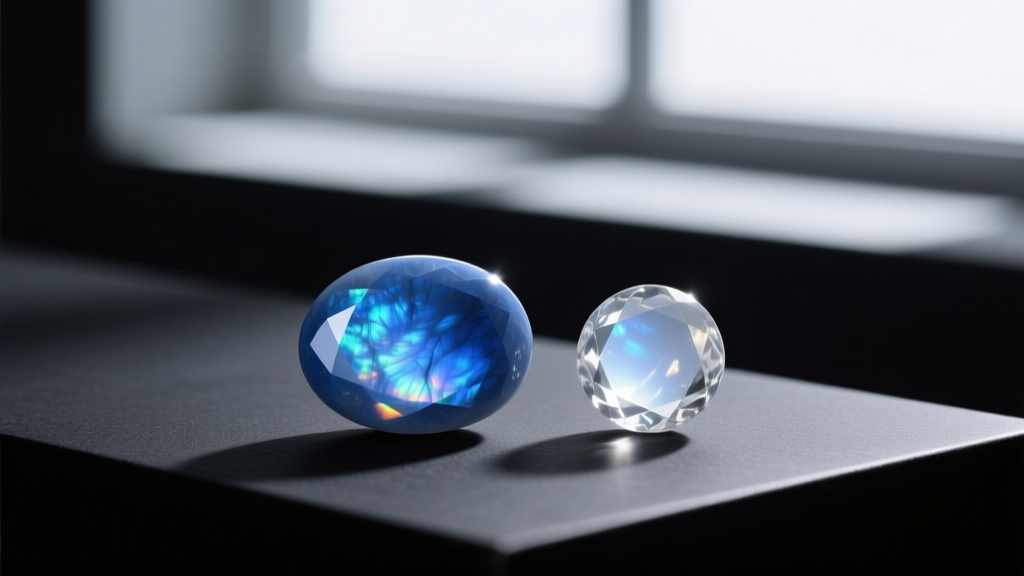
Material Comparison Matrix
When evaluating or sourcing stones for a custom necklace, it is vital to distinguish between natural and synthetic/vintage alternatives. The table below outlines the critical physical properties used by gemologists for identification.
| Property | Blue Sheen Moonstone (Orthoclase) | Vintage Clair de Lune Glass | Opalite (Modern Synthetic) |
|---|---|---|---|
| Refractive Index (RI) | 1.518 - 1.526 | 1.60 - 1.70 (Lead Glass) | 1.46 (Glass-based) |
| Specific Gravity (SG) | 2.56 - 2.58 | 3.10 - 3.60 (Due to PbO) | 2.40 - 2.50 |
| Mohs Hardness | 6.0 - 6.5 | 5.0 - 6.0 | 5.5 |
| Optical Phenomenon | Adularescence (Internal scattering) | Thin-film interference (Surface/Sub-surface) | Opalescence (Mie scattering) |
| Reaction to UV Light | Inert to weak blue | Variable (often inert) | Inert |
Precision Setting Techniques for Cabochons
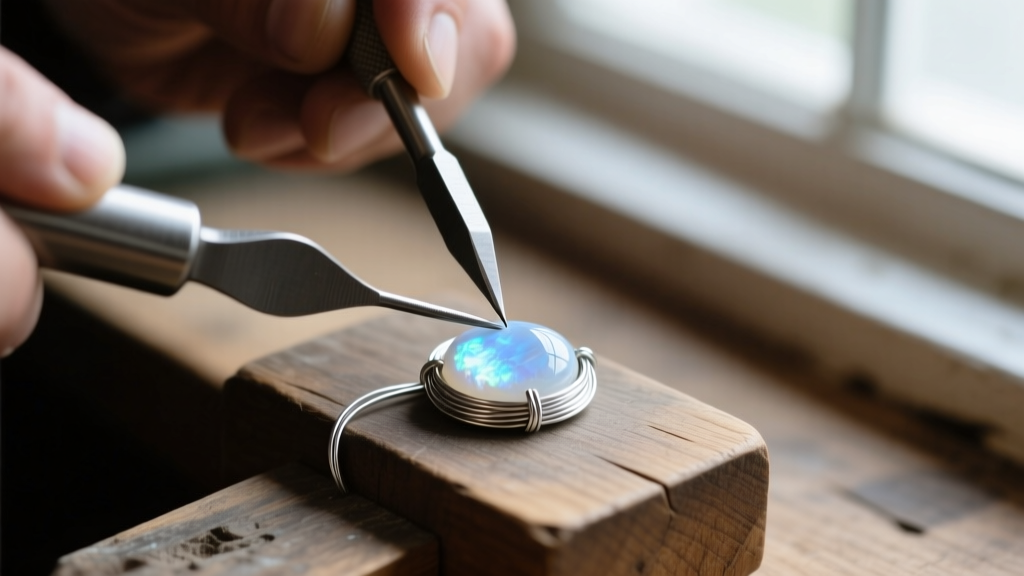
Setting a moonstone or a fragile vintage glass cabochon requires specialized metalwork. Because natural moonstone possesses two distinct cleavage planes and a relatively low Mohs hardness of 6 to 6.5, it is highly susceptible to chipping under uneven pressure. The Mindat mineral database notes that feldspars can easily fracture if subjected to point-stress.
Bezel vs. Prong: Light Performance and Security
While prong settings maximize light entry from the sides, they are strongly discouraged for clair d lune pendants. Prongs apply localized pressure that can easily crack the stone's cleavage planes. Furthermore, moonstone requires a dark or contrasting backing to maximize the visibility of the blue schiller; an open-back prong setting often washes out the adularescence in bright ambient light.
Master jewelers utilize a closed-back bezel setting with a blackened interior. The technical specifications for this setting include:
- Bezel Wire Gauge: 24-gauge (0.51mm) or 26-gauge (0.40mm) fine silver (.999 purity). Fine silver is used because it anneals softer than sterling, requiring less downward force to push over the stone, thereby reducing the risk of fracturing the cabochon.
- Interior Backing: The inside of the bezel cup is oxidized with liver of sulfur or painted with matte black enamel. This dark background absorbs transmitted light and reflects the scattered blue wavelengths back to the viewer's eye, amplifying the clair d lune effect.
- Bearing Creation: A precise 0.75mm bearing (shelf) is cut using a setting bur to ensure the stone sits perfectly flat. Any tilt will cause the adularescence to face away from the viewer.
Chain Gauge and Clasp Engineering
The pendant is only half the equation; the suspension system must be engineered to support the specific gravity and weight of the piece. A substantial 20mm solid moonstone cabochon set in sterling silver can easily exceed 12 grams.
For a clair d lune necklace, delicate 0.8mm chains are structurally inadequate and prone to snapping under dynamic loads (e.g., the pendant catching on clothing). The optimal chain specifications include:
- Chain Style: 1.2mm to 1.5mm box chain or flattened cable chain. Box chains offer superior tensile strength due to their interlocking geometric links.
- Jump Rings: The jump ring connecting the pendant to the chain must be soldered closed or feature a minimum wire thickness of 18-gauge (1.02mm) to prevent deformation.
- Clasp Mechanics: A standard spring-ring clasp is insufficient. A 10mm or 12mm solid lobster clasp with an internal steel spring is required to ensure the mechanism does not fatigue over time.
Advanced Care and Preservation Protocols
Maintaining the optical integrity of a clair d lune necklace requires strict adherence to material-specific cleaning protocols. The most common catastrophic failure mode for these necklaces is the use of ultrasonic cleaners.
Expert Warning: Never place natural moonstone or vintage lead glass in an ultrasonic cleaner. The high-frequency vibrations (typically 20-40 kHz) will exploit the natural cleavage planes of the feldspar, causing internal fracturing known as "crazing," which permanently destroys the adularescence.
Instead, utilize a mild solution of distilled water and pH-neutral dish soap. Use a soft-bristled goat hair brush to gently agitate the bezel edge where skin oils and cosmetic debris accumulate. Skin oils have a refractive index of roughly 1.46; when trapped behind a closed-back setting or smeared on the crown of the cabochon, they severely dampen the light scattering required for the moonlight effect. After washing, dry the piece immediately with a microfiber cloth to prevent water spotting on the high-polish sterling or gold bezel.
By understanding the intricate gemological properties and precise metalwork requirements, collectors and jewelers can properly appreciate, craft, and preserve the enduring magic of the clair d lune necklace.


