Care Guide: Cross Necklace for Men Macy's Collection
Learn how to clean, maintain, and store your cross necklace for men. Macy's collection care tips for silver, steel, and gold-plated pendants.


The Material Reality of Department Store Men's Crosses
When selecting a cross necklace for men, Macy's offers a diverse catalog ranging from minimalist stainless steel pieces to ornate sterling silver and black onyx designs. Brands like Tommy Hilfiger, Calvin Klein, and Effy dominate the department store space, each utilizing distinct metallurgical profiles. However, the mass-market nature of these pieces means they often feature protective rhodium flashes, gold electroplating, or PVD (Physical Vapor Deposition) coatings that require highly specific maintenance. As of 2026, understanding the exact material composition of your pendant is the single most critical factor in preventing irreversible damage during cleaning.
Many owners mistakenly treat all men's silver-toned jewelry as solid sterling silver, leading to disastrous results when harsh chemical dips strip away protective plating. According to the Federal Trade Commission Jewelry Guides, terms like 'gold electroplate' and 'silver-toned' have strict micron-thickness definitions, and department store crosses frequently sit at the lower end of these durability spectrums. This guide provides a meticulous, material-specific maintenance protocol to ensure your pendant retains its structural integrity and visual weight.
Material Identification & Cleaning Matrix
Before applying any cleaning agent, locate the hallmark stamp on the bail or the back of the cross pendant. Use the matrix below to identify your metal and select the appropriate cleaning protocol.
| Material / Stamp | Common Macy's Brands | Primary Cleaning Agent | Ultrasonic Safe? | Tarnish Risk |
|---|---|---|---|---|
| 925 Sterling Silver | David Yurman, Effy | Aluminum/Baking Soda Bath | Yes (No stones) | High |
| 316L Stainless Steel | Tommy Hilfiger, CK | Mild Dish Soap & Water | Yes | Very Low |
| Gold Electroplate | Various In-House | Damp Microfiber Only | No | N/A (Wear Risk) |
| PVD Black Coating | Modern Steel Brands | Dry Polishing Cloth | No | N/A (Scratch Risk) |
Deep Cleaning Protocols by Metal Type
Sterling Silver (925): The Electrochemical Reduction Method
Sterling silver is an alloy containing 92.5% pure silver and 7.5% copper. The copper is the culprit behind tarnish, reacting with atmospheric sulfur to form silver sulfide—a dark, dull layer on the surface. For solid sterling silver crosses, avoid commercial liquid dips containing thiourea, as they are highly toxic and can cause micro-pitting over time. Instead, utilize an electrochemical reduction bath.
- Line a glass bowl with aluminum foil (shiny side up).
- Add one tablespoon of baking soda and one tablespoon of kosher salt.
- Pour in boiling water to activate the alkaline solution.
- Submerge your silver cross for exactly 90 seconds.
The aluminum acts as a sacrificial anode, pulling the sulfur away from the silver and transferring it to the foil. Rinse with distilled water and pat dry with a microfiber cloth. For deeper insights into silver oxidation, the Gemological Institute of America (GIA) recommends this gentle, non-abrasive approach to preserve the metal's patina in engraved crevices.
316L Surgical Stainless Steel & PVD Coatings
Most contemporary men's crosses found in department stores are crafted from 316L marine-grade stainless steel. While highly resistant to oxidation, 316L is not entirely impervious to chemical damage. Exposure to chlorinated pool water or household bleach can cause localized pitting and permanent surface scarring.
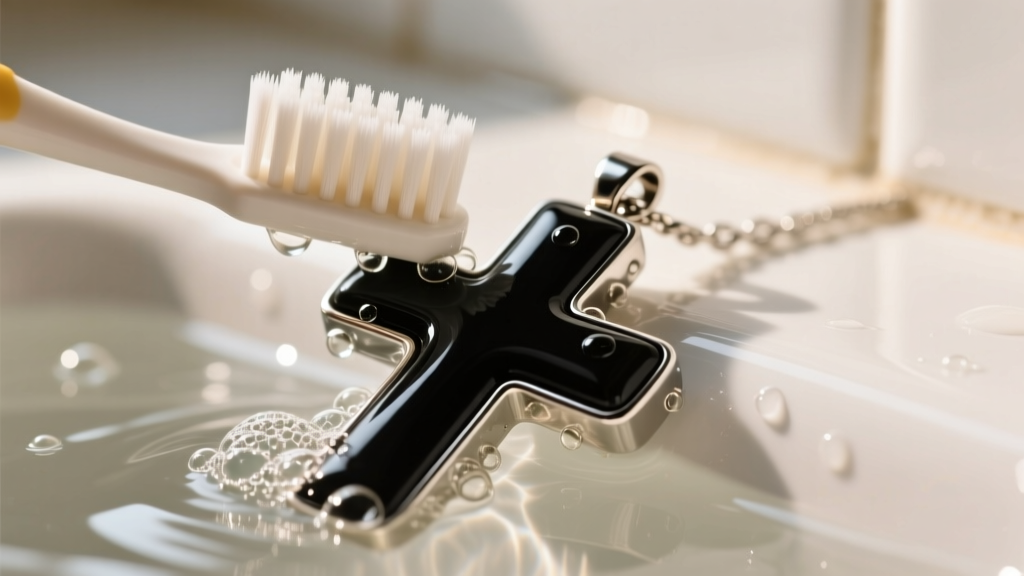
To clean a steel cross, mix three drops of phosphate-free dish soap into a cup of lukewarm water. Use an extra-soft baby toothbrush to gently agitate the crevices, particularly around inlaid black onyx stones. Warning: If your steel cross features a black or gold PVD (Physical Vapor Deposition) coating, never use ultrasonic cleaners. The high-frequency cavitation bubbles can delaminate the microscopic PVD layer from the steel substrate, resulting in irreversible peeling.
Gold-Plated and Vermeil Crosses
Gold-plated brass or copper crosses require the most delicate touch. Department store gold plate is often 'flash plated' at a thickness of just 0.175 microns. Using abrasive polishing cloths, baking soda pastes, or even vigorous rubbing with a towel will strip the gold layer down to the base metal within weeks. Clean these pieces by simply wiping them with a slightly damp, lint-free microfiber cloth after wear to remove acidic skin oils, which are the primary catalyst for base-metal corrosion underneath the plating.
Chain and Clasp Maintenance
The chain supporting your cross pendant accumulates dead skin cells, sebum, and environmental dust, particularly in complex weaves like Figaro, Rope, or Box chains. This buildup not only dulls the metal but creates an acidic micro-environment that accelerates tarnishing.
- Figaro & Rope Chains: Soak in a shallow dish of warm water and a single drop of mild ammonia-free dish soap for 10 minutes. Agitate gently, then rinse under a low-pressure stream of distilled water.
- Box Chains: The sharp 90-degree interior angles of box chain links trap grit. Use a wooden toothpick to gently dislodge compacted debris before washing.
- Clasp Lubrication: Spring-ring and lobster-claw clasps frequently become stiff due to soap scum buildup in the hinge mechanism. Dip a cotton swab in a tiny drop of food-grade mineral oil and apply it directly to the clasp hinge. Pump the lever several times to distribute the lubricant, then wipe away any excess to prevent dust attraction.
Pro Tip: Never pull a wet chain through a towel. The loops of the fabric can catch on the links of a delicate rope chain, causing micro-fractures in the solder joints. Always lay the chain flat on a dry microfiber cloth and press gently to absorb moisture.
Proper Storage to Prevent Oxidation
How you store your cross necklace when it is not being worn is just as important as how you clean it. Leaving jewelry on a bathroom counter exposes it to high humidity and aerosolized grooming products, both of which rapidly degrade metal finishes and gemstone adhesives.

Invest in treated anti-tarnish flannel pouches or line your jewelry box drawers with Pacific Silvercloth. These materials are embedded with microscopic silver particles that intercept and neutralize airborne sulfur compounds before they can reach your jewelry. For long-term storage, place a small packet of silica gel desiccant inside the jewelry box to maintain a relative humidity level below 40%, effectively halting the copper oxidation process in sterling silver and gold-plated alloys.
The 2026 Maintenance Checklist
To keep your Macy's men's cross necklace looking pristine year-round, adopt this simple maintenance cadence:
- Daily: Wipe with a dry microfiber cloth before bed to remove skin oils.
- Monthly: Inspect the bail (the loop connecting the cross to the chain) for thinning or structural weakness.
- Bi-Annually: Perform a deep clean using the material-specific methods outlined above.
- Annually: Replace the anti-tarnish strips in your storage container, as their chemical absorption capacity depletes after 6 to 12 months.
By respecting the specific metallurgical properties of your pendant and avoiding the 'one-size-fits-all' cleaning traps, your cross necklace will maintain its bold, masculine aesthetic and structural integrity for decades.


