How to Clean and Care for Your Gold Rectangle Pendant Necklace
Learn expert tips to clean, maintain, and protect your gold rectangle pendant necklace from tarnish, scratches, and daily wear damage.

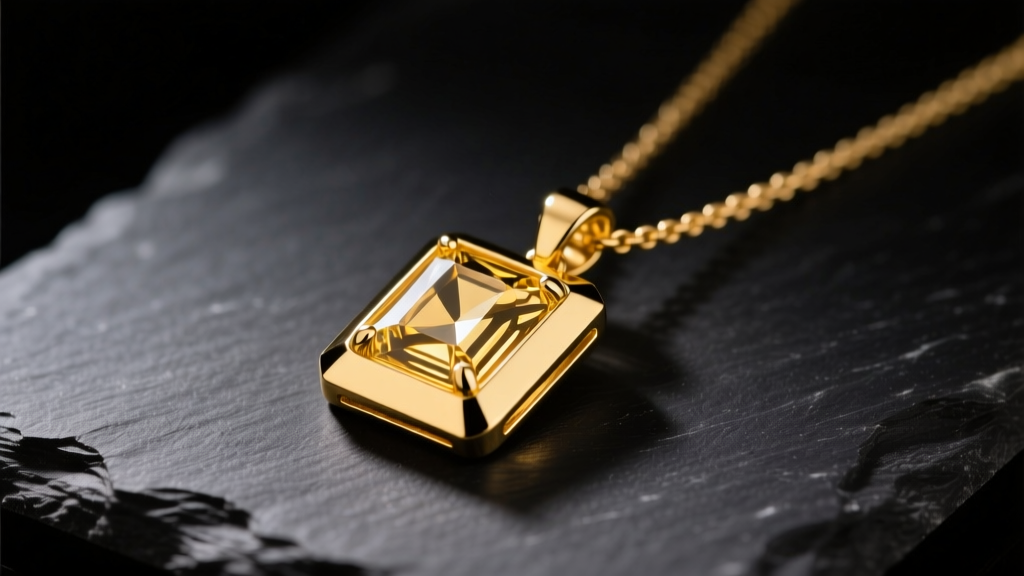
Geometric jewelry has firmly cemented its place in modern minimalist aesthetics, and the gold rectangle pendant necklace remains a standout staple. Its clean lines and architectural silhouette offer a striking visual anchor for any neckline. However, the very design elements that make a rectangular pendant so visually appealing—broad, flat surfaces and sharp 90-degree edges—also make it uniquely susceptible to visible micro-scratches, edge bruising, and concentrated bail friction.
Unlike spherical or teardrop pendants that naturally deflect impact and distribute wear evenly, a flat gold rectangle acts as a canvas for environmental particulates, sebum, and micro-abrasions. Maintaining the pristine, mirror-like finish of this specific silhouette requires a departure from generic jewelry care routines. Below, we detail the precise, expert-level maintenance protocols required to preserve the structural integrity and optical brilliance of your gold rectangle pendant necklace.
The Architectural Vulnerabilities of Rectangle Pendants
To properly care for a gold rectangle pendant necklace, you must first understand its mechanical vulnerabilities. The high surface-area-to-volume ratio of the flat face makes it a magnet for fingerprint oils and cosmetic residue, which can quickly dull the metal's luster. Furthermore, the sharp 90-degree corners are prone to 'edge bruising'—microscopic dents caused by the pendant swinging against hard surfaces like desks or countertops.
The bail (the loop connecting the pendant to the chain) is another critical failure point. Because a solid gold rectangle is often heavier than cast, hollow-form pendants, it swings with greater momentum. This pendulum effect concentrates up to 80% of the mechanical wear on the interior of the bail and the corresponding chain link. According to the Jewelers of America, regular inspection of the bail's solder joints is crucial for heavier geometric pendants to prevent catastrophic loss.
The Expert Cleaning Protocol for Flat Gold Surfaces
When cleaning a gold rectangle pendant necklace, the goal is to remove lipid buildup without introducing new micro-scratches to the expansive flat face. Avoid commercial jewelry dips, which often contain harsh ammonia or thiourea compounds that can strip the alloyed metals and leave the surface porous and prone to rapid re-tarnishing.
Step 1: Formulating the Cleaning Solution
Mix three drops of phosphate-free, non-lotion dish soap (such as original Dawn) into one cup of lukewarm distilled water. Tap water contains trace minerals and chlorine that can leave microscopic water spots on the broad gold surface, which are particularly glaring under direct light.
Step 2: Targeted Soaking and Agitation
Submerge the necklace for exactly five minutes to loosen sebum. Next, use an ultra-soft baby toothbrush (bristles rated at 0.12mm or thinner). 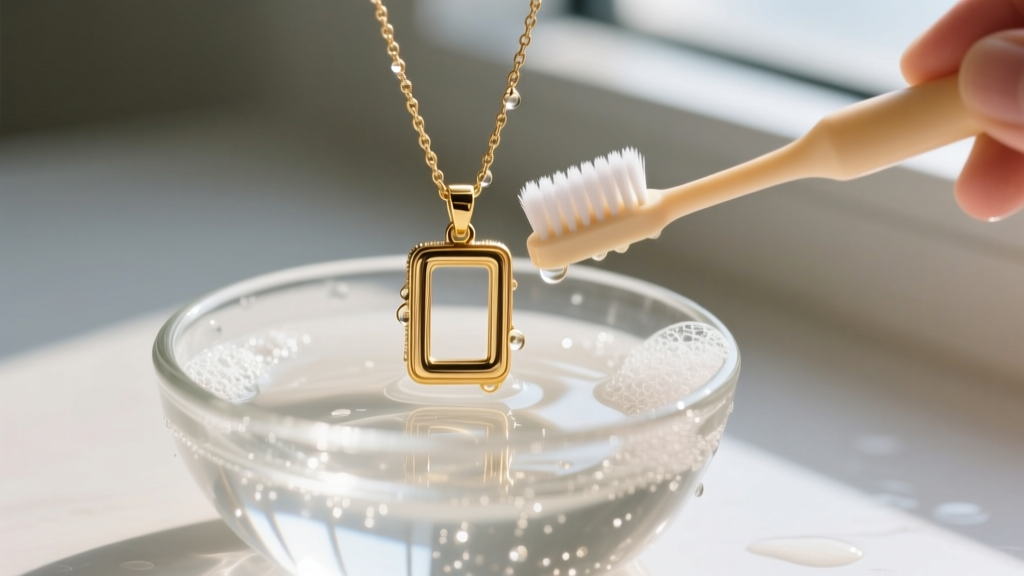 Gently brush the back of the pendant, the sharp corners, and the interior of the bail. Never use a standard adult toothbrush, as the stiffer nylon bristles will leave sweeping micro-scratches across the flat rectangular face.
Step 3: The Rinse and Dry Technique
Rinse the pendant under a gentle stream of distilled water. Do not rub the flat face with a towel. Instead, lay the necklace on a clean, lint-free microfiber cloth and gently pat it dry. For a streak-free finish on the expansive gold rectangle, use a dedicated jewelry polishing cloth that is impregnated with jeweler's rouge, wiping strictly in one direction rather than in circles to prevent cross-hatching.
Material-Specific Care: Solid Gold vs. Vermeil vs. Plated
The cleaning intensity and maintenance schedule for your gold rectangle pendant necklace depend entirely on its material composition. A 14k solid gold rectangle can withstand frequent polishing, whereas a vermeil or plated piece requires a vastly different, much gentler approach to avoid breaching the gold layer.
| Material Grade | Durability Profile | Cleaning Frequency | Specific Risks & Maintenance |
|---|---|---|---|
| 14K Solid Gold | High (58.5% pure gold) | Bi-weekly | Resists tarnish; prone to surface scratching. Can be professionally re-polished multiple times without losing structural integrity. |
| 18K Solid Gold | Medium-High (75% pure gold) | Bi-weekly | Rich color but softer. The 90-degree edges of the rectangle will round off faster if aggressively polished. Avoid ultrasonic cleaners. |
| Gold Vermeil | Medium (Thick 14k/18k over sterling) | Monthly | Never use abrasive polishing cloths. Clean only with soapy water. Re-plating is required every 2-3 years on high-friction areas like the bail. |
| Gold Plated (Brass Base) | Low (Micro-thin gold layer) | As needed | Highly susceptible to sweat and acidity. Wipe with a damp cloth after every wear. Do not soak, as water can seep into micro-pores and cause the brass base to oxidize and blister the gold. |
Preventative Storage and Daily Wear Frameworks
Preventative care is vastly superior to corrective restoration. The flat face of a gold rectangle pendant necklace will easily pick up scratches if stored haphazardly in a communal jewelry box where it can slide against diamond or sapphire pieces (which rank much higher on the Mohs hardness scale).
Implement a strict storage framework: store the necklace individually in a polyethylene zip-lock bag equipped with a 3M anti-tarnish strip. Polyethylene is chemically inert and will not off-gas sulfur compounds that cause gold alloys to dull. 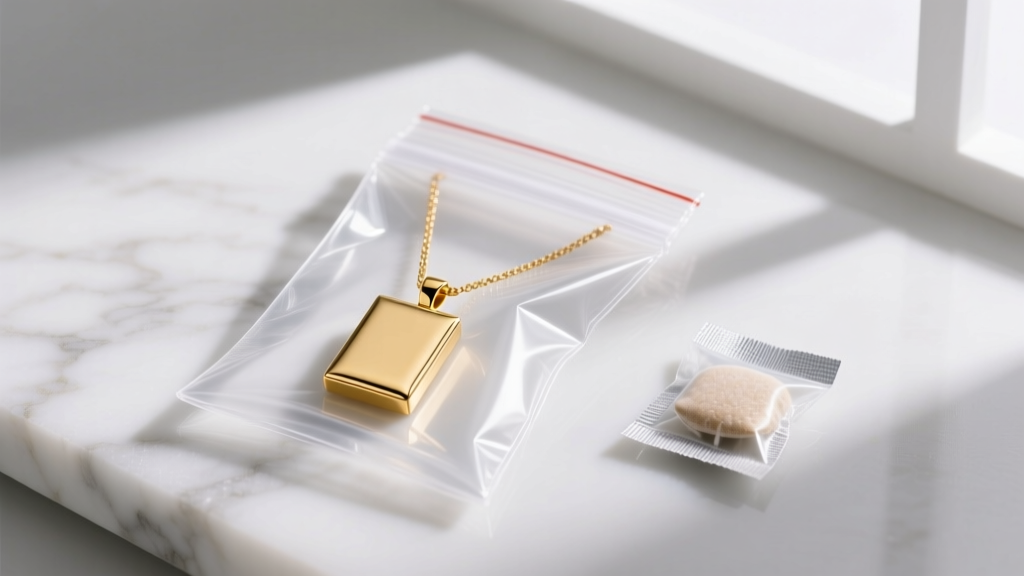 Furthermore, always unclasp the necklace and lay it flat or hang it vertically to prevent the chain from kinking or placing uneven torsion stress on the pendant's bail.
"The most common mistake consumers make with geometric pendants is wearing them in chlorinated environments. Chlorine reacts aggressively with the copper and silver alloys in 14k and 18k gold, leading to stress corrosion cracking, particularly at the soldered joints of the bail." — Gemological Institute of America (GIA)
Professional Restoration: Preserving the 90-Degree Edge
Over time, the broad face of your gold rectangle pendant necklace will inevitably accumulate a patina of micro-scratches. While DIY polishing cloths can restore shine, they cannot remove deeper abrasions. When the pendant requires professional restoration, you must explicitly instruct your jeweler on how to handle the geometry.
Standard machine polishing using a high-speed buffing wheel and heavy cutting compounds will naturally round over the sharp 90-degree edges of the rectangle, fundamentally altering its architectural silhouette and softening its modern aesthetic. Request that the jeweler use a hard felt bob or a flat lapidary polishing pad with a fine diamond paste (such as 14,000 grit) to maintain the absolute flatness of the face and the crispness of the corners. By understanding the unique mechanical and aesthetic demands of the gold rectangle pendant necklace, you can ensure it remains a flawless, striking centerpiece in your collection for decades to come.


