How to Clean and Maintain a Pomegranate Seed Necklace
Learn how to safely clean, store, and maintain your pomegranate seed necklace. Expert tips for resin-encased botanicals and carved garnet alternatives.

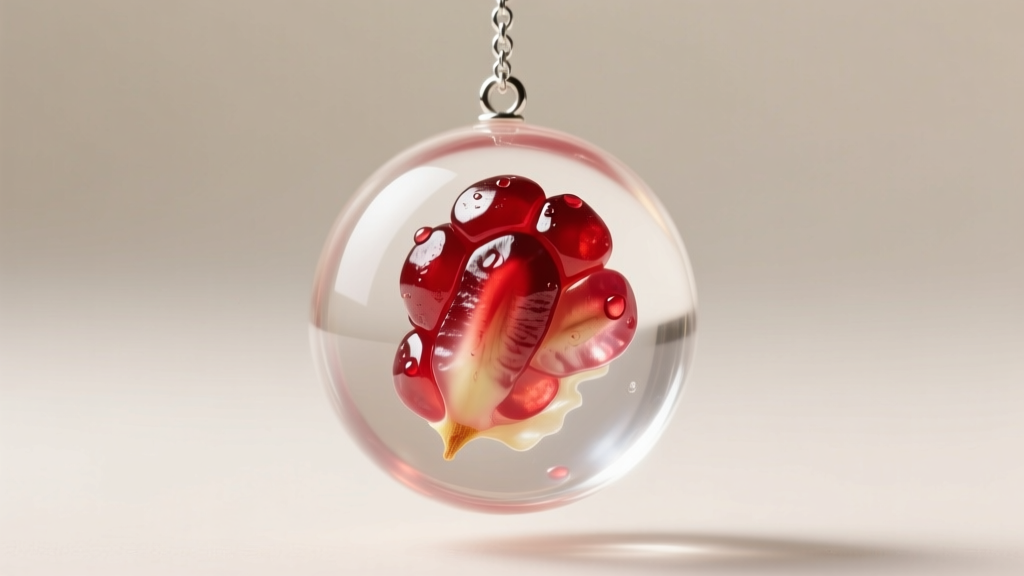
The pomegranate seed necklace has surged in popularity, celebrated for its rich symbolism of fertility, abundance, and the striking visual of suspended crimson jewels. However, when it comes to care and maintenance, these unique pieces present a complex challenge. Unlike standard metal or gemstone jewelry, a pomegranate seed necklace typically falls into one of two distinct categories: real botanical seeds encased in jewelry-grade resin, or carved gemstones (usually garnet or carnelian) shaped like seeds. Each material demands a radically different approach to cleaning, storage, and daily wear.
In this comprehensive guide, we break down the exact material science behind your necklace and provide actionable, expert-level maintenance protocols to ensure your piece remains vibrant and structurally sound for decades.
Identifying Your Necklace Material: Resin vs. Gemstone
Before applying any cleaning solution, you must accurately identify the medium holding your pomegranate seed. The cleaning agents that will safely restore a carved garnet will instantly ruin a resin-encased botanical piece.
Botanical Resin-Encased Seeds
These necklaces feature real, dehydrated pomegranate seeds suspended in a clear polymer matrix. Jewelers typically use either two-part epoxy resin or UV-cured resin. Epoxy is harder, more scratch-resistant, and cures via a chemical reaction. UV resin is softer, more prone to micro-scratches, and cures under ultraviolet light. Both are highly sensitive to heat, harsh solvents, and prolonged UV exposure, which can trigger a chemical breakdown known as photodegradation, resulting in a yellowed, cloudy appearance.
Carved Garnet or Carnelian "Seeds"
Many high-end "pomegranate seed" necklaces are actually carved from red garnet (Mohs hardness 6.5 to 7.5) or carnelian (Mohs 6.5 to 7). These are traditional gemstones that can withstand standard jewelry cleaning methods, though they still require care to protect their polished facets and the metal settings holding them.
Step-by-Step Cleaning Guide for Resin-Encased Botanicals
Cleaning resin requires a gentle touch. The primary goal is to remove skin oils and environmental dust without compromising the polymer surface or the delicate seed inside.
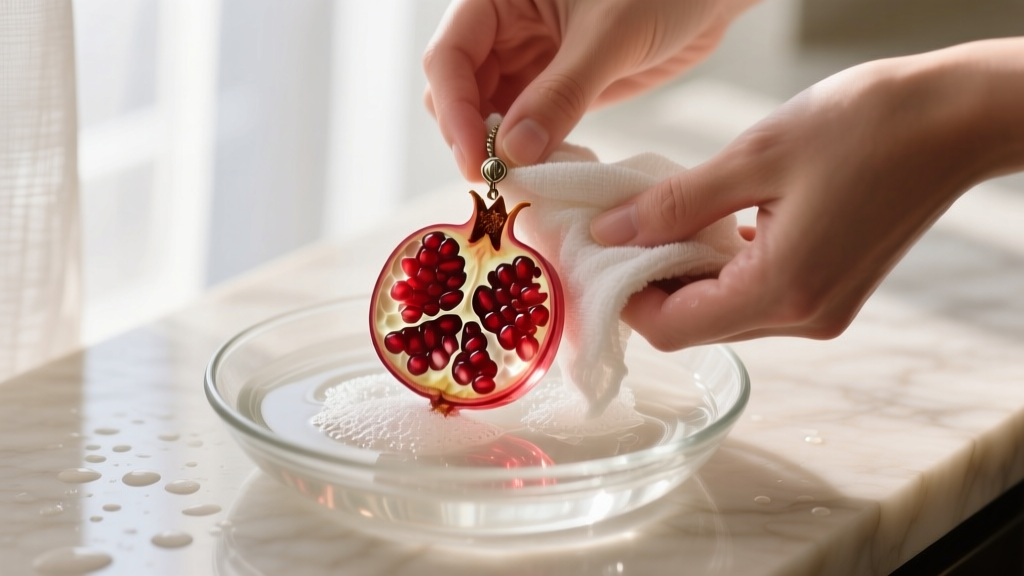
- Prepare a Lukewarm Bath: Fill a shallow glass dish with distilled or filtered water heated to exactly 80°F–85°F (26°C–29°C). Never use hot water; temperatures above 95°F can soften lower-grade UV resins and cause the encapsulated seed to shift or release trapped moisture bubbles.
- Add a pH-Neutral Surfactant: Add a single drop of pH-neutral, fragrance-free dish soap (such as Dawn Free & Clear). Avoid soaps with moisturizers or citrus extracts, as the d-limonene in citrus can degrade the resin surface over time.
- Gentle Agitation: Submerge the pendant (avoid submerging the chain if it is oxidized or plated). Use a clean, lint-free microfiber cloth to gently wipe the resin in circular motions. Do not use soft-bristled toothbrushes, as the bristles can leave micro-scratches on UV resin.
- Rinse and Dry: Rinse briefly under a gentle stream of cool distilled water. Pat dry immediately with a fresh microfiber cloth. Allow it to air dry completely in a shaded area before storing.
Cleaning Agents: What to Avoid
| Cleaning Agent | Effect on Resin | Effect on Garnet |
|---|---|---|
| Isopropyl Alcohol (70%+) | Causes immediate clouding and surface crazing | Safe for quick cleaning |
| Ultrasonic Cleaners | Shatters resin via high-frequency cavitation | Safe unless fracture-filled |
| Commercial Silver Dip | Strips the glossy resin finish permanently | Safe for metal settings only |
| Ammonia-based Glass Cleaner | Accelerates UV yellowing and brittleness | Safe for occasional use |
Care Protocols for Carved Garnet Pomegranate Pendants
If your necklace features carved garnet beads or pendants shaped like pomegranate seeds, you are dealing with a silicate mineral that is relatively durable but susceptible to thermal shock and hard impacts.
According to the Gemological Institute of America (GIA), warm soapy water is always the safest cleaning method for garnets. While ultrasonic cleaners are generally safe for solid garnets, they are strictly prohibited if your carved seeds have been fracture-filled with a glass-like resin to improve clarity—a common treatment in commercial-grade carved beads. The ultrasonic vibrations and heat will melt the filler, leaving your pomegranate seeds looking cloudy and fractured.
"When cleaning carved gemstone beads with intricate crevices, use a makeup brush with ultra-soft natural bristles rather than a toothbrush. The softer bristles reach into the carved 'seed' textures without scratching the high-polish facets."
— Best Practices in Gemological Conservation
Chain Maintenance and Hardware Integrity
The chain and jump rings on a pomegranate seed necklace endure significant mechanical stress due to the weight of the resin or stone pendant. Most botanical necklaces utilize 14k gold-filled or sterling silver (925) rolo or cable chains.
- Sterling Silver (925): Prone to tarnishing when exposed to the sulfur compounds in human sweat and atmospheric hydrogen sulfide. Polish the chain weekly using a treated jeweler's cloth (e.g., a Sunshine Polishing Cloth). Never use liquid silver dips, as the chemical residue can seep into the jump ring connecting the pendant and degrade the resin from the inside out.
- 14k Gold-Filled: Features a thick outer layer of 14k gold mechanically bonded to a brass core. It is highly tarnish-resistant. Simply wipe it down with a damp microfiber cloth after wear to remove sebum and dead skin cells, which can dull the gold's luster over time.
- Jump Ring Inspection: Every three months, inspect the jump ring connecting the pendant to the chain. Resin pendants can weigh between 5 to 15 grams. If you notice the gap in the jump ring widening, use two pairs of flat-nose pliers to gently twist it closed, or take it to a jeweler to have it soldered shut to prevent catastrophic loss of the pendant.
Proper Storage Techniques to Prevent Yellowing
The most common complaint among owners of botanical resin jewelry is the inevitable yellowing of the clear matrix. This is not a defect, but a natural chemical reaction called photo-oxidation. When the epoxy or UV resin is exposed to ultraviolet light (both from the sun and indoor fluorescent bulbs), the polymer chains break down, creating chromophores that absorb blue light and reflect a yellow tint.
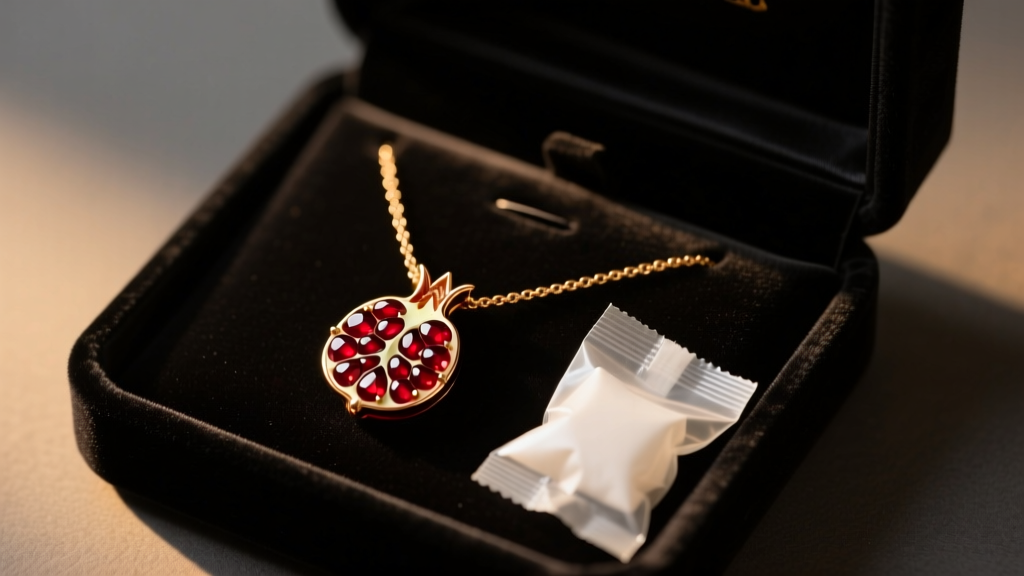
To drastically slow this process, you must control the storage environment. As noted by resin manufacturers like ArtResin, minimizing UV exposure is the only proven method to delay yellowing.
The Ideal Storage Protocol
- Light Deprivation: Store the necklace in an opaque, velvet-lined jewelry box or a drawstring pouch. Never leave it on a vanity table exposed to direct sunlight or near a window.
- Humidity Control: Real pomegranate seeds are organic matter. If the pendant is exposed to high humidity and fluctuating temperatures, microscopic condensation can form inside the resin, leading to mold growth on the seed. Always store the necklace in a sealed container with a 3-gram silica gel desiccant packet to maintain a relative humidity below 40%.
- Thermal Stability: Keep the storage environment between 60°F and 75°F (15°C–24°C). Storing the necklace in a car glovebox or a bathroom where steam showers cause temperature spikes will soften the resin and compromise the structural bond around the seed.
Troubleshooting Common Issues
Cloudy or Scratched Resin
If your resin-encased seed has lost its glass-like clarity due to micro-scratches from daily wear, you can restore it using a plastic polish. Apply a small amount of Novus 2 Fine Scratch Remover to a microfiber cloth and buff the resin in a circular motion for 2–3 minutes. Follow up with Novus 1 Clean & Shine to restore the optical clarity. Do not use metal polishes or abrasive toothpaste, as these will permanently frost the surface.
Bubbles Inside the Resin
If you notice new bubbles forming around the seed months after purchase, this indicates improper dehydration of the botanical material before encapsulation. The residual moisture inside the seed is slowly off-gassing. Unfortunately, this is a structural failure that cannot be reversed or repaired at home. Keep the piece away from heat sources to slow the expansion of the gas pockets.
Tarnish Transfer
If you wear your sterling silver chain while the resin pendant rests against your skin, the oxidized silver can leave a blackish smudge on the back of the resin. This is easily removed by wiping the resin with a slightly damp microfiber cloth and a drop of mild dish soap. To prevent this, ensure you polish the back of the pendant bail and the chain links that make contact with the resin regularly.
By understanding the specific material properties of your pomegranate seed necklace and adhering to these targeted maintenance protocols, you can preserve its striking botanical beauty and structural integrity for years to come.


