How to Clean and Care for a Vintage Rock Crystal Necklace
Learn expert methods to clean, maintain, and store your vintage rock crystal necklace without damaging antique settings or the quartz stone.

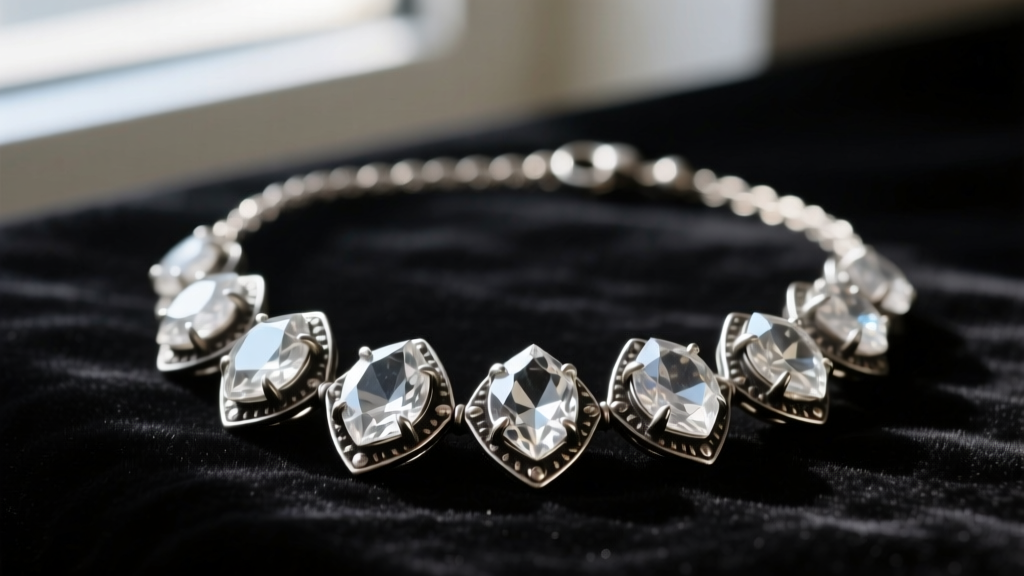
Owning a vintage rock crystal necklace is akin to holding a piece of geological and artistic history. Whether your piece features the geometric precision of Art Deco lapidary work or the romantic, hand-carved rose cuts of the Victorian era, rock crystal (colorless quartz) possesses a timeless, icy brilliance. However, caring for antique jewelry requires a vastly different approach than maintaining modern, mass-produced pieces. The combination of pure silicon dioxide (SiO2) and aged metal alloys creates specific vulnerabilities that, if ignored, can lead to irreversible damage.
In this comprehensive guide, we will explore the exact protocols for cleaning, inspecting, and preserving your vintage rock crystal necklace, ensuring its optical clarity and structural integrity for decades to come.
Understanding Rock Crystal and Antique Settings
Rock crystal is the purest form of quartz, ranking at a 7 on the Mohs scale of mineral hardness. While this makes it relatively resistant to everyday scratching from dust (which typically contains quartz particles at a 6.5 to 7), it possesses a conchoidal fracture pattern. This means that if struck against a hard surface, it can chip or shatter in curved, shell-like patterns. According to the Gemological Institute of America (GIA), while quartz is durable, its toughness is only 'fair,' meaning vintage cuts with thin girdles or sharp points are highly susceptible to edge abrasion.
The metalwork in vintage necklaces—often sterling silver, gold-filled, or low-karat gold—presents its own challenges. Antique silver is prone to sulfur-induced tarnishing, while the delicate solder points on hand-assembled chain links degrade over decades of wear. Understanding the interplay between the stone's hardness and the metal's softness is the first step in proper maintenance.
The Foil-Back Dilemma: Open vs. Closed Settings
Before you introduce any moisture to your vintage rock crystal necklace, you must determine the setting style. This is the single most critical diagnostic step in antique jewelry care.
Closed-Back (Foiled) Settings
Many Victorian and Edwardian rock crystal pendants feature closed-back settings. Lapidaries of these eras often placed a thin sheet of metallic foil behind the stone to enhance its brilliance and reflectivity. If your necklace has foiled stones, you must never submerge it in water. If moisture breaches the setting and becomes trapped behind the stone, the foil will oxidize, turn black, and permanently ruin the optical performance of the crystal. In severe cases, the trapped moisture can cause the stone to crack from internal pressure changes.
Open-Back Settings
Art Deco and mid-century pieces frequently utilize open-back settings, allowing light to pass entirely through the stone. These are significantly easier to clean, as dirt, skin oils, and cosmetic residues tend to accumulate on the culet (the bottom point of the faceted stone), severely dulling its sparkle. Open-back settings can safely withstand gentle aqueous cleaning.
The Step-by-Step Cleaning Protocol
For open-back vintage rock crystal necklaces, follow this meticulous cleaning routine to lift decades of grime without stressing the antique metal.
- Preparation: Plug the drain of your sink or use a small glass bowl. This prevents the catastrophic loss of your necklace if it slips from your grasp.
- The Solution: Mix lukewarm distilled water with a single drop of pH-neutral, phosphate-free dish soap. Avoid tap water, as the dissolved minerals and chlorine can leave microscopic water spots on the crystal and accelerate silver tarnishing.
- Soaking: Submerge the necklace for exactly 3 to 5 minutes. This loosens sebum and cosmetic buildup around the prongs.
- Agitation: Using a brand-new, ultra-soft baby toothbrush, gently sweep the bristles across the table (top) of the crystal and carefully around the pavilion (bottom). Never scrub the metal prongs directly, as antique silver is soft and can be worn away over time.
- Rinsing: Rinse briefly under a gentle stream of distilled water.
- Drying: Pat dry with a lint-free microfiber cloth. Use a wooden toothpick or a blast of compressed air (held at least six inches away) to dislodge water droplets trapped beneath the gallery wire.
Chemical and Mechanical Hazards to Avoid
Modern jewelry cleaning methods are often highly destructive to vintage pieces. The GIA's gem care guidelines explicitly warn against using aggressive mechanical or chemical cleaners on antique jewelry. Below is a breakdown of common cleaning hazards and their specific effects on vintage rock crystal necklaces.
| Cleaning Method | Effect on Rock Crystal | Effect on Vintage Metal / Settings |
|---|---|---|
| Ultrasonic Cleaners | High-frequency vibrations can exploit internal fluid inclusions or micro-fractures, causing the stone to shatter. | Shakes loose antique solder joints; can cause brittle prongs to snap entirely. |
| Steam Cleaners | Sudden thermal shock can induce fracturing, especially in stones with internal tension. | Heat can soften low-temperature antique solders, leading to chain failure. |
| Ammonia / Bleach | Can etch the surface of the crystal over time, leaving a permanent cloudy film. | Strips the desirable antique patina; bleach causes irreversible pitting in silver alloys. |
| Silver Dip Solutions | Chemicals can become trapped in the setting, slowly degrading the stone's polish. | Removes all oxidation, leaving a harsh, unnatural white shine that ruins the piece's historical character. |
Inspecting the Integrity of Vintage Clasps and Links
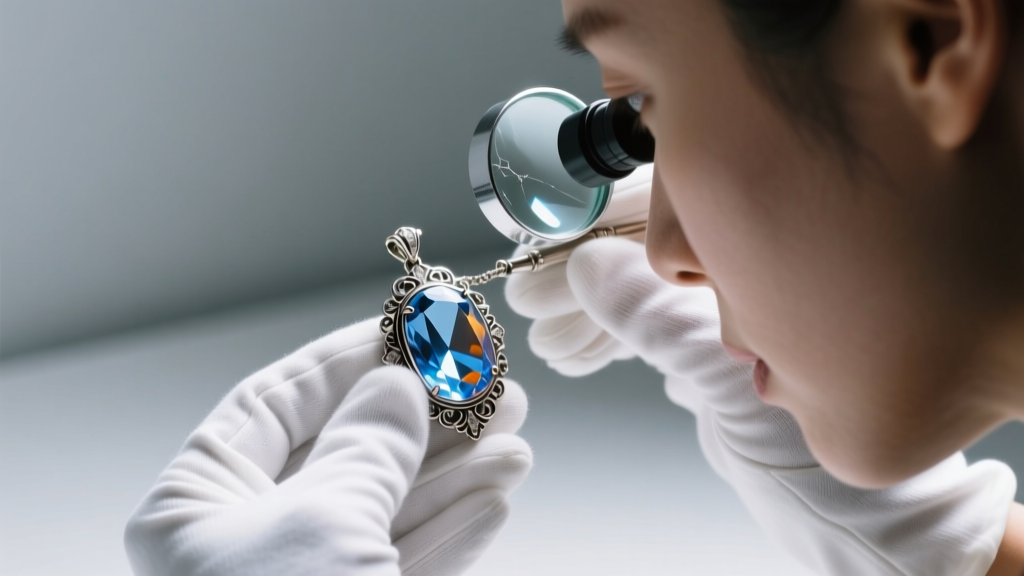
A vintage rock crystal necklace is only as secure as its weakest link. Antique findings operate differently than modern jewelry components, and recognizing their failure modes is essential for preventive maintenance.
The C-Clasp and Push-Pull Mechanisms
Necklaces dating prior to the 1930s often lack modern safety catches. The traditional 'C-clasp' relies entirely on the tension of the pin. Over decades, the pin metal fatigues and loses its spring, making it prone to slipping out of the catch. Similarly, early push-pull (barrel) clasps rely on internal friction. If the clasp feels loose or slides open with minimal resistance, the necklace must be restrung or fitted with a modern safety chain by a professional bench jeweler before it is worn.
Jump Ring Wear
Examine the jump rings connecting the pendant to the chain. In antique pieces, these rings were often hand-sawn rather than soldered shut. Look for 'gapping'—where the two ends of the ring have pulled apart. If you can see daylight between the ends of the jump ring, the heavy rock crystal pendant is at imminent risk of detaching and falling.
Long-Term Storage and Preservation
How you store your vintage rock crystal necklace when it is not being worn dictates its long-term survival. Quartz is harder than silver and gold; if tossed into a communal jewelry box, the crystal will act as an abrasive file, scratching adjacent pearls, opals, and soft precious metals.
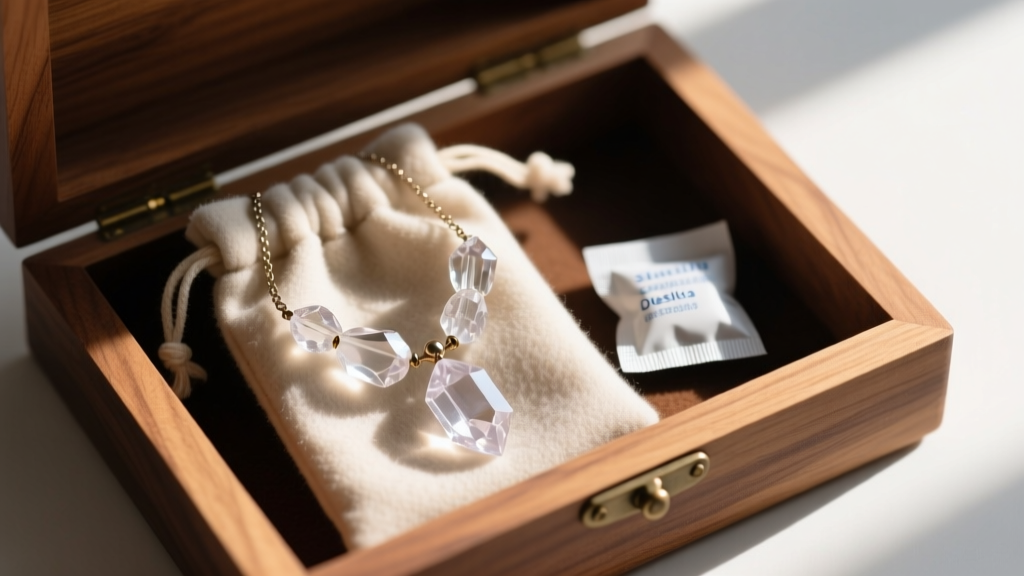
- Individual Containment: Always store the necklace in its own soft, anti-tarnish flannel pouch. This prevents the metal chains from tangling and scratching the crystal's table.
- Climate Control: Store the pouch in a cedar-lined drawer or a specialized jewelry safe. Include a small silica gel packet to control ambient humidity, which accelerates silver sulfide formation (tarnish).
- Flat vs. Hanging: Heavy vintage pendants should be stored flat. Hanging a heavy rock crystal pendant on a standard jewelry stand places continuous tensile stress on the top bail and the first three links of the chain, eventually causing metal fatigue and stretching.
When to Seek Professional Restoration
While routine cleaning and inspection can be handled at home, certain issues require the intervention of a master jeweler who specializes in antique restoration. If you notice any of the following, cease wearing the necklace immediately:
- Prong Lift: If a prong catches on your clothing, it has lifted away from the stone's girdle. A jeweler must gently burnish it back into place.
- Stone Rattling: If the rock crystal clicks or shifts when you gently tap the setting, the internal bearing (the shelf the stone sits on) may be worn, or the prongs have lost their tension.
- Foil Degradation: If a closed-back stone suddenly appears cloudy, dark, or 'dead,' the foil backing has likely oxidized. A specialist can carefully remove the stone, replace the foil, and reseal the setting to restore its original brilliance.
By respecting the unique material properties and historical construction of your vintage rock crystal necklace, you preserve not just a beautiful accessory, but a tangible artifact of lapidary history. Proper care ensures that the icy fire of the quartz will continue to captivate for generations to come.


