How to Clean and Restore a Vintage White Jade Bead Necklace
Learn expert techniques to safely clean, maintain, and restring your vintage white jade bead necklace without damaging the stone or silk.

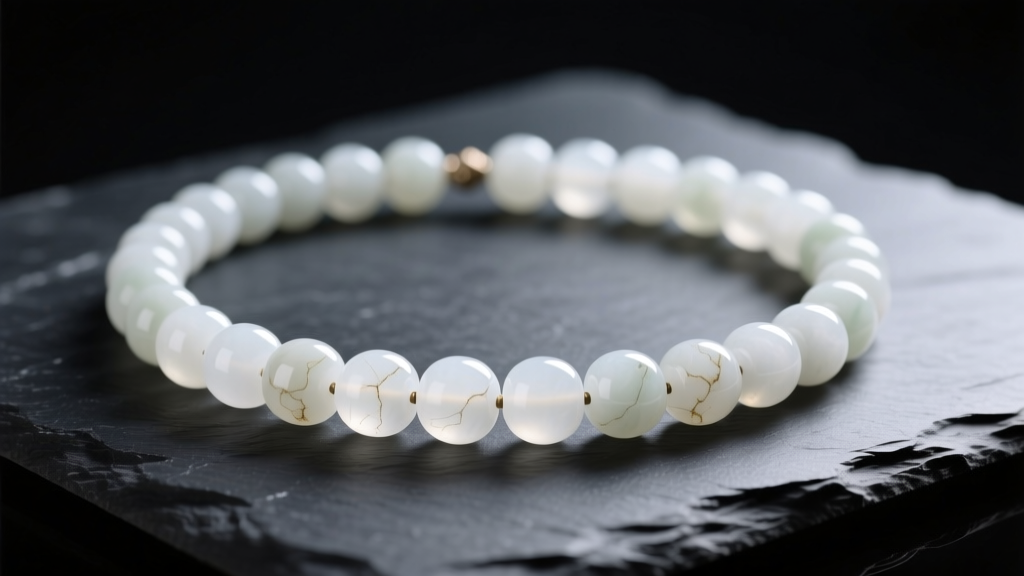
Understanding Your Vintage Jade: Type A, B, and C
Owning a vintage white jade bead necklace is an investment in both history and gemology. However, before applying any cleaning solution, you must identify the treatment level of your jade. According to the Gemological Institute of America (GIA), jade is categorized into three distinct types, and treating the wrong type with standard jewelry cleaners can cause irreversible damage.
- Type A (Untreated): Pure, natural jadeite or nephrite. This is the most durable and can withstand mild soaps and gentle mechanical cleaning.
- Type B (Bleached and Polymer-Impregnated): Common in mid-century vintage pieces, the jade is acid-bleached to remove brown inclusions and filled with a polymer resin to improve translucency. Harsh chemicals, alcohol, and heat will melt or cloud the resin, permanently ruining the bead's luster.
- Type C (Dyed): Color is artificially introduced. Solvents and ultrasonic cleaners will strip the dye, leaving a pale, mottled stone.
Because vintage white jade is often nephrite (Mohs hardness 6.0-6.5) or treated jadeite (Mohs 6.5-7.0), it is susceptible to scratching from harder gemstones and environmental debris. Furthermore, the silk thread holding the beads together is a protein fiber that degrades rapidly when exposed to the lactic acid and urea found in human sweat.
The Step-by-Step Cleaning Protocol
To safely clean your vintage white jade bead necklace without compromising the silk thread or the stone's polish, follow this meticulous, low-impact protocol. Never submerge a silk-knotted necklace in water, as the silk will stretch, retain moisture, and eventually rot from the inside out.
Materials Required
- Distilled water (tap water contains chlorine and hard minerals that can leave micro-deposits)
- pH-neutral liquid soap (e.g., unscented baby shampoo or pure Castile soap)
- Two lint-free microfiber cloths
- Wooden toothpicks or bamboo skewers (never metal picks)
- Soft-bristled makeup brush (like a clean goat-hair blending brush)
The Wipe-Down Method
- Surface Dusting: Use the soft-bristled makeup brush to gently sweep away loose dust and skin cells from between the beads and around the knots.
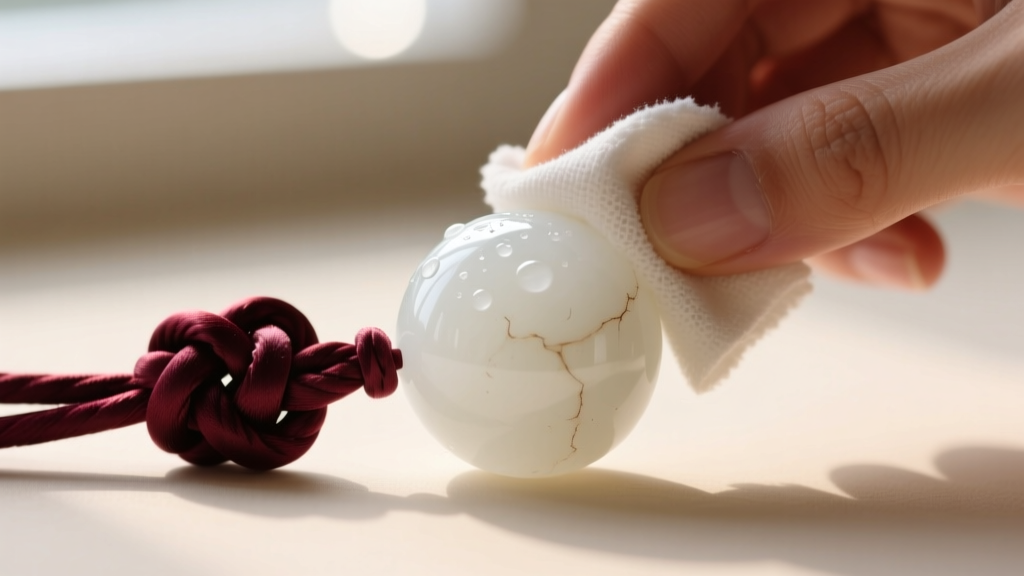
- Damp Cleaning: Mix one drop of pH-neutral soap into a half-cup of distilled water. Dampen one microfiber cloth in the solution and wring it out until it is barely moist—not dripping.
- Bead-by-Bead Polish: Gently wipe each white jade bead individually. Avoid dragging the damp cloth over the silk knots.
- Drying: Immediately follow with the second, completely dry microfiber cloth to buff the stone and remove any residual moisture.
Inspecting and Cleaning the Drill Holes
Dirt, cosmetics, and sebum accumulate heavily inside the drill holes of vintage beads. This hidden grime can harbor bacteria that accelerates silk degradation. Take a wooden toothpick, lightly dampen the tip with your distilled water solution, and gently ream the inside of the drill hole. Wood is softer than jade (Mohs 1.5 vs. 6.5), ensuring you will not scratch the interior channel or chip the exit hole. Wipe away the extracted grime with your dry cloth.
Chemical Agents to Avoid: A Damage Prevention Guide
The GIA's jade care guidelines explicitly warn against ultrasonic and steam cleaners. Ultrasonic cavitation creates microscopic shockwaves that can exploit natural internal faults in nephrite, causing the beads to fracture or shatter entirely. Steam can melt polymer resins in Type B jade and shock the stones with sudden thermal expansion.
| Cleaning Agent / Method | Effect on Jade Stone | Effect on Silk Thread |
|---|---|---|
| Ultrasonic Cleaners | High risk of internal fracturing and chipping | Shreds and weakens protein fibers |
| Isopropyl Alcohol | Dissolves Type B polymer resin; clouds finish | Dries out silk, causing brittleness |
| Ammonia / Windex | Strips natural waxes and polymer coatings | Chemically burns and degrades silk |
| Steam Cleaning | Thermal shock; melts polymer fillers | Shrinks and weakens the knot integrity |
| Mild Soapy Damp Cloth | Safe for all Types (A, B, and C) | Safe if moisture is kept away from knots |
Silk Thread Maintenance and Restringing
The structural integrity of a vintage white jade bead necklace relies entirely on its thread. Historically, these pieces were strung on 100% natural silk. If you wear your necklace weekly, the silk should be replaced every 12 to 18 months. Sweat, perfume, and environmental humidity cause the silk to stretch and fray, significantly increasing the risk of a catastrophic strand break.
Choosing the Right Restringing Materials
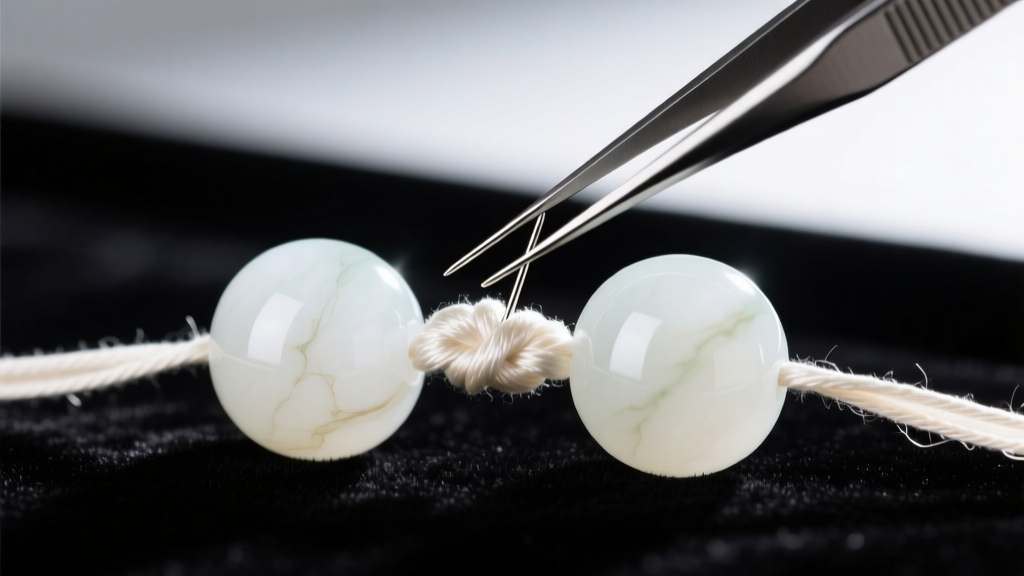
When it is time to restring, avoid modern nylon or fishing lines, which are too rigid and will cause the vintage drill holes to chip over time due to friction. Instead, use high-quality German silk cord, such as Griffin Natural Silk. For standard 6mm to 8mm white jade beads, a Size #2 (0.45mm) or Size #3 (0.50mm) cord is ideal. The cord must pass through the bead twice when knotting, so ensure the drill holes are at least 1.0mm wide.
The Importance of French Wire (Gimp)
Never tie silk directly to a metal clasp. The metal will act like a saw against the silk, cutting through the fibers within months. Always use French wire (also known as gimp or bullion)—a microscopic coiled spring of fine silver or gold-filled wire. The silk passes through this coil, creating a smooth, protective barrier against the clasp's jump ring, preserving the necklace's longevity.
Proper Storage and Environmental Control
Unlike diamonds or sapphires, jade is a slightly porous, water-rich mineral. Storing a vintage white jade bead necklace in an airtight plastic bag with a silica gel desiccant will draw the natural moisture out of the stone, leading to "crazing" (a network of fine, permanent surface cracks).
"Jade requires a stable, breathable environment. Store vintage pieces in a soft, unbleached cotton pouch or a lined wooden jewelry box. Keep them away from direct sunlight and extreme temperature fluctuations to preserve both the stone's internal structure and the silk's elasticity."
Finally, always put your jade necklace on after applying cosmetics, perfumes, and hairspray. The alcohols and aerosolized chemicals in beauty products will settle on the beads, creating a dull, sticky film that is difficult to remove without repeated, stressful cleanings. By adhering to these meticulous care standards, your vintage white jade bead necklace will retain its milky translucence and structural integrity for generations to come.


