Expert Care Guide for Gold Charm Necklaces for Women
Learn expert cleaning and maintenance tips for gold charm necklaces for women. Protect your 14k and 18k gold pendants from tarnish and damage.


Gold charm necklaces for women are more than just accessories; they are deeply personal curations of memories, milestones, and individual style. However, the intricate textures, cast details, and layered pendants that make these necklaces so visually captivating also make them notorious traps for skin oils, cosmetic residues, and environmental pollutants. Unlike a simple, smooth gold chain, a charm necklace requires a highly specific, meticulous approach to maintenance.
As a senior jewelry specialist, I frequently see beautiful 14k and 18k gold pieces lose their luster or suffer structural damage simply because the owner used a one-size-fits-all cleaning method. This comprehensive guide will walk you through the exact metallurgical realities of your gold, the precise tools required for deep cleaning, and the preventative protocols necessary to keep your charm necklace pristine for decades.
Understanding Your Gold Purity and Tarnish Risk
Before you apply any cleaning solution, you must understand the metallurgy of your specific necklace. Pure 24k gold does not tarnish, but it is far too soft for durable charm jewelry. Therefore, gold charm necklaces for women are typically crafted in 10k, 14k, or 18k gold. The non-gold alloy metals—usually copper, silver, and zinc—are what provide durability, but they are also the culprits behind tarnish and discoloration.
Copper, in particular, reacts aggressively with sulfur and moisture in the environment to form copper sulfate, which manifests as a dark, dull film on your jewelry. The higher the copper content, the faster the tarnish.
| Gold Purity | Gold Content | Alloy Composition | Tarnish Risk | Recommended Cleaning Frequency |
|---|---|---|---|---|
| 10k Gold | 41.7% | High copper/silver/zinc | High | Every 2-3 weeks |
| 14k Gold | 58.3% | Moderate copper/silver | Moderate | Monthly |
| 18k Gold | 75.0% | Low copper/silver | Low | Every 6-8 weeks |
According to the Gemological Institute of America (GIA), understanding these alloy ratios is critical because harsh chemical dips designed for 10k gold can easily strip the polished finish off a delicate 18k gold charm.
The "Last On, First Off" Protocol
Preventative maintenance is always superior to corrective cleaning. The golden rule of jewelry wear is "Last On, First Off." Your gold charm necklace should be the very last item you put on when getting dressed, and the first item you take off when you return home.

Environmental and Cosmetic Hazards
- Perfumes and Body Sprays: The alcohol and essential oils in fragrances can create a cloudy film on gold, particularly settling into the deep crevices of textured charms where it is hard to wipe away.
- Skincare Lotions: Thick body butters and lotions contain emollients that bind to gold alloys, attracting dust and dead skin cells that form a stubborn, grayish paste around charm jump rings.
- Chlorine and Sulfur: Never wear your necklace in a chlorinated pool or a hot spring. Chlorine reacts with the copper and zinc in 14k gold, causing a phenomenon known as "stress corrosion cracking," which can literally cause your chain links and charm solder joints to snap.
Step-by-Step Cleaning Routine for Intricate Charms
Standard jewelry polishing cloths are excellent for smooth chains, but they are virtually useless for the deep grooves, milgrain edges, and cast details of most charms. To properly clean gold charm necklaces for women, you need a liquid-based agitation method.
The Safe Soak and Brush Method
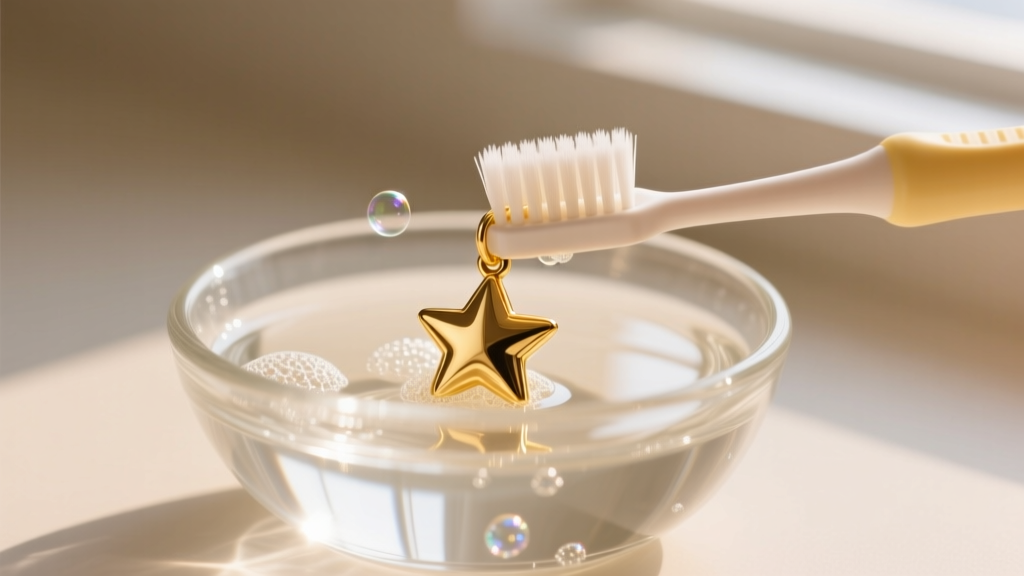
- Prepare the Solution: Fill a small glass bowl with lukewarm water (never hot, as thermal shock can fracture any gemstone accents on your charms). Add exactly two drops of a mild, phosphate-free liquid dish soap, such as Dawn. Avoid soaps with heavy moisturizers or harsh degreasers.
- The Soak: Submerge the necklace completely and let it soak for 10 to 15 minutes. This allows the surfactants in the soap to break down the lipid bonds of skin oils trapped under the charms.
- The Agitation: Use an extra-soft baby toothbrush. Standard adult toothbrushes have medium bristles that can leave micro-scratches on high-polish gold finishes. A baby toothbrush has ultra-fine bristles (typically under 0.12mm in diameter) that can safely reach into microscopic crevices without marring the metal.
- The Rinse: Rinse the necklace under a gentle stream of lukewarm tap water. Ensure the drain is securely plugged or use a mesh strainer to prevent accidental loss.
- The Dry: Pat the necklace dry with a lint-free microfiber cloth or 100% cotton flannel. Never use paper towels or tissues. Paper products are made from wood pulp and will leave microscopic scratches on your gold, dulling the mirror finish over time.
Ultrasonic Cleaners: A Risky Shortcut?
Many jewelry enthusiasts invest in at-home ultrasonic cleaners, which use high-frequency sound waves (usually around 40 kHz) to create microscopic cavitation bubbles that blast dirt out of hard-to-reach areas. While this is incredibly effective for plain diamond and gold jewelry, it requires extreme caution with charm necklaces.
"Ultrasonic cleaners can safely clean gold and platinum, but they can easily damage soft gemstones, enamel work, and porous materials often found in charm jewelry." - Jewelers of America
If your gold charm necklace features enamel detailing, pearls, turquoise, opals, or coral accents, do not use an ultrasonic cleaner. The intense vibrations can shatter soft stones, strip enamel coatings, and loosen the adhesive used in pearl settings. Stick to the manual soak-and-brush method for any multi-material charm necklaces.
Inspecting Hardware: Jump Rings and Clasps
Maintenance extends beyond mere aesthetics; it is also about structural integrity. The constant swinging and friction of charms against one another put immense stress on the hardware.
Checking the Jump Rings
Charms are typically attached to the chain via jump rings. There are two main types:
- Split Rings: Look like tiny keychains. They are secure but can stretch out over time if heavy charms pull on them.
- Soldered Jump Rings: These have a tiny weld (solder) sealing the gap. They are much safer for expensive charms. Inspect the solder joint with a magnifying loupe; if you see a dark line, a crack, or a visible gap, take the necklace to a professional jeweler immediately for re-soldering before you lose a cherished charm.
Clasp Lubrication
If your necklace features a lobster clasp, the tiny internal spring mechanism can become stiff or sticky due to lotion buildup. Place a microscopic drop of sewing machine oil or specialized jewelry lubricant on the clasp hinge, work it open and closed a few times, and wipe away any excess with a cotton swab.
Proper Storage to Prevent Tangling and Micro-Scratches
How you store your gold charm necklaces for women is just as critical as how you clean them. Tossing a charm necklace into a communal jewelry box is a recipe for disaster. The harder gold charms will scratch softer chains, and the multiple pendants will inevitably tangle into frustrating knots that can weaken the chain links when pulled apart.
The Ideal Storage Environment
Store your necklace in an individual, soft flannel pouch or a lined jewelry box compartment. For added protection against tarnish, place a 3M anti-tarnish strip inside the pouch or drawer. These strips absorb sulfur and other corrosive gases from the ambient air, significantly extending the time between necessary deep cleanings. If you prefer hanging storage, use a multi-hook necklace organizer with adequate spacing to ensure the charms do not rest against one another.
By treating your gold charm necklace with this level of specialized care, you preserve not only the financial value of the precious metal but also the sentimental integrity of the charms themselves, ensuring they remain brilliant and structurally sound for generations.


