Expert Guide to Choosing a Clear Cross Necklace: Stones & Settings
Explore the technical anatomy of a clear cross necklace. Compare diamond, moissanite, and CZ, plus learn about prong settings and chain gauges.

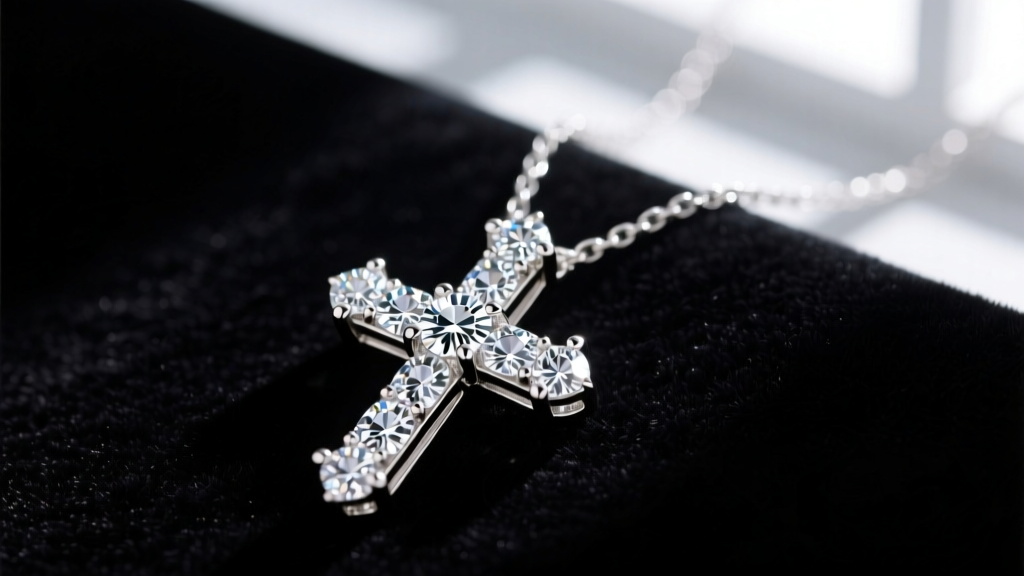
The Intersection of Optics and Metallurgy
When evaluating a clear cross necklace, most consumers focus solely on the visual sparkle. However, from a gemological and metallurgical perspective, the true quality of the piece lies in the precise intersection of optical physics, structural geometry, and alloy tensile strength. A cross pendant introduces unique stress points and light-refraction challenges that do not exist in simpler, single-stone solitaires. Whether you are selecting a piece for daily wear or archival collection, understanding the technical specifications of the gemstones, setting mechanics, and chain gauges is critical to ensuring longevity and maximum brilliance.
In this deep dive, we will deconstruct the anatomy of high-quality clear cross pendants, examining the refractive indices of colorless stones, the structural integrity of prong configurations, and the exact chain gauges required to support varying pendant weights without risking metallurgical fatigue.
Gemological Breakdown: What Makes the Cross 'Clear'?
The term 'clear' in jewelry is a colloquialism for 'colorless and highly transparent.' However, the optical behavior of colorless materials varies drastically based on their atomic structure. The brilliance of a clear cross necklace is dictated by two primary gemological factors: Refractive Index (RI), which measures how much light bends as it enters the stone, and Dispersion, which dictates the stone's ability to separate white light into spectral colors (fire).
Comparing Colorless Gemstone Materials
According to the Gemological Institute of America (GIA), a stone's cut quality interacts with its inherent RI to produce brilliance. Below is a technical comparison of the most common 'clear' stones used in cross pendants.
| Material | Refractive Index (RI) | Dispersion | Mohs Hardness | Optical Character |
|---|---|---|---|---|
| Diamond | 2.417 | 0.044 | 10 | Singly Refractive |
| Moissanite | 2.65 - 2.69 | 0.104 | 9.25 | Doubly Refractive |
| Cubic Zirconia (CZ) | 2.15 - 2.18 | 0.058 - 0.066 | 8.0 - 8.5 | Singly Refractive |
| Clear Quartz | 1.54 - 1.55 | 0.013 | 7.0 | Doubly Refractive |
Moissanite exhibits more than double the dispersion of a diamond, resulting in intense 'fire' that can sometimes create a 'disco ball' effect in smaller accent stones often used in the arms of a cross. Diamonds offer a balanced, crisp white brilliance. Cubic Zirconia, while initially brilliant, is susceptible to microscopic surface abrasions over time due to its lower Mohs hardness, which eventually scatters light and makes the stone appear cloudy. For a clear cross necklace meant for daily wear, diamond or moissanite are the only technically sound choices for long-term optical clarity.
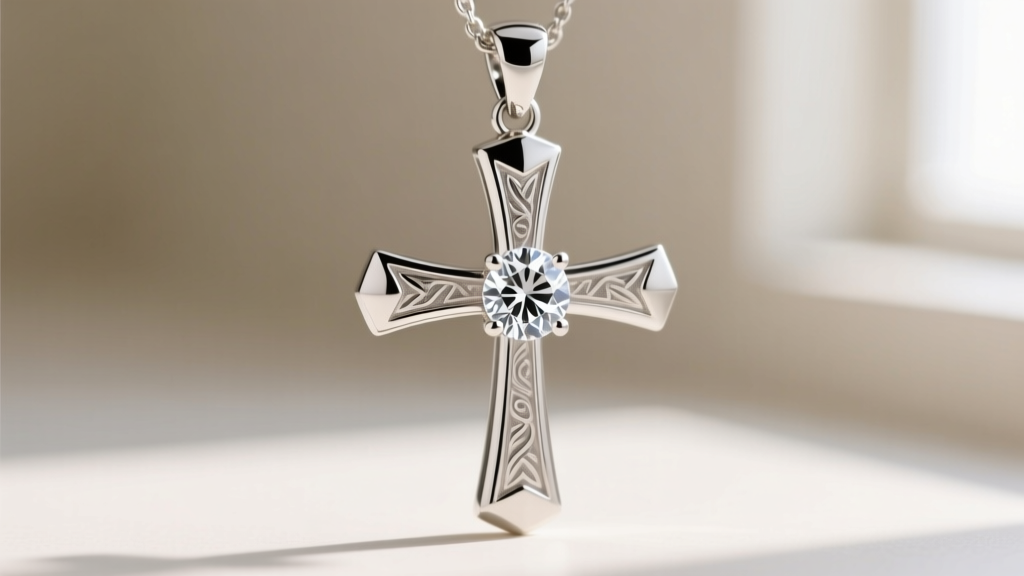
Structural Integrity: Setting Styles for Cross Pendants
The geometry of a cross pendant introduces unique structural vulnerabilities. The inner corners (the four quadrants where the vertical and horizontal arms meet) are natural stress concentrators. If a piece is dropped or caught on fabric, the kinetic energy transfers directly to these apexes. Therefore, the setting style must balance maximum light exposure with structural reinforcement.
Prong vs. Bezel vs. Channel Settings
- Four-Prong Martini Settings: Ideal for round brilliant stones running down the vertical axis. To prevent snagging, the prongs should be 'tipped' (rounded at the apex) and polished. For a 2.0mm accent stone, the prong wire should be at least 0.40mm in diameter to prevent shearing.
- V-Prongs for Marquise Cuts: Many high-end clear cross necklaces utilize marquise-cut stones for the horizontal arms to create a tapered, elegant silhouette. The pointed tips of a marquise stone are highly vulnerable to chipping. A V-prong setting completely encapsulates the fragile 90-degree tip of the stone, distributing impact forces into the metal rather than the gemstone's cleavage plane.
- Bezel Settings: While a full bezel reduces light entry by approximately 15-20% compared to a prong setting, it is the superior choice for active lifestyles. A 0.25mm thick 14k white gold bezel wall provides an impenetrable barrier against lateral impacts.
- Channel Settings: Often used for the central vertical column of the cross. The stones are set between two continuous metal walls. This requires precise calibration; if the channel is too wide, the stones will rattle and eventually fracture against one another. The tolerance must be kept under 0.05mm.
Expert Insight: When inspecting a multi-stone clear cross pendant, always check the 'gallery' (the underside of the setting). High-quality manufacturing will feature open galleries or 'honeycomb' cutouts to allow light to enter the pavilion of the stones and to facilitate ultrasonic cleaning. Solid, closed-back settings trap sebum and cosmetics, rapidly degrading the stone's brilliance.
Chain Metallurgy and Gauge Specifications
A common failure point in fine jewelry is the mismatch between the pendant's mass and the chain's tensile strength. A solid platinum or 18k gold clear cross necklace can easily weigh between 4 to 8 grams. Suspending this weight on a delicate 22-gauge chain is a recipe for metallurgical fatigue and eventual snapping.
Matching the Bail and Chain Gauge
The bail (the loop connecting the pendant to the chain) dictates the maximum chain width, but the chain's gauge dictates its load-bearing capacity. According to manufacturing standards from Rio Grande Jewelry Supply, wire gauge thickness directly correlates to tensile strength.
- 20-Gauge (0.81mm): Suitable for lightweight crosses (under 3 grams). Best utilized in 14k gold, as the higher alloy content (copper, silver, zinc) increases the yield strength compared to pure 24k or softer 18k gold.
- 18-Gauge (1.02mm): The optimal sweet spot for medium-weight crosses (3 to 6 grams). An 18-gauge rolo or cable chain provides excellent structural integrity while maintaining a refined, elegant profile that does not overpower the pendant.
- 16-Gauge (1.29mm): Required for heavy, solid-cast crosses or those featuring dense pavé diamond settings exceeding 8 grams. Often paired with a reinforced box chain, which features interlocking square links that resist lateral twisting and kinking.
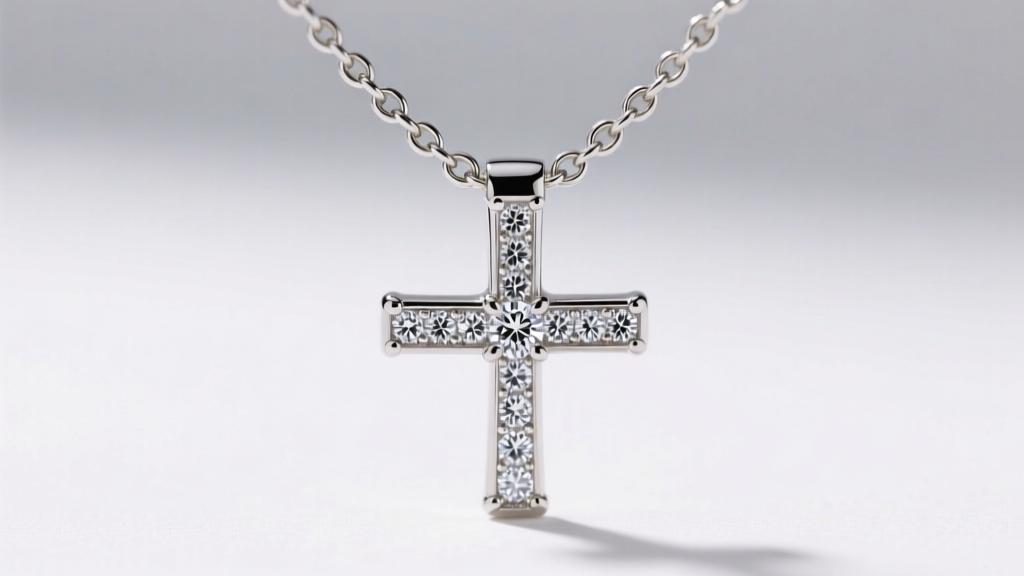
The Importance of Alloy Selection
For white gold clear cross necklaces, the metallurgy of the chain is just as important as the setting. Standard 14k white gold is alloyed with nickel or palladium to achieve its silver hue, but it requires rhodium plating. Over time, the friction between the chain and the bail will wear away the rhodium, exposing the slightly yellowish underlying alloy. For a maintenance-free alternative, consider a 950 Platinum chain. Platinum is denser and heavier, but it is highly ductile; rather than snapping under sudden tension, a platinum chain will stretch and deform, giving the wearer a visual warning before catastrophic failure occurs.
Maintenance and Optical Degradation
Diamonds are inherently hydrophobic (water-repelling) and lipophilic (oil-attracting). This means a clear cross necklace worn daily will rapidly accumulate a microscopic layer of sebum, lotions, and environmental grease on the pavilion (bottom) of the stones. This oil film alters the critical angle of light refraction, causing light to 'leak' out of the bottom of the stone rather than reflecting back to the eye, resulting in a dull, opaque appearance.
To maintain optimal optical performance, clean the pendant bi-weekly using a solution of warm distilled water and a few drops of degreasing dish soap. Utilize a soft-bristled baby toothbrush to gently agitate the galleries and under the prongs. While ultrasonic cleaners are generally safe for diamonds and moissanite in secure prong settings, they should be strictly avoided if the cross features fracture-filled diamonds or if the stones are set with tension, as the high-frequency vibrations can loosen the setting's grip over time.
Conclusion
Selecting the perfect clear cross necklace requires looking beyond the initial sparkle. By prioritizing stones with high Mohs hardness and optimal refractive indices, demanding structurally sound setting configurations like V-prongs for tapered stones, and pairing the pendant with a metallurgically appropriate chain gauge, you ensure the piece remains both optically brilliant and physically enduring. True luxury in jewelry is defined not just by the materials used, but by the precision of its engineering.


