Coatlicue Necklace Materials: Silver, Obsidian & Bronze Compared
Explore the best materials for a Coatlicue necklace. Compare 925 silver, bronze, and obsidian for durability, weight, and Aztec authenticity.

The Mythological Weight of the Coatlicue Necklace
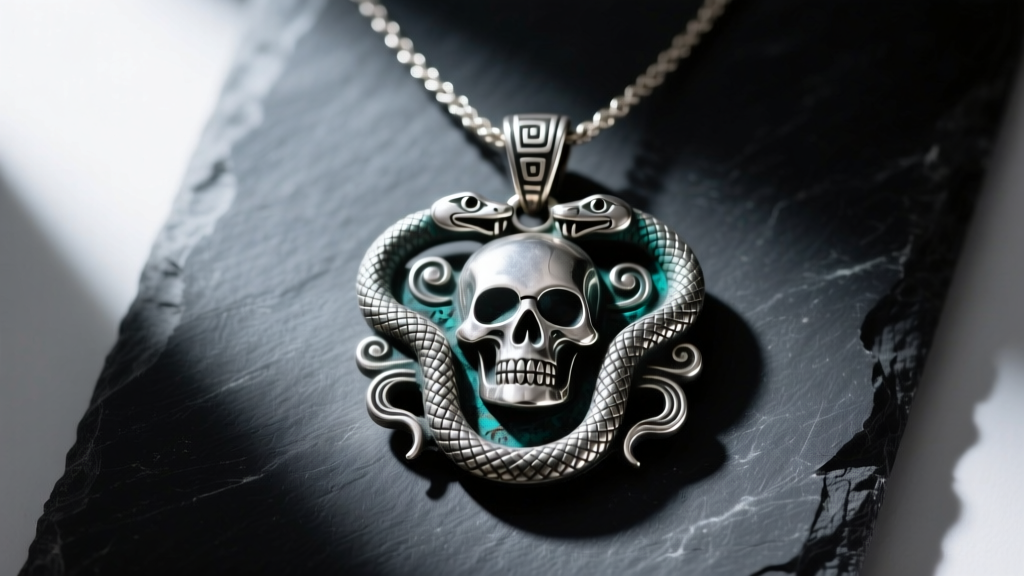
Coatlicue, the revered and feared Aztec goddess of earth, life, death, and rebirth, is traditionally depicted wearing a skirt of intertwined serpents and a gruesome necklace of human hands, hearts, and skulls. In contemporary jewelry design, the Coatlicue necklace has evolved into a powerful statement piece that honors this rich Mesoamerican mythology. However, translating such intricate, heavy, and macabre motifs into wearable art requires a deep understanding of metallurgy and gemology. When investing in a high-relief Coatlicue pendant, the material dictates not only the aesthetic authenticity but also the structural longevity, weight distribution, and skin safety of the piece. This guide breaks down the specific material properties you must consider before purchasing or commissioning an Aztec-inspired statement necklace.
The goddess Coatlicue represents the duality of creation and destruction. A well-crafted necklace honoring her must balance the heavy, brutalist elements of skulls and serpents with the refined, enduring properties of premium metals and stones.
Primary Metals Used in Aztec-Inspired Jewelry
The foundation of any Coatlicue necklace is the metal used to cast the intricate serpent and skull reliefs. Because these designs require deep undercuts and high-relief carving, the choice of alloy affects both the casting quality and the final patina.
925 Sterling Silver & Oxidation Techniques
Sterling silver (92.5% pure silver, 7.5% copper) is the premier choice for fine artisan Coatlicue necklaces. According to The Silver Institute, the copper alloy provides the necessary tensile strength to support heavy pendant bails without warping. More importantly, the copper content allows artisans to use liver of sulfur to induce a deep, black oxidation. This chemical patina is crucial for Coatlicue designs, as it settles into the deep crevices of skull eye sockets and serpent scales, creating a stark contrast against the polished high points. A solid cast 925 silver Coatlicue pendant measuring roughly 50mm by 60mm can weigh between 45 and 85 grams, providing a substantial, luxurious drape.
Bronze and Brass Alloys
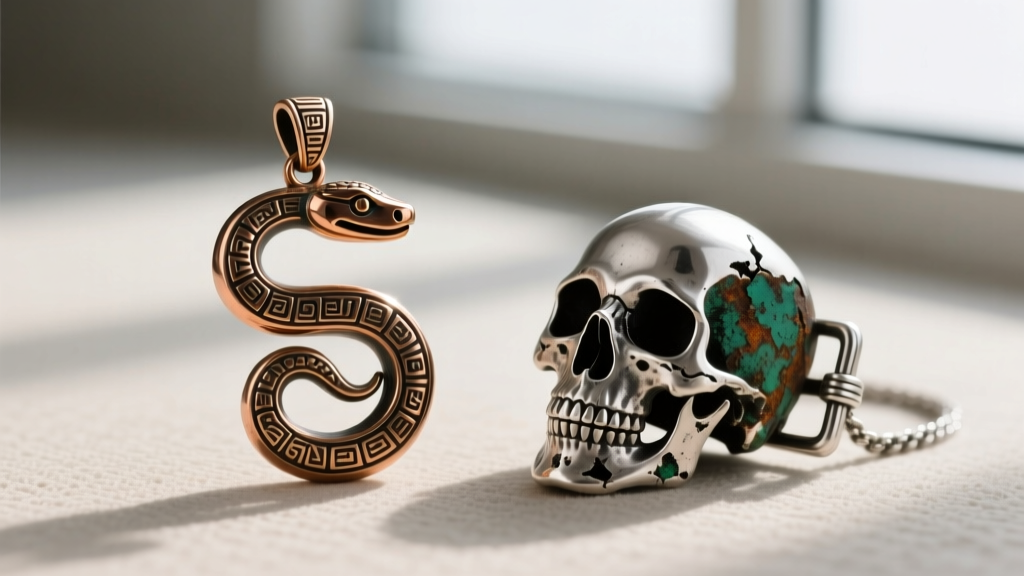
For a more earthy, historically resonant aesthetic, many jewelers use bronze (typically 88% copper and 12% tin) or jeweler's brass. Bronze naturally develops a warm, brownish patina that mimics ancient unearthed artifacts. However, buyers must be aware of the material's reactivity. The high copper content in bronze can react with the chlorides and moisture in human sweat, leading to verdigris (a green surface corrosion) and potential skin discoloration. To mitigate this, high-end bronze necklaces are often treated with a micro-crystalline wax or a clear nano-coating. While bronze is harder and more scratch-resistant than sterling silver, it lacks the malleability required for ultra-fine prong settings if the piece includes gemstones.
Gemstone and Organic Inlays: Obsidian, Turquoise, and Bone
Authentic Mesoamerican jewelry heavily utilized local, spiritually significant materials. Modern Coatlicue necklaces often incorporate these elements as inlays or focal beads to enhance the mythological narrative.
Genuine Obsidian vs. Glass Imitations
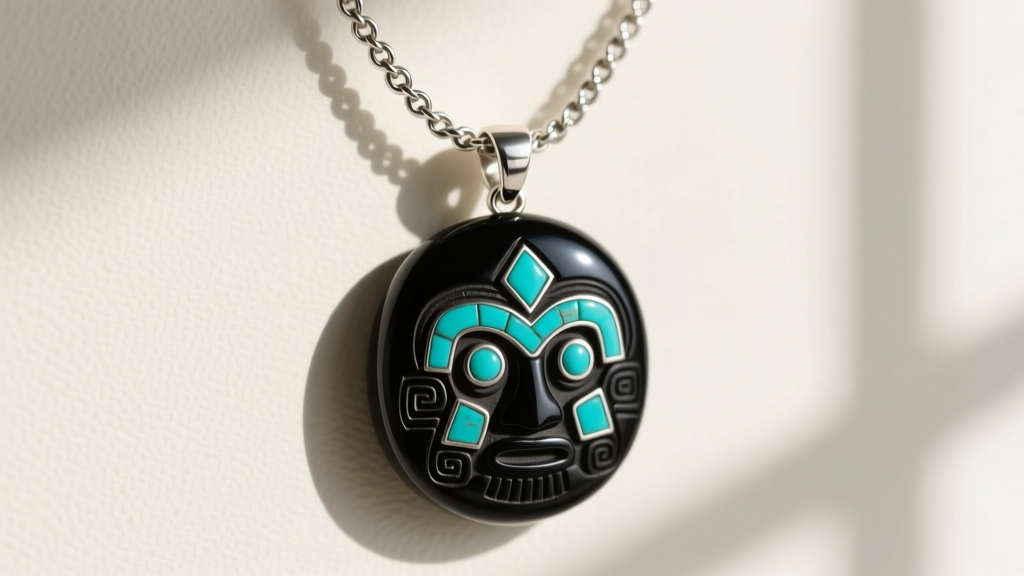
Obsidian, a naturally occurring volcanic glass, was used by the Aztecs for everything from mirrors to the razor-sharp blades of the macuahuitl weapon. In a Coatlicue necklace, black obsidian is frequently carved into skull motifs or used as a backing plate for silver serpents. The Gemological Institute of America (GIA) notes that obsidian ranks at 5 to 5.5 on the Mohs hardness scale. While it takes a brilliant, glassy polish, it is highly susceptible to conchoidal fracturing—meaning it can chip or shatter if dropped on a hard surface. Buyers must beware of cheap 'obsidian' which is often just molded black glass. Genuine obsidian will exhibit slight imperfections, flow bands, or a distinctive greasy luster when examined under a loupe.
Ethical Sourcing of Bone and Resin Alternatives
To replicate the bone elements of Coatlicue's traditional adornment, some artisans use carved animal bone or antler. However, bone is highly porous (ranking a mere 2.5 on the Mohs scale) and will absorb skin oils, lotions, and sweat, eventually leading to discoloration and structural degradation. As a superior alternative, many modern jewelers utilize high-density, hand-painted polyurethane resins or stabilized turquoise. Stabilized turquoise (infused with a clear epoxy resin under high pressure) provides the vivid blue-green contrast associated with Aztec royalty while completely sealing the stone's natural porosity, ensuring it survives daily wear without cracking or fading.
Structural Integrity: Chain Gauges and Clasp Mechanics
A common failure point in heavy statement jewelry is the chain and clasp assembly. A solid metal Coatlicue pendant is exceptionally front-heavy. Standard 1mm to 2mm chains will inevitably stretch, kink, or snap under the dynamic load of a 60-gram pendant swinging against the chest.
- Chain Gauge: Opt for chains with a minimum wire thickness of 14-gauge (1.6mm) and an overall width of 4mm to 6mm. Heavy Rolo, Curb, or thick Rope chains provide the necessary tensile strength.
- Jump Rings: The jump ring connecting the pendant to the chain must be soldered shut or constructed from at least 12-gauge (2.0mm) wire. An open, thin jump ring will easily pull apart under the pendant's weight.
- Clasp Selection: Avoid standard spring-ring clasps, which have weak internal springs that fail under heavy loads. Instead, utilize a heavy-duty lobster claw clasp or, ideally, a toggle clasp. The sheer weight of a Coatlicue pendant actually makes a toggle clasp highly secure, as the gravitational pull keeps the T-bar firmly seated against the wide ring.
Material Comparison Matrix
Use the following data table to compare the physical properties and maintenance requirements of the most common materials used in Coatlicue necklaces.
| Material | Mohs Hardness | Weight Density | Patina / Aging | Maintenance Level |
|---|---|---|---|---|
| 925 Sterling Silver | 2.5 - 3.0 | High (10.4 g/cm³) | Controlled oxidation (black) | Medium (Polish high points only) |
| Cast Bronze | 3.0 - 4.0 | Medium (8.8 g/cm³) | Natural verdigris / darkening | High (Requires wax sealing) |
| Black Obsidian | 5.0 - 5.5 | Low (2.4 g/cm³) | None (Stable glass) | Low (Avoid hard impacts) |
| Stabilized Turquoise | 5.0 - 6.0 | Low (2.7 g/cm³) | None (Resin sealed) | Low (Wipe with damp cloth) |
| Carved Bone | 2.5 | Very Low (1.8 g/cm³) | Yellowing / Oil absorption | High (Keep dry, avoid oils) |
Price Tiers and Authenticity Markers
When shopping for a Coatlicue necklace, pricing is a direct reflection of the material integrity and casting method. Mass-produced 'Tibetan silver' or zinc-alloy pendants, often manufactured via cheap die-casting, typically range from $20 to $50. These pieces lack the crisp detail of lost-wax casting and may contain nickel or lead, posing severe allergy risks. Artisan-cast bronze pieces with genuine stone inlays generally sit in the $80 to $180 range, offering excellent durability and historical aesthetics. For heirloom-quality, solid 925 sterling silver necklaces featuring hand-carved obsidian and stabilized turquoise, expect to invest between $250 and $600. Fine jewelry interpretations utilizing 14k gold accents and natural, high-grade Sleeping Beauty turquoise can easily exceed $1,500.
Care and Maintenance for High-Relief Statement Pieces
The intricate, three-dimensional nature of a Coatlicue necklace makes it a magnet for dust, skin oils, and environmental pollutants. However, standard jewelry cleaning methods can ruin the piece. Never use ultrasonic cleaners on a Coatlicue necklace. The high-frequency vibrations can fracture obsidian inlays, loosen turquoise settings, and strip away the deliberate chemical oxidation that gives silver skulls their depth. Similarly, liquid silver dips will instantly remove the dark patina, leaving the piece looking flat and washed out. To clean your necklace, use a soft, dry microfiber cloth to gently wipe the polished high points. For debris trapped in the deep serpent scales or skull crevices, use a soft-bristled makeup brush or a blast of compressed air. Store the piece flat in an anti-tarnish pouch to prevent the heavy pendant from tangling with and stressing the chain links.


