Expert Guide: Grading Your Crystal Butterfly Necklace
Master the technical details of a crystal butterfly necklace. Learn about crystal grades, chain metallurgy, and clasp mechanics in our expert guide.

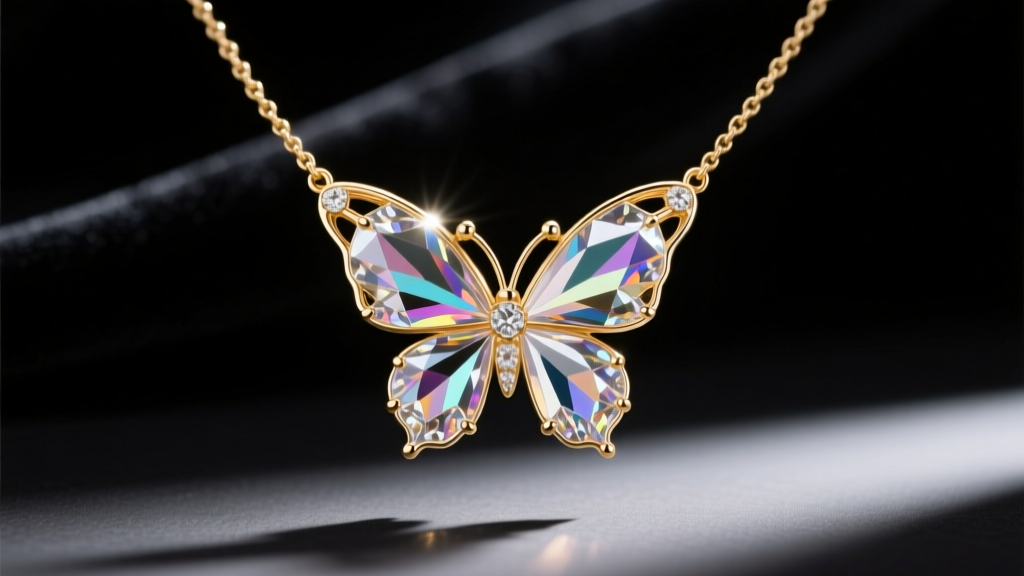
The Anatomy of a High-Quality Crystal Butterfly Necklace
The market for the classic crystal butterfly necklace is saturated with everything from $10 fast-fashion trinkets to $1,500 fine jewelry pieces. As a jewelry appraiser and materials specialist, I look past the aesthetic appeal to evaluate the optical physics, metallurgical integrity, and structural engineering of each piece. In 2026, with the industry's near-total transition to eco-conscious, lead-free crystal manufacturing, understanding the technical specifications of your jewelry is more critical than ever. This deep dive will equip you with the exact metrics needed to grade, purchase, and maintain a high-performance crystal butterfly pendant and chain system.
Crystal Composition: Refractive Index and Material Density
The term 'crystal' is frequently misused in jewelry marketing. True optical crystal relies on specific chemical compositions to achieve high light return (brilliance) and spectral separation (fire). When evaluating the wings and body of a butterfly pendant, you are generally looking at three distinct material categories.
1. Advanced Lead-Free Crystal (Barium/Zinc Glass)
Historically, lead oxide (PbO) was added to glass to increase its refractive index (RI). Due to global toxicity regulations, top-tier manufacturers like Swarovski and Preciosa now use proprietary blends of barium oxide, zinc oxide, and titanium dioxide. According to the GIA Gem Encyclopedia, advanced lead-free crystal maintains an RI of approximately 1.70 to 1.75. This provides excellent brilliance without the environmental hazards. A high-grade crystal butterfly necklace will feature precision machine-cut facets that align perfectly at the pavilion, ensuring light reflects back through the crown rather than leaking out the bottom.
2. Cubic Zirconia (CZ)
CZ is a synthetic crystalline substance with an RI of 2.15 to 2.18, making it significantly more brilliant than glass. It also possesses a high dispersion rate (0.058-0.066), which creates the rainbow 'fire' seen in premium pieces. However, CZ has a specific gravity of 5.6 to 6.0—nearly double that of glass. A large, 30mm wingspan butterfly pendant paved with CZ can weigh upwards of 15 grams, requiring a heavier, more robust chain to prevent dynamic sagging.
3. Acrylic and Molded Resin
Found in entry-level tiers, acrylic has an RI of just 1.49 and a Mohs hardness of 2 to 3. While lightweight, it scratches easily and lacks the internal faceting required for true light return, relying instead on surface-level iridescent coatings that degrade over time.
Metallurgy & Chain Selection: Supporting the Pendant
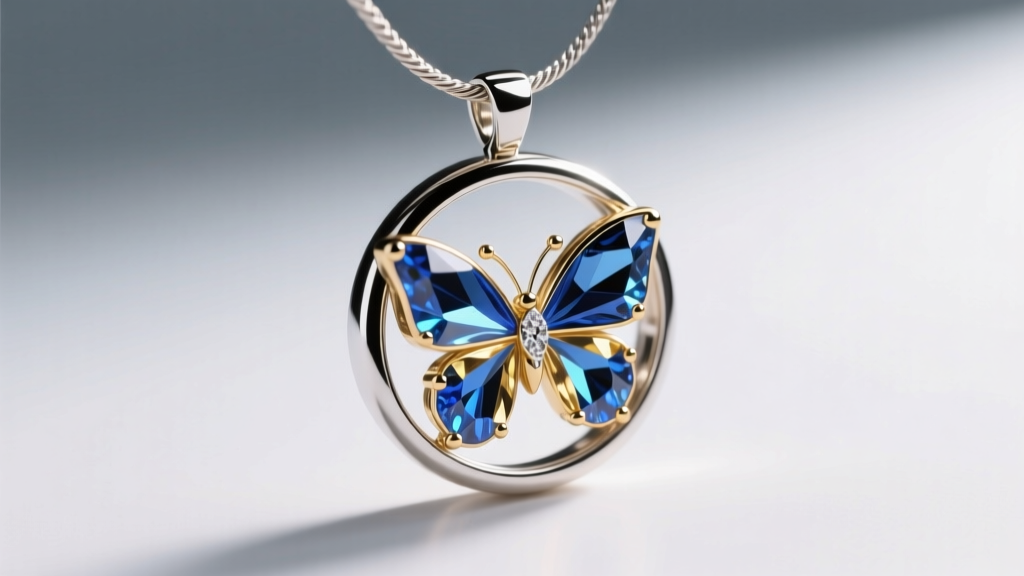
The pendant is only half the equation. The chain must support the pendant's weight while resisting tensile failure and corrosion. In 2026, the Federal Trade Commission (FTC) strictly enforces the definition of 'Gold Vermeil,' requiring a base of 925 Sterling Silver plated with at least 10k gold to a minimum thickness of 2.5 microns. Many sub-standard brands sell 'gold-plated brass,' which lacks the structural memory of silver and will oxidize rapidly once the microscopic gold layer wears away.
Chain Gauge and Tensile Strength
Butterfly pendants typically feature a wide center of gravity. If the chain is too thin, it will twist and tangle constantly. Below is a technical comparison of common chain weaves used for crystal pendants:
| Chain Type | Gauge (mm) | Tensile Strength (Approx.) | Best For |
|---|---|---|---|
| Cable Chain | 0.8mm - 1.0mm | 2.5 - 4.0 kg | Lightweight glass crystals (< 5g) |
| Box Chain | 1.2mm - 1.5mm | 6.0 - 9.0 kg | Medium CZ pendants (5g - 12g) |
| Wheat (Spiga) Chain | 1.5mm - 2.0mm | 10.0 - 15.0 kg | Heavy, oversized statement pieces |
| Snake Chain | 1.0mm - 1.5mm | 3.0 - 5.0 kg | Smooth drape, but prone to kinking if bent |
For a standard 8-gram crystal butterfly necklace, a 1.2mm Box chain or a 1.5mm Wheat chain provides the optimal balance of tensile strength and fluid drape, preventing the pendant from flipping upside down during wear.
Prong vs. Bezel Settings: Securing the Wings
The method used to secure the crystal into the metal framework dictates both the optical performance and the durability of the necklace.
- Prong Settings: Metal claws grip the girdle of the crystal. This maximizes light exposure to the pavilion facets, increasing brilliance. However, prongs can snag on knitwear and silk, and if bent, will result in stone loss.
- Bezel Settings: A continuous rim of metal surrounds the crystal's edge. While this reduces light entry by roughly 15%, it offers superior impact protection. For daily-wear butterfly necklaces that may collide with zippers or desks, a bezel or semi-bezel setting is highly recommended.
- Channel/Pave Settings: Often used on the 'body' or 'antennae' of the butterfly. Ensure the melee stones are set with at least three shared prongs per stone to prevent loss during ultrasonic cleaning.
Clasp Mechanics and Failure Points
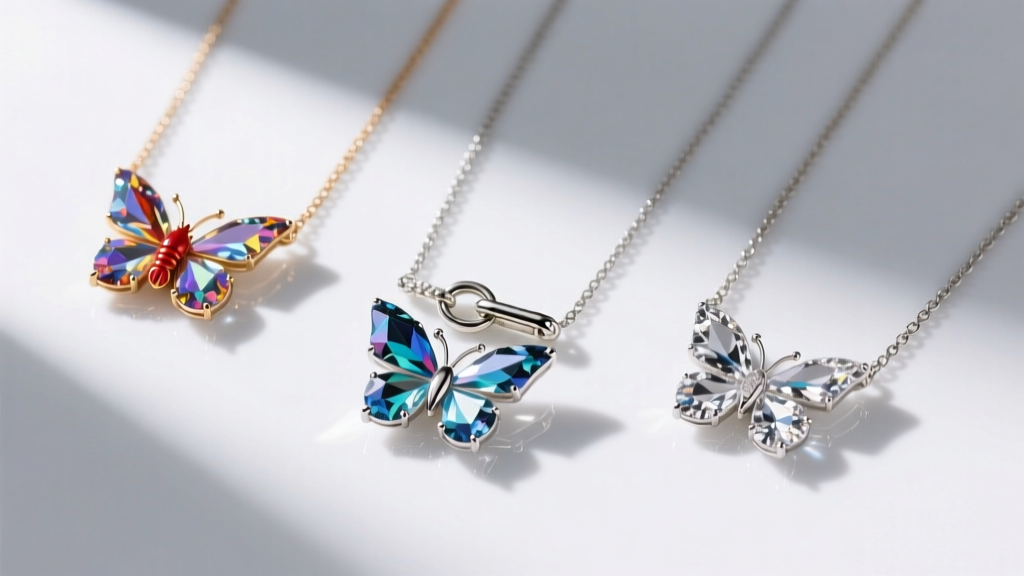
The clasp is the most common point of mechanical failure in any necklace. When investing in a premium crystal butterfly necklace, inspect the clasp hardware.
Spring Ring Clasps: Common on budget chains. The internal spring mechanism is prone to fatigue and failure after 12-18 months of daily tension. Furthermore, the tiny trigger lever is difficult to operate single-handedly.
Lobster Clasps: The industry standard for mid-to-high-tier jewelry. A forged lobster clasp with a heavy-duty internal spring offers superior shear strength. Look for a 'swivel' lobster clasp, which rotates 360 degrees at the jump ring, preventing the chain from twisting and accumulating torsional stress.
Magnetic Clasps: While convenient, neodymium magnetic clasps can inadvertently attract metallic dust and iron particles from the environment, which can scratch the crystal surface if not cleaned regularly.
Price Tiers and Authenticity Markers
Understanding the correlation between materials and pricing will help you identify genuine value versus inflated marketing.
- Tier 1: Fashion / Costume ($15 - $45) Base metal alloys (zinc/brass) with flash plating (< 0.5 microns). Stones are molded acrylic or low-grade stamped glass. Settings are glued rather than mechanically set.
- Tier 2: Bridge / Demi-Fine ($60 - $180) 925 Sterling Silver or 316L Surgical Steel with 2.5-micron gold vermeil. Features precision-cut lead-free crystal or AAA-grade CZ. Mechanically set with prongs or bezels. Includes a swivel lobster clasp.
- Tier 3: Fine Jewelry ($350 - $1,200+) Solid 14k or 18k gold. High-grade CZ or natural diamond accents. Hand-polished settings, laser-inscribed authenticity markers, and engineered chain weaves.
Expert Maintenance Tip: Never use ultrasonic cleaners on a crystal butterfly necklace if the stones are fracture-filled or if the piece features glued-in resin components. The high-frequency vibrations will shatter the adhesive bond. Instead, use a solution of warm distilled water and a drop of pH-neutral dish soap, gently agitating with a soft-bristled baby toothbrush to remove sebum and cosmetic buildup from the pavilion facets.
Final Thoughts on Material Selection
A crystal butterfly necklace is a masterclass in balancing delicate aesthetics with material science. By prioritizing advanced lead-free crystals or high-density CZ, demanding proper FTC-compliant vermeil or solid metals, and selecting a chain weave with adequate tensile strength, you ensure the piece remains a brilliant, structurally sound staple in your collection for decades. Always verify the specific gravity and setting mechanics before purchase, and rely on authoritative gemological data rather than brand marketing to guide your investment.


