The Curse of the Necklace 2024: Trend Autopsy & 2026 Revival
Unpacking the curse of the necklace 2024: how hyper-layering caused tangling and allergies, and the 2026 material science shift to curated, skin-safe chains.


The Phenomenon: Defining the Curse of the Necklace 2024
By late 2024, the jewelry industry and dermatology clinics alike were grappling with a viral aesthetic fallout colloquially dubbed 'the curse of the necklace 2024'. Driven by algorithmic trends that championed hyper-layered 'neck stacks' of five to eight mismatched chains, consumers were sold an illusion of effortless maximalism. The reality, however, was a mechanical and metallurgical disaster. The curse manifested in three distinct ways: inextricably knotted chains that required professional jeweler intervention, a massive spike in contact dermatitis, and widespread clasp failures. Now in 2026, as the market corrects itself toward curated minimalism and engineered durability, it is crucial to autopsy what went wrong and how modern collectors are rebuilding their stacks using material science and spatial geometry.
The Mechanics of Tangling: Chain Topology & Friction
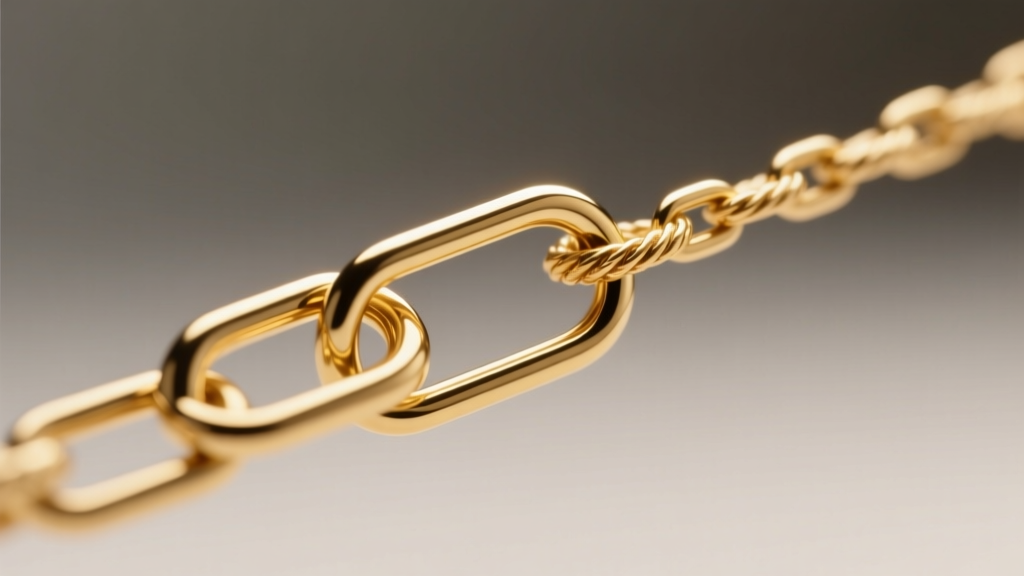
The primary symptom of the curse was the 'knotting epidemic.' This was not merely bad luck; it was a predictable outcome of ignoring chain topology. When consumers layered a 1.2mm rope chain with a 3.5mm hollow Cuban link, they created a high-friction trap. The small, tightly wound links of the rope chain possess a high surface friction coefficient, acting like microscopic hooks. When subjected to the kinetic movement of the human body, these smaller links slip into the hollow gaps of the larger Cuban or paperclip chains. Once entangled, the tensile strength of cheap brass alloys (often around 200-300 MPa) is easily exceeded when the wearer pulls them apart, leading to micro-fractures in the solder joints.
2024 Failure Data: Chain Compatibility Matrix
| Chain Type (2024 Trend) | Avg. Thickness | Tangling Risk | Primary Failure Mode |
|---|---|---|---|
| Rope Chain | 1.2mm - 1.5mm | Extreme (92%) | Hooking into larger link gaps |
| Hollow Cuban | 3.0mm - 5.0mm | Moderate (45%) | Crushing under tension |
| Snake Chain | 2.0mm - 3.0mm | Low (15%) | Kinking and permanent bending |
| Box Chain | 1.5mm - 2.0mm | High (78%) | Interlocking with cable chains |
Metallurgical Fallout: The Contact Dermatitis Spike
The second, more painful facet of the curse of the necklace 2024 was the severe dermatological backlash. To meet the price points demanded by fast-fashion layering sets (often priced between $25 and $45 for a stack of four), manufacturers relied on brass or nickel-silver base metals with 'flash plating'—a gold layer measuring less than 0.175 microns. According to the Federal Trade Commission Jewelry Guides, this barely qualifies as gold electroplate. When exposed to the slightly acidic pH of human sweat (typically between 4.5 and 7.0), this microscopic barrier degrades within weeks, exposing the nickel-rich base metal.
The EU Nickel Directive strictly limits nickel release to 0.5 µg/cm²/week for prolonged skin contact. The unregulated 2024 trend stacks frequently exceeded this by a factor of ten. A comprehensive study published in the National Institutes of Health (NIH) highlights that nickel is the most common contact allergen globally, and the sudden introduction of multiple nickel-leaching chains resting directly against the highly sensitive skin of the décolletage resulted in a documented spike in allergic contact dermatitis among young demographics. The red, weeping rashes became a physical hallmark of the trend's failure.
The 2026 Antidote: Engineered Layering Frameworks
In 2026, the industry has pivoted from chaotic stacking to 'engineered layering.' High-end and mid-market brands now design modular systems that physically prevent tangling and utilize hypoallergenic metallurgy. The modern approach relies on strict spatial geometry and material upgrades.
- The 2.5-Inch Drop Rule: To prevent friction overlap, 2026 styling dictates a minimum 2.5-inch length differential between layered chains. A standard curated stack now features a 15-inch choker, a 17.5-inch pendant, and a 20-inch heavy chain, ensuring the pendants and links occupy entirely different kinetic zones on the chest.
- Texture Isolation: Layering is now restricted to varying textures rather than varying link sizes. A 2.0mm solid cable chain is paired with a 2.0mm beaded chain. The uniform thickness prevents smaller links from slipping inside larger ones.
- Clasp Engineering: The fragile 4mm spring-ring clasp has been entirely phased out of premium layering. It has been replaced by the 8mm lobster claw or, increasingly, neodymium magnetic clasp converters that allow for seamless removal without stressing the solder joints at the end of the chain.
- Material Purity: ASTM F136 implant-grade titanium and solid 14k or 18k gold (nickel-free alloyed with palladium or silver) are now the baseline for reputable brands, ensuring zero degradation against skin acids.

Investment Shift: From Fast-Fashion Sets to Modular Systems
The economic footprint of the curse has permanently altered consumer purchasing behavior. The 'buy once, wear twice' mentality of 2024 has been replaced by a modular investment strategy. Consumers in 2026 are spending $150 to $300 on a single, high-quality, solid-gold foundational chain—such as a 2.5mm solid curb or a 3mm Figaro—and utilizing interchangeable, high-grade bail pendants to alter the aesthetic. Brands that survived the 2024 crash are those that transparently publish their metallurgical compositions, offering lifetime warranties against tarnishing and clasp failure.
'The curse of the necklace 2024 was ultimately a lesson in material respect. We spent a year treating fine jewelry like disposable apparel, and the physical degradation of those pieces was the market's way of demanding a return to horological and metallurgical standards.' — 2026 Global Jewelry Market Report
Conclusion: Breaking the Curse
Looking back, the curse of the necklace 2024 served as a vital, albeit painful, correction for the jewelry industry. It exposed the physical limitations of cheap alloys and the mechanical flaws of unstructured layering. Today, wearing a neck stack is no longer a game of chance involving tangled knots and skin irritation. By respecting chain topology, demanding transparent material grades, and applying strict spatial geometry, modern collectors can enjoy the visual depth of layering without falling victim to the structural failures of the past.


