Custom Cross Necklace Drawing: Budget & Value Guide
Learn how to turn your custom cross necklace drawing into reality. We break down 2026 CAD costs, metal weights, and bench jeweler pricing.

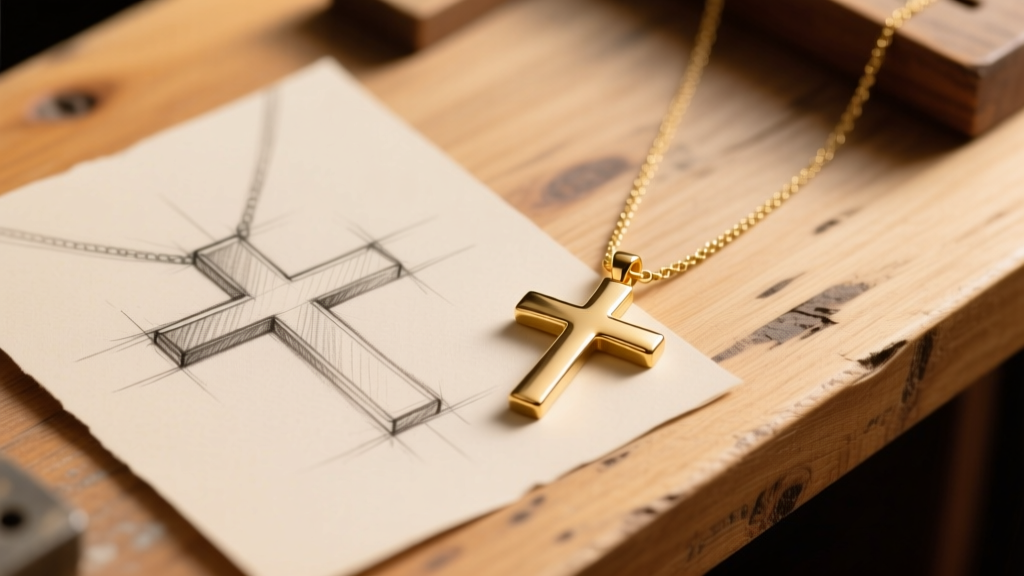
The True Cost of Turning a Cross Necklace Drawing Into Reality
Taking a personal cross necklace drawing to a bench jeweler is a deeply meaningful way to create bespoke faith-based or fashion jewelry. Whether you have sketched a minimalist line-art cross on a napkin or drafted an ornate, gemstone-encrusted gothic cross on your iPad, transforming that 2D concept into a 3D wearable piece requires navigating the complex economics of custom jewelry manufacturing. With precious metal markets fluctuating in early 2026, understanding the exact breakdown of labor versus material costs is critical to ensuring you receive fair value.
Many consumers mistakenly believe that the metal weight is the primary driver of custom jewelry costs. In reality, for a delicate cross pendant weighing between 1.5 and 4 grams, the labor, CAD (Computer-Aided Design) modeling, and casting setup fees will account for 60% to 80% of your final invoice. According to industry benchmarks from Jewelers of America, the average bench jeweler charges between $85 and $150 per hour for custom fabrication and finishing work in 2026.
Benchmarking the Custom Fabrication Pipeline
When you hand your cross necklace drawing to a professional, it enters a multi-step pipeline. First, a CAD designer translates your sketch into a 3D model, accounting for structural integrity and metal shrinkage. Next, a 3D resin printer creates a wax pattern. This pattern is invested in plaster, burned out in a kiln, and finally cast using your chosen metal alloy. Below is a realistic cost matrix for a standard 25mm x 15mm solid cross pendant without gemstones.
| Production Stage | Average Cost (2026) | Value Assessment Notes |
|---|---|---|
| CAD Design & Rendering | $150 - $350 | Includes up to two revisions. Highly complex filigree designs push this to $500+. |
| 3D Wax Printing & Spruing | $25 - $45 | Fixed cost regardless of metal choice. Multiple pieces on one tree reduce per-unit cost. |
| Casting Labor & Flask Fee | $60 - $120 | Covers kiln time, investment material, and the centrifuge or vacuum casting process. |
| Cutting, Polishing & Finishing | $80 - $150 | Bench time to remove sprue marks, sand, and achieve a high polish or brushed texture. |
| Findings (Bail & Jump Ring) | $15 - $40 | Pre-cast or hand-fabricated bails soldered onto the pendant. |
Material Selection: Where Your Budget Actually Goes
Once the baseline labor costs are established, your choice of metal dictates the final price. A common pitfall when commissioning a custom cross necklace drawing is underestimating the density differences between alloys. A cross pendant that weighs 2.5 grams in sterling silver (925) will weigh approximately 3.4 grams in 14k yellow gold due to gold's higher specific gravity. This means you are not just paying for the spot price of gold; you are paying for a heavier physical object.
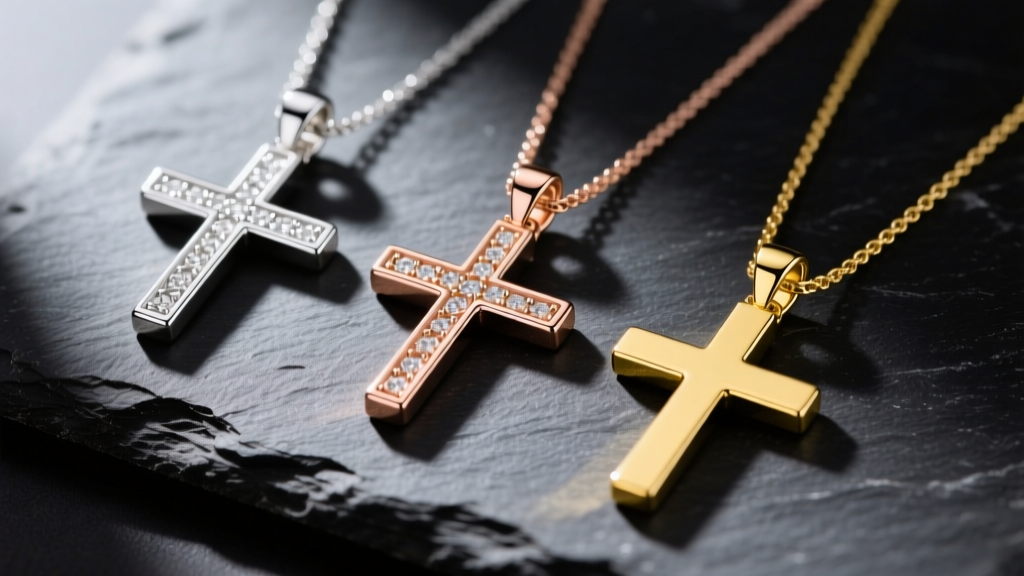
The 'Silver First' Prototype Strategy
If your cross necklace drawing features intricate, untested proportions, consider the 'Silver First' strategy. Have the jeweler cast the initial prototype in sterling silver. Silver casting grain is significantly cheaper, and if the bail is too small or the horizontal beam of the cross looks too thick in 3D space, the CAD file can be adjusted before committing to 14k or 18k gold. According to metal suppliers like Stuller, the raw material cost difference between 5 grams of silver and 5 grams of 14k gold is massive, making silver the ultimate budget-friendly prototyping tool.
Understanding Casting Tolerances and Porosity
When evaluating your cross necklace drawing, you must consider the physical limitations of lost-wax casting. The Gemological Institute of America (GIA) and metallurgical experts note that cast metals require minimum thicknesses to avoid porosity (tiny air pockets that weaken the metal). For 14k gold, the absolute minimum cast thickness is 0.8mm. For sterling silver, which is more prone to oxidation and shrinkage issues during the cooling phase, the minimum safe thickness is 1.0mm. If your sketch features ultra-thin, needle-like points on the cross, the CAD designer will need to thicken them by at least 15% to account for the 1.25% shrinkage rate that occurs when molten gold cools and solidifies.
Evaluating 'Line Drawing' Style Crosses vs. Fully Custom
Before spending $600+ on a fully custom fabrication, assess whether your vision aligns with existing 'line drawing' or 'sketch' style cross necklaces. In recent years, minimalist single-line crosses—where a continuous wire forms the shape of a cross—have surged in popularity.
- Mass-Produced Line Art Crosses ($40 - $120): Stamped or die-struck from sheet metal. Excellent for tight budgets, but limited to standard proportions. The metal is often hollow or very thin (under 0.5mm), making it prone to bending if snagged.
- Semi-Custom Wire Crosses ($150 - $300): A bench jeweler solders standard wire stock into your desired shape. Bypasses the CAD and casting fees entirely, offering a raw, organic 'hand-drawn' aesthetic at a fraction of the cost of cast custom pieces.
- Fully Custom Cast Crosses ($450 - $900+): Best for solid, dimensional crosses with specific bevels, engravings, or gemstone settings that match your exact drawing.
How to Prepare Your Sketch for a Bench Jeweler
To maximize your budget and minimize hourly design fees, your cross necklace drawing must be translated into a technical brief before you approach a jeweler. Vague sketches lead to endless CAD revisions, which are often billed at $75 per additional hour.
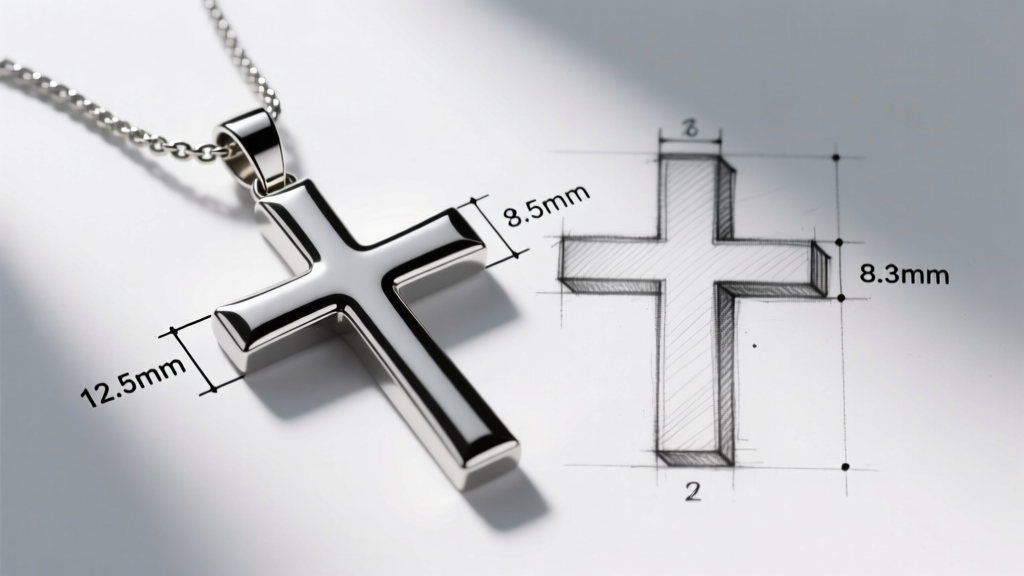
Dimensional Tolerances and Bail Sizing
Always annotate your drawing with exact millimeter dimensions. A standard, elegant cross pendant typically measures 20mm to 25mm in height and 12mm to 15mm in width. More importantly, you must specify the bail (the loop that connects the cross to the chain). If you plan to wear the pendant on a 1.2mm cable chain, the interior dimension of the bail must be at least 2.5mm x 1.5mm. If you forget to specify this, the CAD designer may use a default micro-bail that your favorite chain cannot pass through, forcing a costly reprint and recast.
Pro Tip: Always factor in a 5% to 8% metal weight loss during the final polishing stage. If your CAD file estimates the cross will weigh 3.0 grams, expect the finished, polished piece to weigh closer to 2.8 grams. You are paying for the starting casting grain weight, not just the final polished weight.
Final Value Assessment: Is Custom Worth It?
Commissioning a piece from a cross necklace drawing is rarely about securing the lowest possible price per gram of gold; it is about acquiring an irreplaceable asset with deep personal resonance. From a strict budget perspective, if you want a standard Latin cross, buying a pre-cast, mass-produced pendant will always offer better financial value. However, if your drawing incorporates non-standard geometry, personalized engraving on the reverse, or specific family motifs, the $400 to $800 investment in custom CAD and casting yields a piece of heirloom-quality jewelry that holds immense sentimental value and superior structural integrity compared to hollow, mass-market alternatives.


