How to Design and Order a Custom Name Necklace in Hebrew
Learn how to design, translate, and order a custom name necklace in Hebrew. Expert tips on fonts, metals, and chain lengths for flawless jewelry.

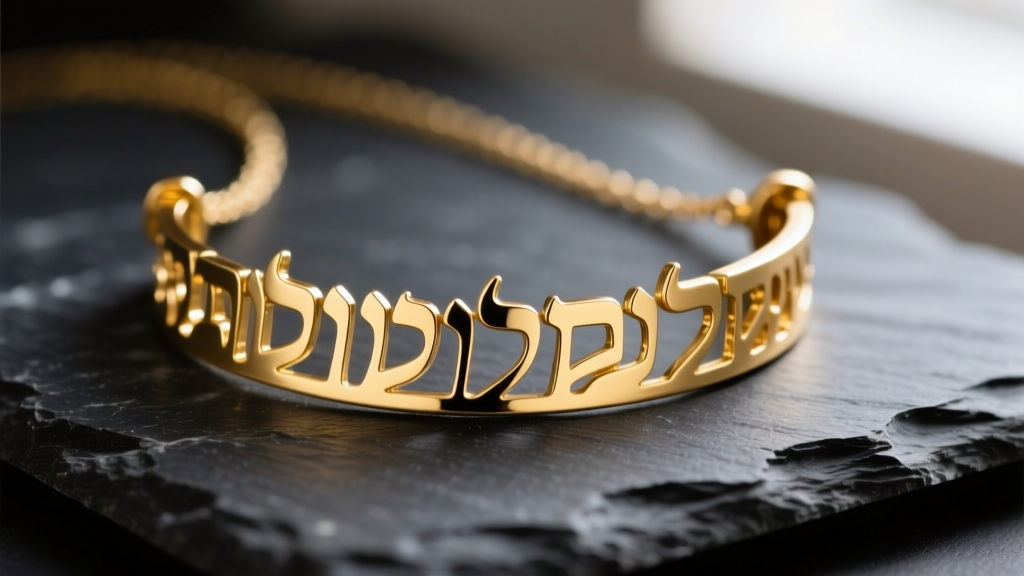
The Art of Personalizing Hebrew Jewelry
Personalized jewelry has transcended simple monograms, with buyers increasingly seeking deep cultural and linguistic connections to their accessories. Designing a custom name necklace in Hebrew is one of the most meaningful ways to wear your identity, but it presents unique typographic and metallurgical challenges that standard English nameplates do not. Because Hebrew reads right-to-left and features complex, stacked character strokes, a flawless piece requires precise planning from translation to final CAD (Computer-Aided Design) rendering.
As of 2026, advancements in fiber laser cutting and 3D wax printing have made custom jewelry more accessible than ever. However, the fundamental rules of structural integrity and linguistic accuracy remain unchanged. This step-by-step guide will walk you through the exact process of designing, translating, and ordering a Hebrew nameplate pendant that is both structurally sound and culturally authentic.
Step 1: Accurate Translation and Typographic Rules
The most common failure point in custom Hebrew jewelry occurs before the metal is even cut. Translating a name from English to Hebrew is not always a direct phonetic swap. You must decide whether to use a literal Hebrew equivalent (e.g., 'David' becomes 'דוד') or a phonetic transliteration for names without biblical roots.
Avoiding Nikkud (Vowel Points)
While Hebrew vowel points (Nikkud) add grammatical correctness, they are the enemy of jewelry manufacturing. These tiny dots and dashes require microscopic laser cuts. During the post-cut tumbling and polishing phases, the micro-bridges holding these vowel points frequently snap, leaving you with an incomplete word. Always design your pendant using the base consonant letters only.
Expert Insight: Pay special attention to the five 'Sofit' (final) letters—Kaf (ך), Mem (ם), Nun (ן), Pe (ף), and Tsadi (ץ). These letters extend significantly below the baseline. Your jeweler must adjust the pendant's vertical bounding box to accommodate these descenders, or the letters will be cropped during the cutting phase.
Step 2: Choosing the Right Hebrew Font Style
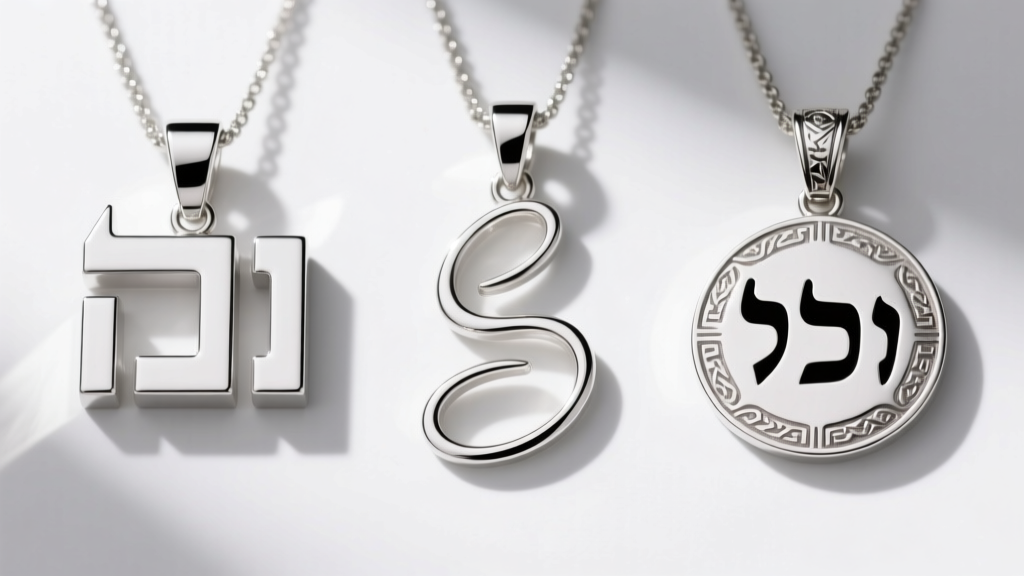
Unlike the Latin alphabet, Hebrew offers three primary typographic families, each with distinct structural implications for a metal nameplate. Choosing the right font is critical for the pendant's physical durability.
| Font Style | Hebrew Name | Structural Pros | Structural Cons |
|---|---|---|---|
| Modern Block | Dfus (דפוס) | Highly legible, clean geometric lines. | Requires a thick baseline bar to connect disconnected letters. |
| Cursive | Ktav (כתב) | Continuous baseline provides inherent structural integrity. | Can look overly casual; complex loops may blur if scaled down. |
| Rashi Script | Rashi (רש"י) | Traditional, deeply historical aesthetic. | Dense strokes require thicker metal gauges to prevent warping. |
For a name necklace in Hebrew, Cursive (Ktav) is generally the most durable choice. Because the letters naturally connect along a continuous baseline, the pendant acts as a single, unified beam of metal, drastically reducing the risk of snapping. If you prefer the sharp, authoritative look of Block (Dfus), ensure your jeweler adds a subtle, integrated bottom rail to anchor the individual characters.
Step 3: Selecting Metal Grades and Gauge Thickness
The metallurgy of your pendant dictates its lifespan. Hebrew letters often feature intricate internal cutouts (negative space), such as the enclosed loop in the letter He (ה) or the multiple prongs in Shin (ש). These cutouts weaken the overall tensile strength of the piece.
14k vs. 18k Gold: The Durability Debate
While 18k gold (75% pure gold) offers a richer, deeper yellow hue, it is inherently softer and more malleable. According to the Gemological Institute of America (GIA), higher purity gold is more susceptible to bending and scratching. For a complex Hebrew nameplate, 14k gold (58.5% pure) is the superior choice. The higher alloy content (usually copper and zinc) provides the necessary rigidity to keep delicate Hebrew strokes from warping when caught on clothing.
Mandatory Gauge Thickness
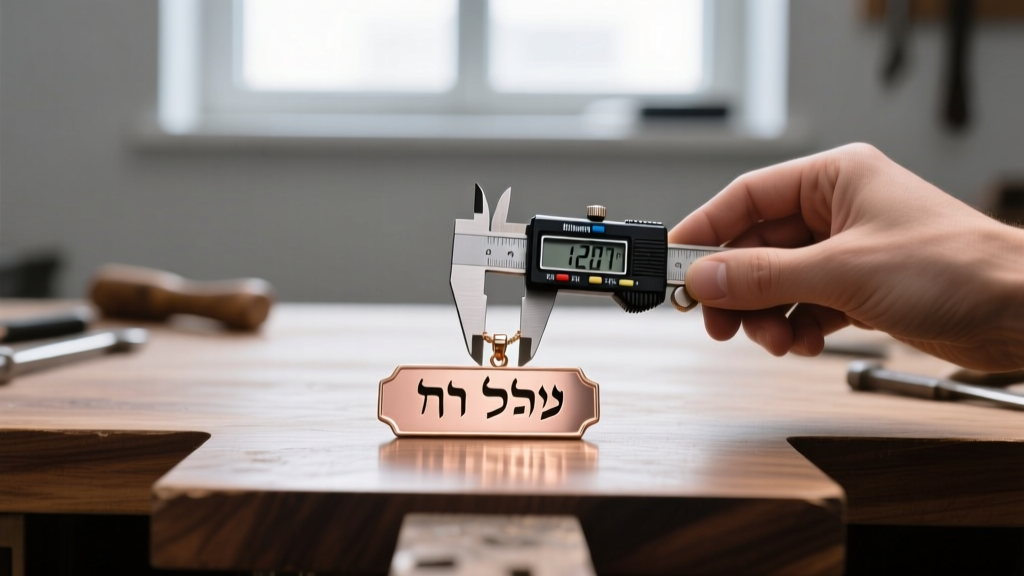
Standard English nameplates are often cut from 20-gauge (0.8mm) sheet metal. This is entirely inadequate for Hebrew typography. The intricate interior cuts of Hebrew characters compromise the metal's rigidity. You must specify an 18-gauge (1.0mm to 1.2mm) thickness. This extra fraction of a millimeter adds significant structural weight and prevents the pendant from bending in half when pressure is applied to the chain.
Step 4: Chain Selection and Proportion
A heavy 18-gauge Hebrew pendant requires a chain that can support its weight without kinking or snapping. The right-to-left orientation of the text also means the pendant's center of gravity must be perfectly balanced on the bail (the loop connecting the pendant to the chain).
- Box Chains (1.2mm - 1.5mm): The absolute best choice for nameplates. The square, interlocking links provide immense tensile strength and lay flat against the collarbone, keeping the Hebrew text facing forward.
- Cable Chains (1.5mm+): A classic, durable option. Ensure the jump rings are soldered shut; otherwise, the weight of the 18-gauge pendant will slowly pull the unsoldered links apart over time.
- Herringbone / Snake Chains: Avoid these entirely. They are highly prone to kinking and do not provide the rigid support needed to keep a wide nameplate resting horizontally.
Step 5: Sizing, Spacing, and the 'Mirror Test'
When reviewing the digital CAD proof provided by your jeweler, you must perform rigorous quality control. The most devastating manufacturing error in custom Hebrew jewelry is the 'Mirrored X-Axis' flaw.
The Right-to-Left CAD Trap
Many CAD software programs default to left-to-right text rendering. If a jeweler is not a native Hebrew reader, they may inadvertently flip the text box to force the software to accept the characters, resulting in a mirrored, backward Hebrew word. Always read the CAD proof from right to left to verify the spelling. For a comprehensive guide on Hebrew letter forms and their proper orientations, consult resources like My Jewish Learning's alphabet guide.
Kerf Width and Negative Space
Fiber lasers have a 'kerf' (the width of the material removed by the beam), typically around 0.005 inches. In tightly spaced Hebrew letters like Tet (ט) or Samekh (ס), the laser can easily melt the interior negative space shut if the design isn't scaled up. Ensure there is at least 1.5mm of solid metal between any exterior edge and an interior cutout.
Pricing Expectations for 2026
Custom Hebrew nameplates require more machine time and post-processing labor than standard designs due to the complex cutting paths. Below is the current market pricing for a standard 1.5-inch wide, 18-gauge custom pendant (chain included):
- Sterling Silver (925): $65 – $110
- 10k Solid Gold: $180 – $260
- 14k Solid Gold (Yellow, White, or Rose): $300 – $550
- 18k Solid Gold: $500 – $850+
By understanding the linguistic nuances of the Hebrew alphabet and the physical limitations of precious metals, you can commission a name necklace in Hebrew that is not only a beautiful tribute to your heritage but also a structurally resilient piece of fine jewelry built to last generations.


