How to Customize a Men's Necklace with Picture: Step-by-Step
Learn how to design, order, and style a custom men's necklace with picture engravings. Expert guide on metals, laser prep, and chain pairing.

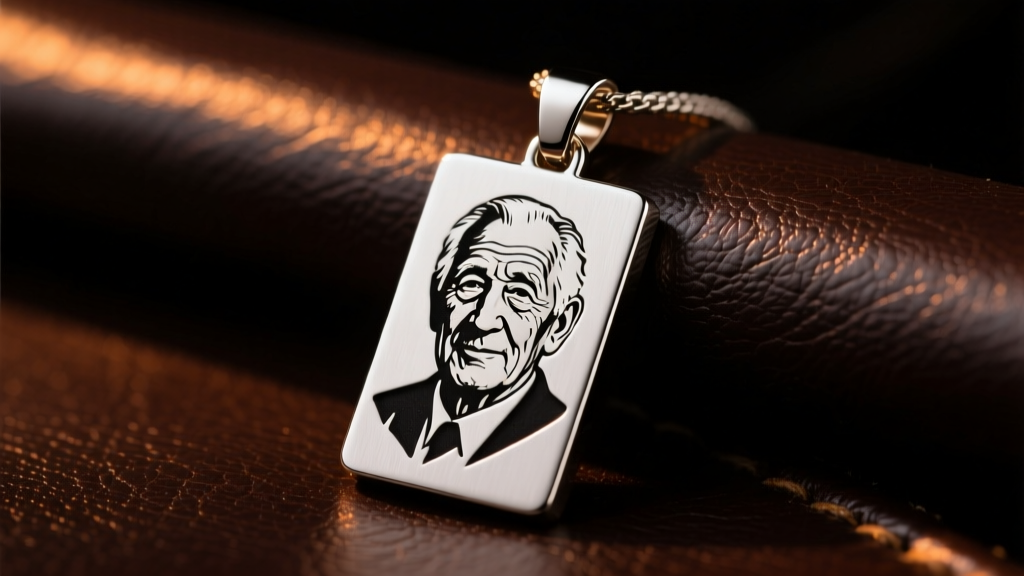
The evolution of men's jewelry has moved far beyond simple chains and signet rings. Today, personalized pieces dominate the market, and the most sought-after item is a custom men's necklace with picture engravings. Whether you are memorializing a loved one, showcasing a pet, or carrying a private token of motivation, a photo pendant bridges the gap between sentimental value and rugged masculinity. However, designing a piece that looks sophisticated rather than cheap requires a deep understanding of metallurgy, laser engraving technology, and proportional styling. This step-by-step guide will walk you through the exact technical specifications and aesthetic choices needed to craft the perfect custom picture necklace in 2026.
Step 1: Select the Ideal Metal and Pendant Silhouette
The foundation of any enduring photo necklace is the base metal. Men's jewelry takes a beating from sweat, friction, and environmental exposure, making material selection critical. Avoid base metals with zinc alloys or thin gold plating, which will degrade and ruin the engraved image within months.
316L Surgical Stainless Steel
This is the gold standard for men's everyday pendants. Unlike standard 304 stainless steel, 316L contains 2-3% molybdenum, which drastically increases its resistance to pitting and corrosion from chlorides (like human sweat). It takes a fiber laser engraving beautifully, yielding high-contrast, permanent grayscale images. Expect to pay between $40 and $85 for a quality 316L blank.
Grade 2 Commercially Pure Titanium
If weight and hypoallergenic properties are your priority, Grade 2 Titanium is unmatched. With a Vickers hardness of roughly 120, it is lighter than steel but highly resistant to scratching. Titanium engraves to a striking, icy white contrast against a dark oxidized background. According to the Gemological Institute of America (GIA), titanium's inert nature makes it completely impervious to tarnish, ensuring your picture remains legible for decades without polishing.
925 Sterling Silver
For a premium, heirloom-quality piece, solid 925 silver offers a brilliant luster. However, silver oxidizes. To protect a laser-engraved picture on silver, the jeweler must apply a localized anti-tarnish coating or rhodium plating over the etched area, otherwise, the micro-cavities created by the laser will trap sulfur and turn black, obscuring the image details.
Step 2: Optimize Your Photo for Fiber Laser Engraving
The most common reason custom picture necklaces fail to capture the subject's likeness is poor image preparation. Standard jewelry workshops use MOPA (Master Oscillator Power Amplifier) fiber lasers operating at a 1064 nm wavelength. These lasers do not 'print' grayscale; they create microscopic craters in the metal.
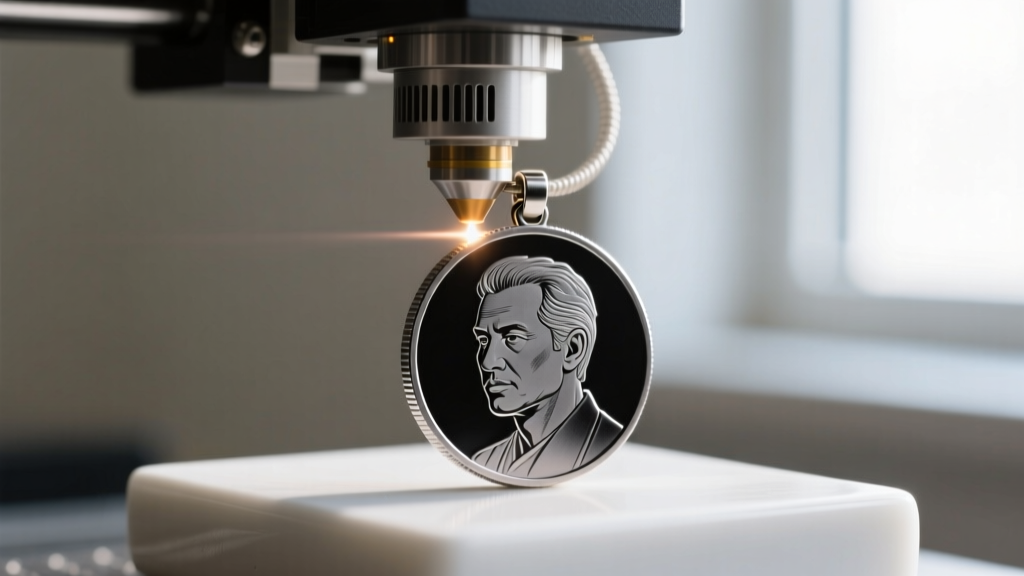
To prepare your image for the jeweler, follow these exact digital specifications:
- Resolution: Minimum 300 DPI at the actual physical size of the pendant (usually 1x1.5 inches for a dog tag or 1-inch diameter for a coin).
- Contrast & Levels: Crush the blacks and blow out the whites. Mid-tones often translate into muddy, illegible patches on metal.
- Halftone Conversion: Convert the image to a stochastic halftone pattern. This breaks the image down into microscopic dots of varying sizes, tricking the human eye into seeing shading while giving the laser binary (on/off) instructions.
- Background Removal: Always isolate the subject. A busy background will look like visual noise when etched onto a 25mm canvas.
Step 3: Match the Chain Gauge to the Pendant Weight
A heavy, custom-engraved medallion will snap a flimsy chain or cause the bail (the loop connecting the pendant to the chain) to warp. You must match the chain's gauge (thickness) and tensile strength to the pendant's mass. As noted in GQ's comprehensive men's jewelry guide, the chain should complement the pendant without overpowering it.
| Chain Style | Ideal Gauge (mm) | Max Pendant Weight | Best Clasp Type | Est. Price Range |
|---|---|---|---|---|
| Box Chain | 1.5mm - 2.0mm | 10g - 15g | Spring Ring | $35 - $60 |
| Rope Chain | 2.5mm - 3.5mm | 20g - 25g | Lobster Claw | $70 - $120 |
| Cuban Link | 4.0mm - 6.0mm | 30g - 50g+ | Fold-Over / Box | $150 - $300+ |
| Wheat (Spiga) | 2.0mm - 3.0mm | 15g - 25g | Lobster Claw | $60 - $110 |
Pro-Tip on Bails: If you choose a 5mm Cuban link, a standard 3mm pendant bail will not fit. You must request a 'hidden pinch bail' or a wide jump ring (minimum 6mm inner diameter) from your fabricator to ensure the heavy chain threads through smoothly without bending the pendant's connection point.
Step 4: Determine the Perfect Drop Length for Your Build
The visual impact of a men's necklace with picture engravings relies entirely on where it rests on the chest. The wrong drop length can make a masculine piece look awkward or disproportionate.
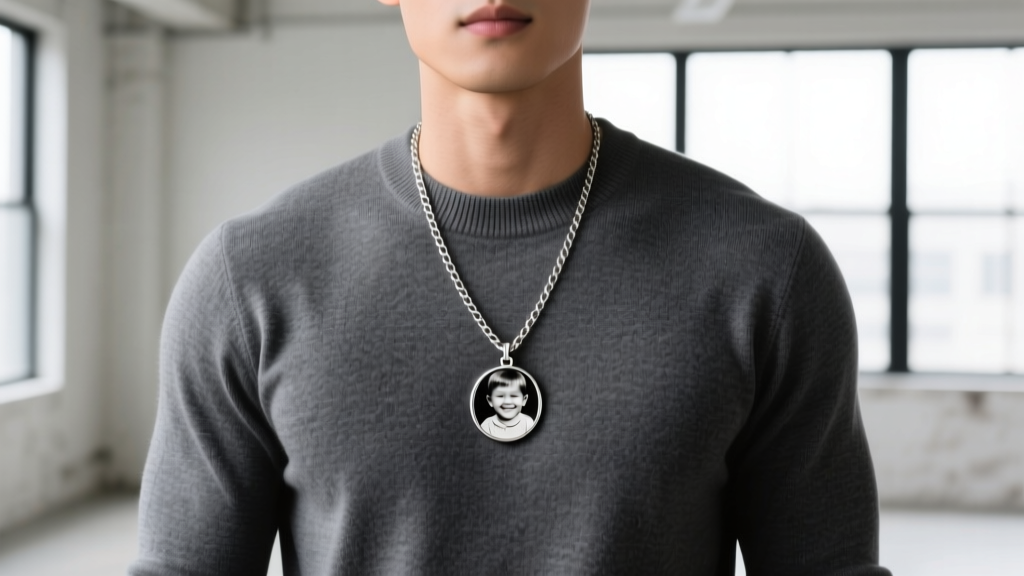
- 18-Inch Drop (Collarbone): Best for smaller, minimalist disc pendants (under 20mm). Sits tightly against the neck. Ideal for men with slender builds or for wearing under unbuttoned collared shirts.
- 20 to 22-Inch Drop (Sternum): The universal sweet spot for men's picture pendants. A 22-inch chain places a standard 1.5-inch dog tag or coin medallion right at the upper sternum. This length allows the pendant to rest visibly over crewneck t-shirts and hoodies without dipping too low into the chest hair zone.
- 24 to 26-Inch Drop (Mid-Chest): Reserved for large, heavy statement pieces, religious medallions, or oversized lockets. Best paired with streetwear or open jackets.
Step 5: Protect and Maintain the Engraved Image
Laser engraving physically alters the surface topology of the metal, creating microscopic grooves that trap dead skin, oils, and environmental dirt. Over time, this can make a high-contrast black-and-white photo look muddy and gray.
Cleaning Protocol:
- Weekly: Wipe the pendant with a dry, lint-free microfiber cloth to remove surface sebum.
- Monthly: Use a few drops of mild dish soap and warm water. Gently agitate the engraved surface with an extra-soft baby toothbrush to dislodge debris from the laser micro-cavities. Rinse and pat dry.
- Avoid Ultrasonic Cleaners: While ultrasonic cleaners are great for diamond rings, the high-frequency vibrations can sometimes cause stress fractures in thin, heavily etched steel or titanium pendants, especially if the engraving covers more than 60% of the surface area.
By mastering these five steps—from selecting marine-grade 316L steel to optimizing your halftone image files and matching the correct chain gauge—you guarantee that your custom men's necklace with picture engravings will be a durable, high-definition tribute that stands the test of time and trends.


