Daffodil Necklace Value Guide: Pricing and Materials
Discover how to evaluate a daffodil necklace. We break down pricing tiers, material grades, and brand premiums to help you assess true market value.

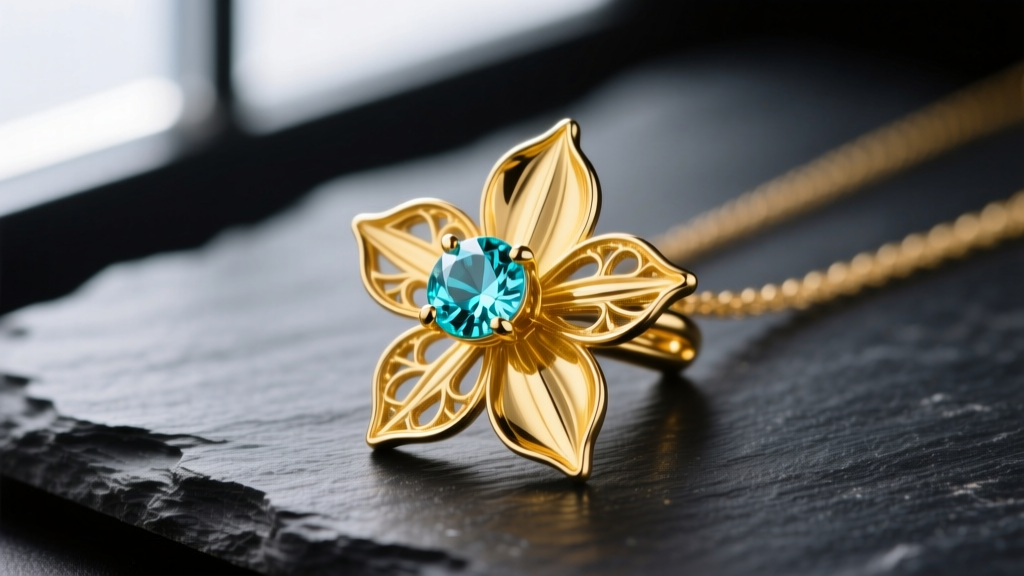
The Allure and Economics of the Daffodil Necklace
The daffodil necklace is a cornerstone of spring-inspired jewelry, symbolizing rebirth, new beginnings, and serving as the iconic floral motif for March birthdays. However, when you begin shopping for a daffodil pendant, the pricing landscape can be incredibly disorienting. You will find pieces ranging from $25 in fast-fashion boutiques to $25,000 in high-end estate jewelry cases. As a buyer, how do you determine if a piece is a genuine investment or an overpriced trinket?
Assessing the true value of a daffodil necklace requires looking past the floral silhouette and examining the metallurgy, the enamel techniques, the gemstone grading, and the structural integrity of the chain. In this comprehensive value assessment guide, we break down the exact metrics professional appraisers use to evaluate floral jewelry, ensuring you pay a fair market price for your next acquisition.
The Anatomy of a Daffodil Pendant: What Are You Paying For?
A botanically accurate daffodil features six outer petals (the perianth) and a central trumpet-shaped corona. Translating this 3D structure into metal requires significant craftsmanship, which directly impacts the price.
- Stamping vs. Casting: Budget necklaces use die-stamped sheet metal, resulting in flat, lifeless petals with sharp edges. Fine jewelry utilizes lost-wax casting or hand-fabrication, allowing for organic curves, varying metal thickness (e.g., 1.2mm at the base tapering to 0.4mm at the petal tips), and a seamless integration of the corona.
- The Bail and Jump Ring: The bail (the loop connecting the pendant to the chain) is a major failure point. High-value pieces feature a solid, soldered bail. If the bail is a thin, unsoldered wire loop, the pendant will eventually wear through and drop, severely diminishing the piece's long-term value.
- Chain Proportionality: A 6-gram solid gold daffodil pendant should never hang on a 1-gram hollow chain. Look for solid cable, box, or rope chains weighing at least 3.5 to 5 grams for an 18-inch length to ensure structural parity.
Pricing Tiers: From Fashion to High Jewelry
To accurately assess a daffodil necklace, you must first identify which manufacturing tier it belongs to. The table below outlines the current market expectations for 2026.
| Tier | Base Material | Technique & Finish | Price Range | Resale Value Retention |
|---|---|---|---|---|
| Fashion | Brass / Zinc Alloy | Flash Plated, Cold Enamel | $25 - $90 | 0% (Zero) |
| Demi-Fine | Sterling Silver (925) | Vermeil, Epoxy Resin | $120 - $350 | 10% - 20% |
| Fine Artisan | 14k / 18k Solid Gold | Vitreous Enamel, Pavé | $800 - $2,500 | 30% - 50% |
| High / Vintage | 18k Gold / Platinum | Plique-à-jour, Calibré | $3,500 - $15,000+ | 60% - 100%+ |
Understanding the Vermeil Standard
Many demi-fine brands market their daffodil necklaces as "gold over sterling silver." However, true value lies in the thickness of the gold layer. According to the Federal Trade Commission (FTC) Jewelry Guides, for a piece to be legally classified as "vermeil," it must have a minimum gold thickness of 2.5 microns over a sterling silver base. Many brands sell 0.5-micron flash-plated silver for $250, which will tarnish and wear down to the silver base within six months of daily wear. Always demand the micron thickness specification before purchasing.
Material & Craftsmanship Red Flags
When evaluating a daffodil necklace in person or via high-resolution online listings, look out for these specific indicators of poor value:
- "Gold Tone" Labeling: If the description says "gold tone" or "gold plated" without specifying a base metal (like brass or copper), you are paying for a costume accessory that holds zero intrinsic metal value.
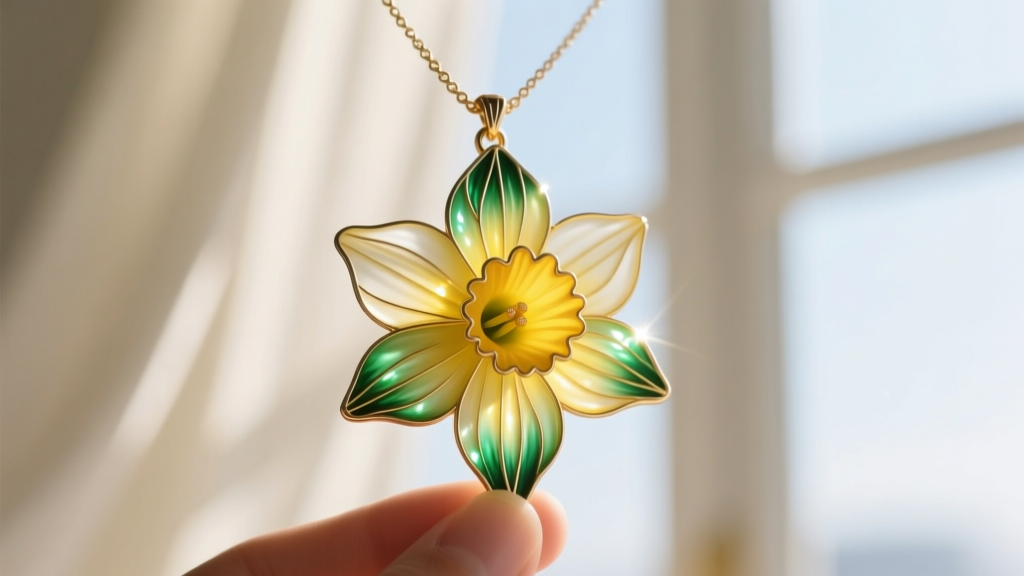
- Cold Enamel vs. Vitreous Enamel: Cold enamel is essentially colored epoxy resin. It scratches easily, yellows with UV exposure, and degrades over time. Vitreous enamel is powdered glass fired at over 1400°F, fusing permanently to the metal. A vitreous enameled daffodil will retain its vibrant yellow and green hues for centuries.
- Hollow-Cast Pendants: Some manufacturers cast large daffodil pendants in 10k or 14k gold but leave the back completely hollow to save on metal weight. While they look large, they dent easily upon impact and have a very low melt value compared to their retail markup.
- Glued Gemstones: If the center of the daffodil (the corona) features a gemstone that is glued rather than set with prongs or a bezel, the piece is fundamentally compromised. Jewelry adhesives become brittle and fail with temperature fluctuations.
The Aquamarine Factor: March Birthstone Valuations
Because the daffodil is the March birth flower, fine jewelers frequently pair daffodil motifs with aquamarine, the March birthstone. This pairing creates a highly sought-after, premium-priced necklace. However, not all aquamarines are created equal, and overpaying for a low-grade stone is a common pitfall.
According to the Gemological Institute of America (GIA), the most valuable aquamarines possess a medium-dark, slightly greenish-blue to pure blue hue. Most commercial aquamarines are heat-treated to remove greenish or yellowish undertones—a permanent and universally accepted practice in the gem trade. However, if a jeweler claims an aquamarine is "unheated" and natural, it must be accompanied by a lab report from a reputable institution like GIA or Gübelin, and it will command a 30% to 50% premium over treated stones of similar visual quality.
Furthermore, evaluate the setting. Aquamarine ranks 7.5 to 8 on the Mohs hardness scale, making it susceptible to chipping if struck. A high-value daffodil necklace will feature a bezel setting or a robust 4-prong setting with prongs no thinner than 1.1mm to protect the gemstone's girdle.
Resale Value and Market Liquidity
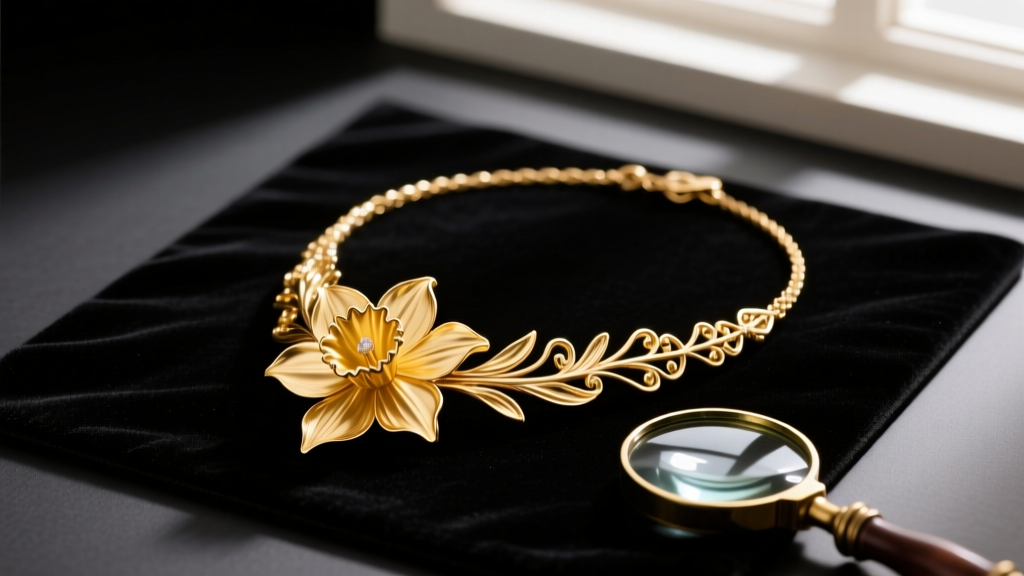
If you are buying a daffodil necklace as a store of value, you must separate the "melt value" from the "brand premium." A solid 18k gold daffodil pendant weighing 8 grams contains approximately 6 grams of pure gold. Based on current precious metal markets, the intrinsic melt value is roughly $400 to $450. If a non-branded artisan jeweler sells this piece for $1,800, you are paying a 300% markup for their labor, design, and overhead. Upon resale, you will likely only recoup the melt value plus a small premium for the craftsmanship.
Conversely, vintage designer pieces—such as the iconic mid-century daffodil brooches and pendants from Tiffany & Co. (often designed by Jean Schlumberger or Elsa Peretti)—carry immense market liquidity. A verified vintage Tiffany 18k gold and diamond daffodil necklace will retain 70% to 100% of its retail appraised value on the secondary market, provided the hallmark is crisp and the original signed pouch or box is included.
Final Verdict: How to Buy Smart
To ensure you are getting true value when purchasing a daffodil necklace, follow this three-step checklist:
- Demand Hallmarks: Look for 750 (18k), 585 (14k), or 925 (sterling) stamped directly on the bail or jump ring, not just on a removable paper tag.
- Verify the Enamel: If the piece features yellow or green accents, ask the jeweler explicitly if it is vitreous (fired glass) or cold (resin). Refuse to pay fine jewelry prices for resin.
- Weigh the Gold: Ask for the exact gram weight of the pendant and chain. Calculate the intrinsic metal value to understand exactly how much of the retail price is allocated to design and brand markup.
By applying these rigorous appraisal standards, you can confidently navigate the market and acquire a daffodil necklace that is as structurally enduring and financially sound as it is visually beautiful.


