Links Necklace Guide: Wire Gauge, Alloy Grades, and Tensile Strength
Discover the technical anatomy of a links necklace. We break down wire gauge, alloy hardness, tensile strength, and clasp mechanics for lasting wear.

Introduction: The Engineering Behind the Elegance
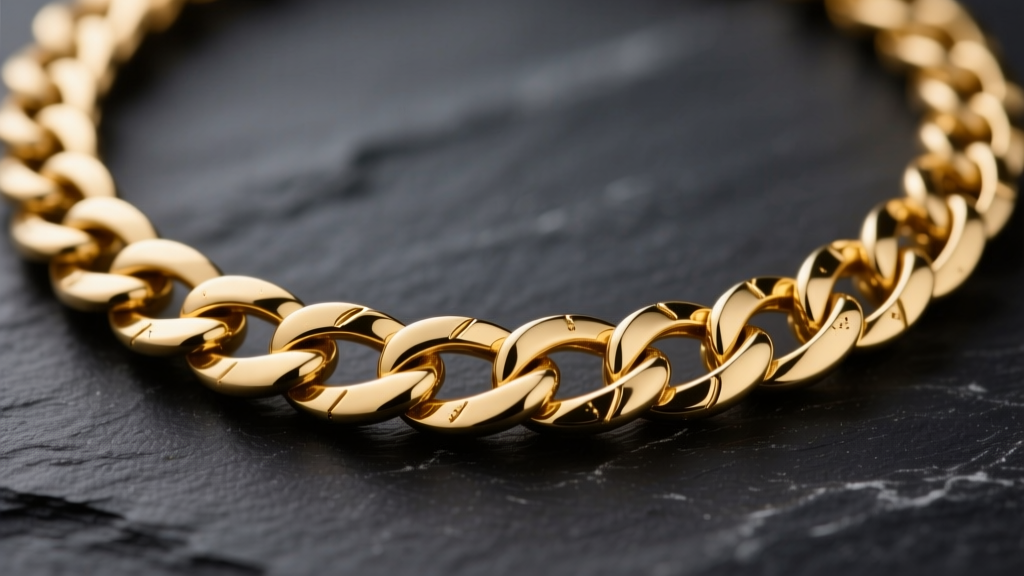
When most consumers shop for jewelry, they focus on visual appeal—the shine of the polish, the color of the metal, and the drape of the chain. However, as jewelry professionals and metallurgists know, a high-quality links necklace is fundamentally a feat of micro-engineering. The longevity, drape, and structural integrity of any chain depend entirely on its wire gauge, alloy composition, link geometry, and clasp mechanics. In this expert deep dive, we bypass superficial styling advice to examine the technical specifications that dictate whether a chain will last a lifetime or snap under minimal tensile stress.
Metallurgy: Alloy Composition and Vickers Hardness
The choice of metal in a links necklace is not merely about color or prestige; it is about the Vickers Hardness (HV) scale and the material's yield strength. Pure gold (24k) is far too malleable for chain manufacturing, possessing an HV of roughly 25. To achieve structural viability, gold must be alloyed with metals like copper, silver, zinc, or nickel.
Gold Karatage Trade-offs
According to the Gemological Institute of America (GIA), 14k gold (58.5% pure gold) typically registers between 135 and 150 HV, depending on the specific alloy mix. This makes it highly resistant to deformation and ideal for intricate, unsoldered link patterns. Conversely, 18k gold (75% pure gold) sits around 125 HV. While 18k offers a richer, warmer hue and higher intrinsic value, its lower hardness means the links are more susceptible to stretching and work-hardening over time, eventually leading to brittle failure if not properly annealed during manufacturing.
Platinum and Steel Alternatives
Platinum (specifically the 950/50 Pt/Ru alloy) presents a unique metallurgical profile. It has a lower HV than 14k gold (around 130 HV) but possesses vastly superior tensile strength and density. When a platinum link is scratched or stressed, the metal displaces rather than wearing away, a property known as malleability without material loss. On the other end of the spectrum, 316L surgical stainless steel boasts an HV of 150-190 and immense tensile strength, making it virtually impervious to the stretching that plagues softer precious metals, though it lacks the intrinsic value and workability for fine micro-welds.
Wire Gauge and Tensile Load Limits
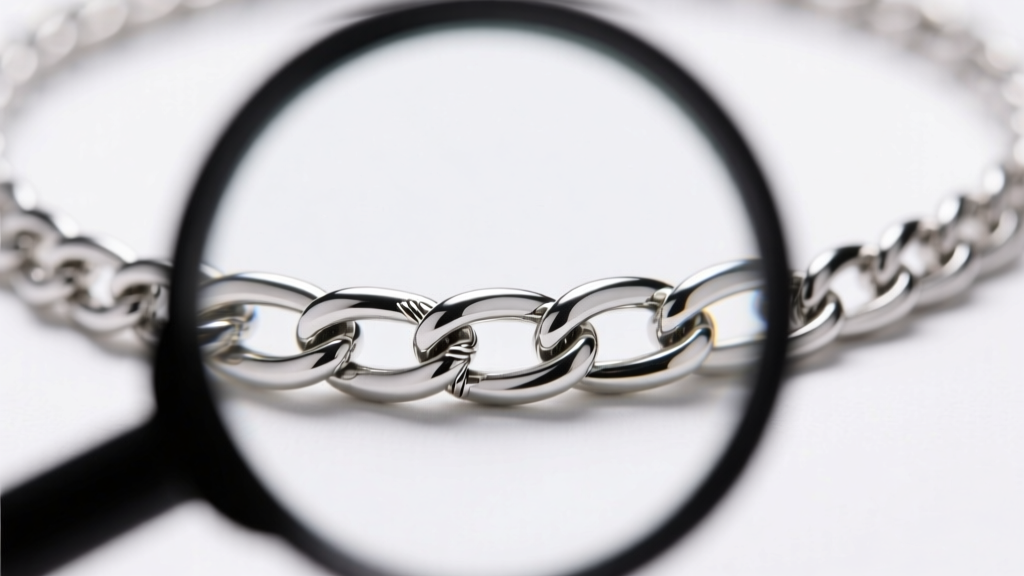
The American Wire Gauge (AWG) system is the universal standard for measuring the thickness of the wire used to forge chain links. The structural failure of a links necklace almost always begins with an inadequate wire gauge relative to the pendant's mass or the wearer's kinetic habits. Below is a technical breakdown of standard gauges used in fine jewelry manufacturing, referencing data benchmarks from Rio Grande's metalworking charts.
| AWG Gauge | Diameter (mm) | Approx. Tensile Limit (14k Gold) | Optimal Application |
|---|---|---|---|
| 20 | 0.81mm | 8 lbs | Ultra-lightweight lariats, temporary fashion wear |
| 18 | 1.02mm | 15 lbs | Lightweight pendants (under 5g), delicate layering |
| 16 | 1.29mm | 25 lbs | Standard everyday pendants (5g - 15g) |
| 14 | 1.63mm | 45 lbs | Heavy gemstone or solid gold pendants (15g - 30g) |
| 10 | 2.59mm | 110+ lbs | Statement standalone chains, no pendant required |
Note: Tensile limits vary drastically based on whether the links are soldered. Unsoldered links fail at roughly 30% of the tensile load of their soldered counterparts due to lateral prying forces.
Link Geometry and Structural Failure Modes
The physical shape of the link dictates how kinetic energy and tensile stress are distributed across the chain. Different geometries exhibit distinct failure modes under microscopic analysis.
- Cable Chains: The most basic geometry (uniform oval links alternating at 90 degrees). Failure Mode: High stress concentration at the solder seam. If unsoldered, the open seam easily catches on textiles and pries open under minimal lateral tension.
- Curb Chains: Links are twisted to lie flat. Failure Mode: The flattened surface area distributes wear evenly, but the twisting process work-hardens the metal. If not properly annealed post-twisting, the links become brittle and prone to micro-fractures.
- Rolo (Belcher) Chains: Composed of uniform, round, thick-wire links. Failure Mode: Highly resistant to lateral tension, but the round geometry means less surface contact between links, leading to accelerated friction wear at the contact points over decades of use.
- Figaro Chains: A patterned chain (usually three short links followed by one long link). Failure Mode: The asymmetrical distribution of mass causes uneven tension loading, making the longer links the primary point of structural failure under sudden kinetic shock.
Clasp Mechanics and Security Protocols
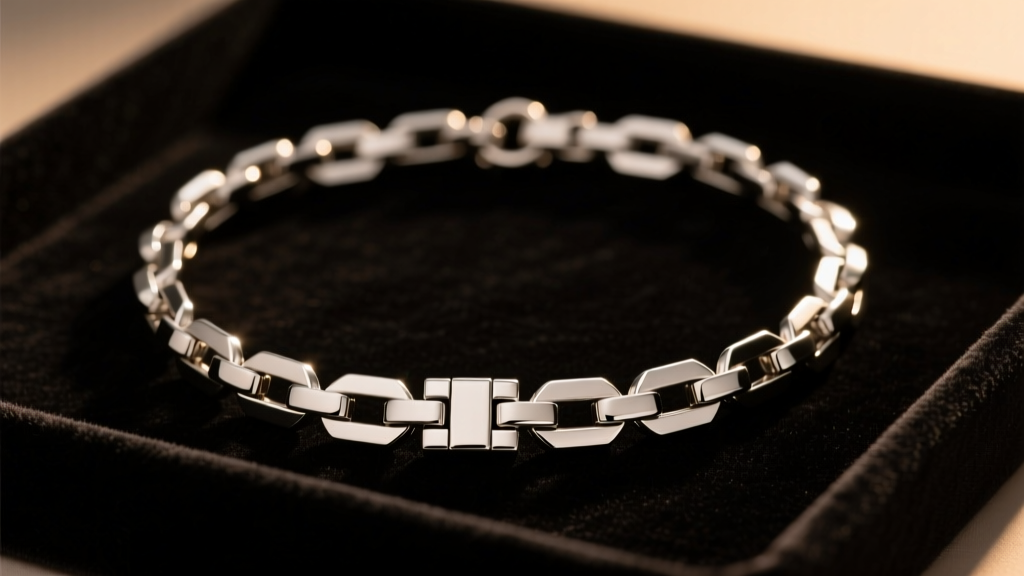
A links necklace is only as secure as its weakest mechanical joint: the clasp. The industry standard lobster claw relies on a microscopic internal spring. Over time, the repeated compression of this spring leads to metal fatigue, resulting in a sluggish return mechanism that fails to fully seat the trigger. Spring rings are even more precarious, utilizing a thin, easily deformed wire gate that frequently snags and bends out of alignment.
For heavy-gauge chains (14 AWG and thicker), a box clasp with a figure-eight safety catch is the only mechanically sound option. The box clasp utilizes a V-shaped tongue that compresses upon insertion and expands to lock into the housing. The primary failure mode here is the flattening of the V-tongue after hundreds of compression cycles. Expert jewelers recommend gently prying the tongue outward with a fine awl every 12 months to restore its locking tension.
Expert Maintenance Protocol: Never use ultrasonic cleaners on links necklaces featuring hollow-core or semi-tubular link constructions. The high-frequency cavitation can force microscopic moisture into the unsealed seams, leading to internal galvanic corrosion and catastrophic structural weakening that remains invisible until the chain snaps.
Conclusion: Specifying for Longevity
Selecting the right links necklace requires looking past the showroom lighting and evaluating the piece as a mechanical assembly. By prioritizing appropriate wire gauges for your specific pendant weights, understanding the Vickers hardness of your chosen alloy, and demanding secure clasp mechanics, you transition from a passive consumer to an informed collector. True luxury in jewelry is not just in the preciousness of the metal, but in the uncompromising precision of its engineering.


